
What is small business marketing? At its core, it is the process of promoting your products or services to the right people, through the right channels, at the right time- without wasting money on strategies that do not work.
The challenge is real. Most small business owners wear multiple hats, have limited budgets, and cannot afford to experiment blindly. Yet marketing is not optional. Without it, even the best products struggle to find customers.
The good news is that building a strong small business marketing strategy that delivers results does not require a massive budget.. It requires clarity, consistency, and the right mix of tactics tailored to your business goals.
This complete guide covers everything- from defining your audience and building your brand identity to running Google Ads, generating referrals, and measuring your marketing ROI. By the end, you will have a clear, actionable marketing plan for your small business.
If you want expert support executing any of these strategies, OLBUZ’s local business digital marketing services are built specifically for small and growing businesses.
What Is Small Business Marketing?
Small business marketing is the strategic promotion of products or services to attract new customers and retain existing ones. It differs from large-scale corporate marketing because it prioritizes cost-effective, targeted approaches over mass-market campaigns.
Successful marketing ideas for small business share three things in common: they reach the right audience, communicate a clear value, and generate a measurable return.
Whether you run a local service business, an eCommerce store, or a professional services firm, a well-built small business marketing plan gives you a structured roadmap to grow faster and spend smarter.
Step 1: Define Your Target Audience and Build a Buyer Persona
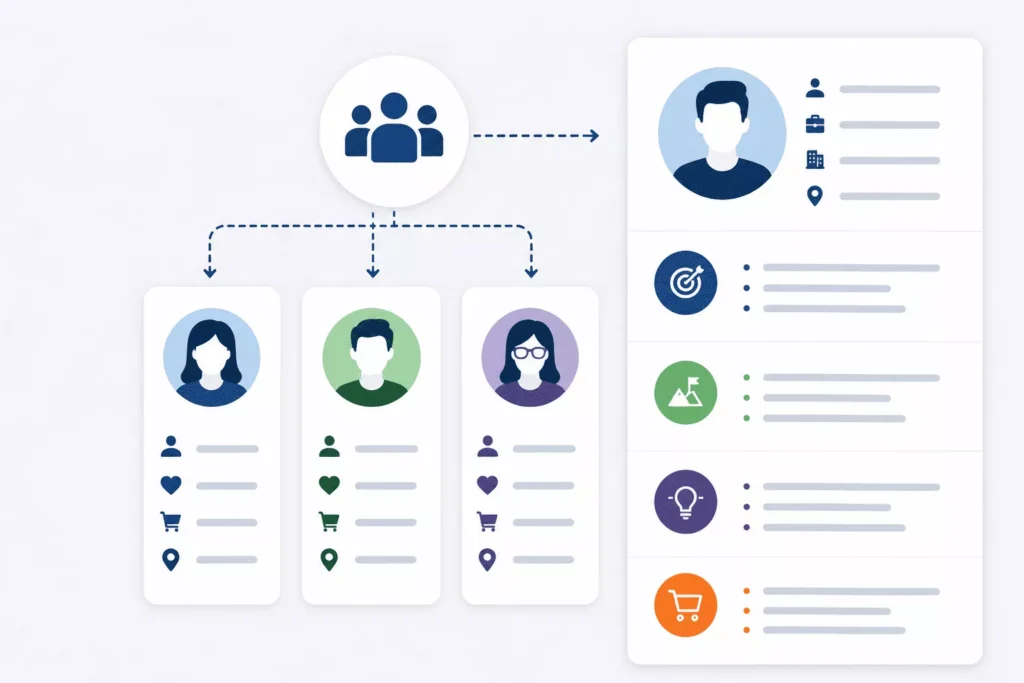
Before you spend a single rupee or dollar on marketing, you need to know exactly who you are marketing to. Your target audience is the specific group of people most likely to buy from you. The more precisely you define them, the more effective every piece of marketing you create will be.
A buyer persona is a detailed, semi-fictional profile of your ideal customer. It goes beyond demographics and gets into motivations, pain points, and buying behavior.
How to build a buyer persona for your small business:
Start by answering these questions about your best current customers:
- How old are they? Where do they live?
- What problem are they trying to solve?
- Where do they spend time online?
- What stops them from buying?
- How did they find you?
A local gym owner might define their buyer persona as “working professionals aged 25 to 40 who want to get fit but struggle to find time and are searching for flexible workout schedules.”
Once you know your persona, every marketing decision becomes clearer- which platforms to use, what content to create, and what offers to make.
Step 2: Define Your Brand Identity and Unique Value Proposition
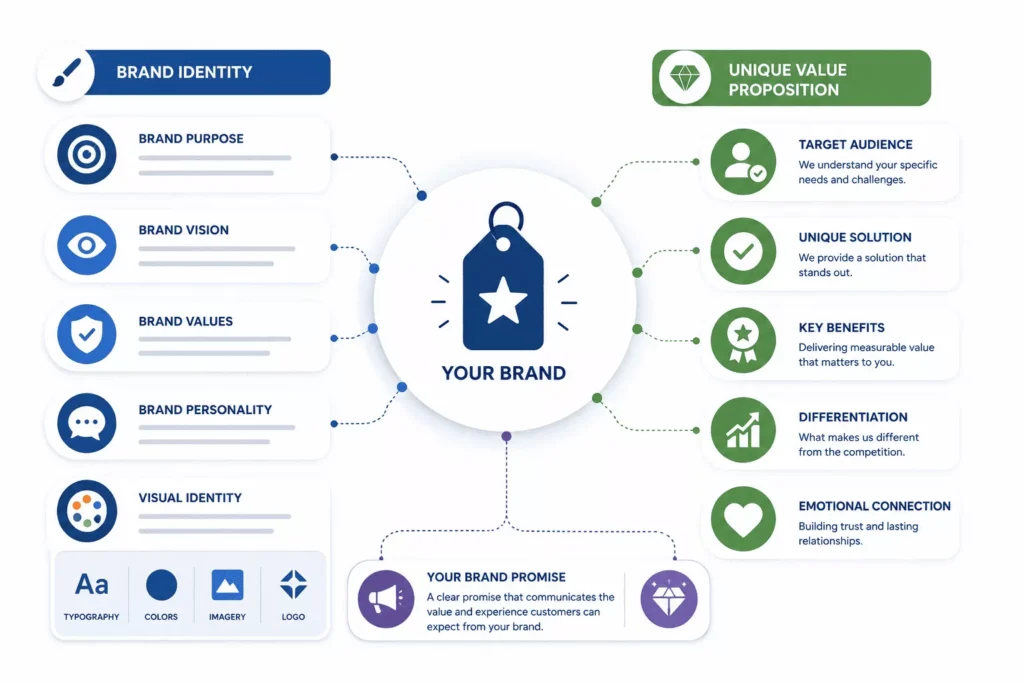
Your brand identity is more than a logo. It is the visual, verbal, and emotional impression your business makes on customers.
Strong brand identity includes:
- A recognizable logo and color palette
- A consistent tone of voice across all channels
- A tagline or positioning statement
- Values and personality that resonate with your audience
More importantly, every small business needs a clear unique value proposition (UVP)- a single, compelling statement that explains why a customer should choose you over everyone else.
A strong UVP answers: “What specific benefit do I offer, to whom, and why can only I deliver it?”
Examples:
- A bakery: “Fresh, custom-made cakes delivered to your door within 24 hours.”
- A digital agency: “More leads, less spend- performance marketing with a guaranteed ROI.”
Without a clear brand identity and UVP, your marketing will always feel generic. With them, every ad, post, and email carries a consistent, compelling message that builds trust and recognition over time.
Need help defining your brand’s digital presence? OLBUZ’s digital marketing services combine strategy and execution to help businesses stand out online.
Step 3: Set SMART Marketing Goals
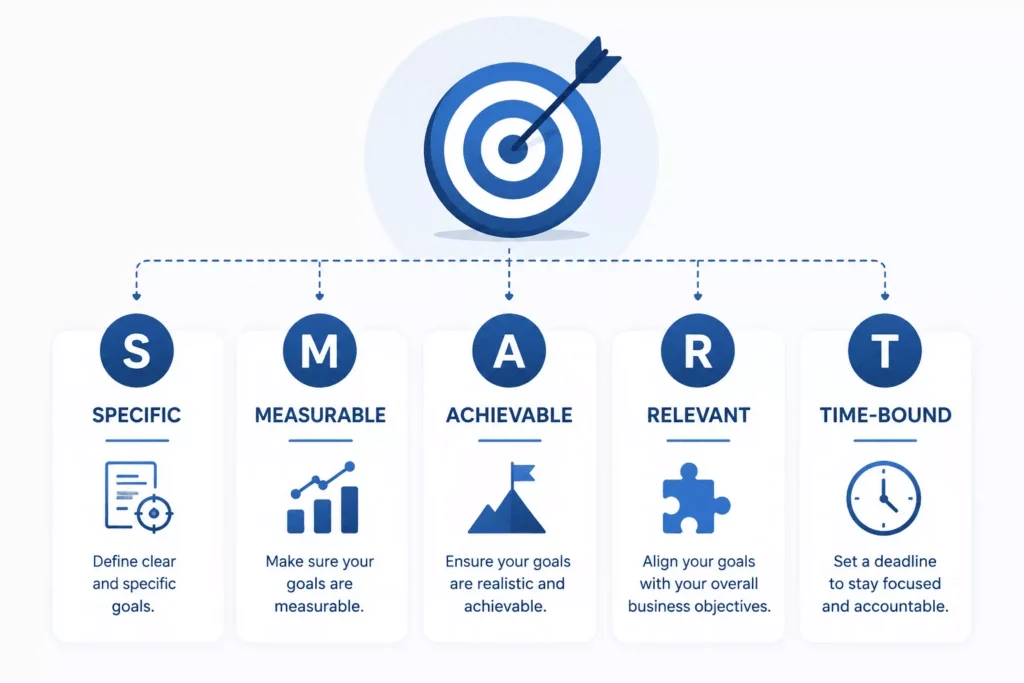
Every effective marketing plan for small business starts with clear goals. Without goals, there is no way to measure success or know when to change direction.
Use the SMART framework to set your marketing goals:
- Specific– “Increase website leads” is vague. “Generate 50 new leads per month from Google Ads” is specific.
- Measurable– Define the metric you will track.
- Achievable– Set ambitious but realistic targets.
- Relevant– Tie goals to business outcomes (revenue, customers, bookings).
- Time-bound– Set a deadline.
Examples of SMART marketing goals:
- Grow Instagram followers from 500 to 2,000 in 90 days.
- Generate 30 inquiries per month from Google Business Profile within 60 days.
- Reduce cost per lead from paid ads from Rs. 500 to Rs. 300 within 3 months.
Once you have goals, you can build a focused small business marketing strategy around them- and know exactly whether your efforts are working.
Step 4: Know Your Customer Journey and Sales Funnel
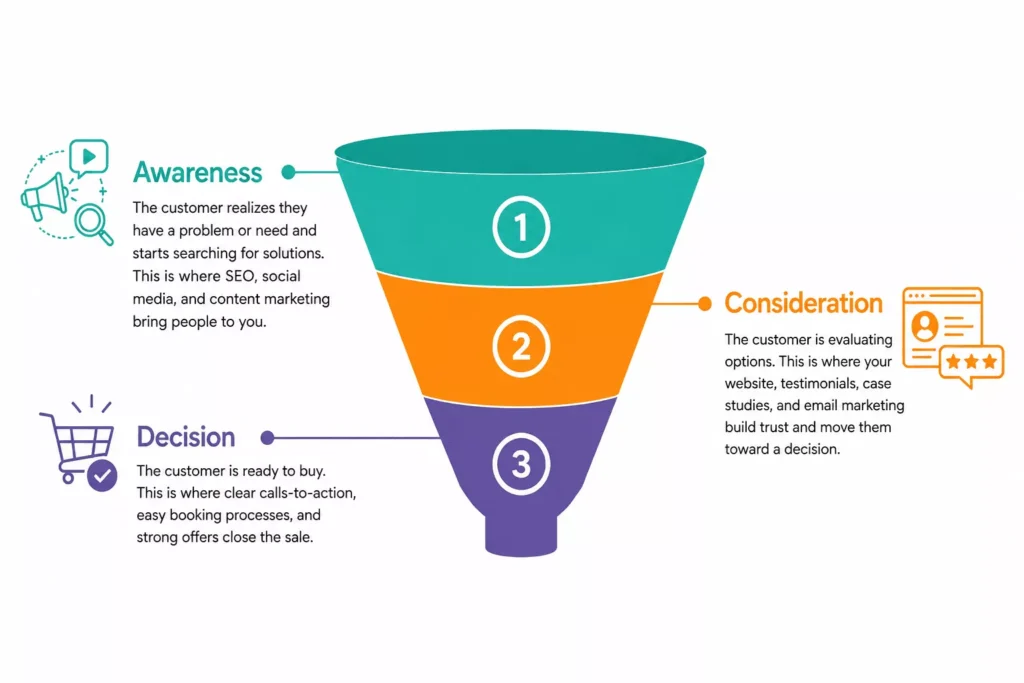
Understanding how your customers move from first hearing about your business to making a purchase is one of the most powerful things you can do as a small business owner.
This is called the customer journey, and it typically moves through a sales funnel with three stages:
Awareness– The customer realizes they have a problem or need and starts searching for solutions. This is where SEO, social media, and content marketing bring people to you.
Consideration– The customer is evaluating options. This is where your website, testimonials, case studies, and email marketing build trust and move them toward a decision.
Decision– The customer is ready to buy. This is where clear calls-to-action, easy booking processes, and strong offers close the sale.
Map your existing customer touchpoints to each stage and identify where customers drop off. Fixing those gaps in your funnel will often produce faster results than adding new marketing channels.
Step 5: Set Your Marketing Budget
How much should a small business spend on marketing?
The industry benchmark is 7 to 10% of annual revenue allocated to marketing. However, for businesses in early growth stages or highly competitive markets, 15 to 20% may be more appropriate.
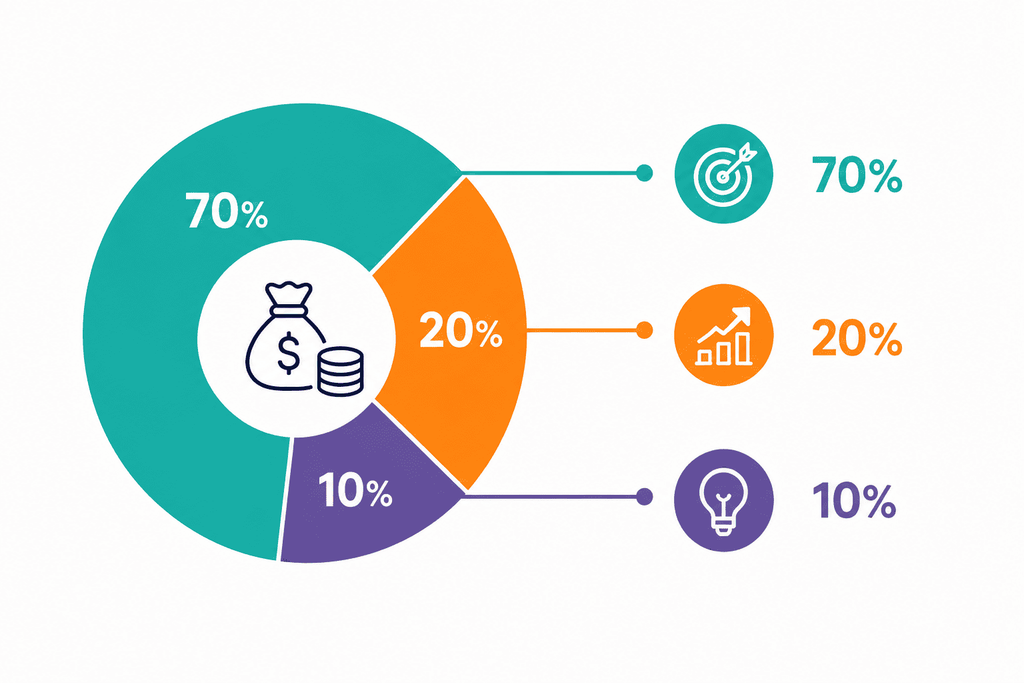
The 70-20-10 budget framework works well for small businesses:
- 70% goes to proven, high-ROI channels (e.g., Google Ads, email, SEO)
- 20% goes to optimizing and expanding what is working
- 10% goes to testing new channels or tactics
If your marketing budget is very limited, prioritize free channels first- Google Business Profile, organic social media, and email marketing- before committing to paid ads.
10 Proven Small Business Marketing Strategies for 2026
1. Optimize Your Google Business Profile
Your Google Business Profile (GBP) is the single most effective free marketing tool for local businesses. It puts your business in front of customers who are actively searching for what you offer, right when they need it.
Steps to optimize your GBP:
- Claim and verify your profile at google.com/business
- Add complete details- name, address, phone, website, hours, category
- Upload real photos of your business, team, and products
- Post weekly updates, offers, and events
- Respond to every review- positive and negative
A well-optimized GBP can generate consistent, free leads for your business every single month. For more advanced local visibility, OLBUZ’s local business marketing services combine GBP optimization with targeted Google Ads to maximize local lead generation.
2. Build a Fast, Mobile-Friendly Website
Your website is your 24/7 salesperson and the foundation of all your digital marketing for small business efforts.
Every small business website needs:
- A clear homepage with your UVP and a call-to-action
- A services or products page
- An about page with real team photos
- A contact page with a form, phone number, and address
- Customer testimonials or case studies
According to Forrester research, a well-designed website can have up to a 200% higher conversion rate than a poorly designed one. Mobile optimization is non-negotiable- over 60% of local searches happen on mobile devices.
OLBUZ offers professional website development services for small and growing businesses, from WordPress sites to custom development.
3. Build and Execute a Local SEO Strategy
Local SEO is the process of making your business visible in geographically relevant searches on Google and other search engines.
Local SEO checklist for small businesses:
- Include your city and service area in page titles, headings, and content
- Get listed in local directories- Yelp, Justdial, Sulekha, Yellow Pages
- Keep your NAP (name, address, phone) consistent across all listings
- Earn reviews on Google and other platforms
- Build local backlinks through community partnerships and local press
Local SEO delivers compounding results- the longer you invest in it, the more traffic you get without ongoing ad spend. OLBUZ’s local business marketing services include local SEO as a core component of their lead generation strategy.
4. Run Google Ads and PPC Campaigns
Google Ads (also called pay-per-click or PPC advertising) allows you to show your business at the top of search results when customers search for exactly what you offer.
For small businesses, PPC advertising is one of the fastest ways to generate leads and inquiries- especially when organic SEO is still building momentum.
In 2026, the average return on ad spend (ROAS) for Google Ads is approximately $3.52 for every $1 spent, making it one of the most profitable digital marketing channels available.
How to start with Google Ads:
- Focus on high-intent keywords (e.g., “electrician near me,” “best bakery in [city]”)
- Create dedicated landing pages for each ad campaign
- Start with a small daily budget (Rs. 300 to 500 or $5 to $10) and scale what works
- Track every click, lead, and conversion in Google Analytics
Running PPC campaigns requires ongoing optimization to get the best results. OLBUZ manages Google Ads for small businesses across India, the USA, UK, and Australia. Explore their digital marketing services to see how managed PPC can work for your business.
5. Use Social Media With Purpose
Social media marketing is not about being everywhere. It is about showing up consistently on the platforms where your customers actually spend time.
Platform guide for small businesses in 2026:
- Instagram and Facebook– local businesses, retail, food, beauty, fitness
- LinkedIn– B2B, professional services, consulting
- YouTube Shorts and Instagram Reels– tutorials, behind-the-scenes, product demos
- WhatsApp Business– direct communication, especially effective in India and South Asia
What performs well in 2026:
- Real, behind-the-scenes content
- Customer testimonials and transformation stories
- Short-form video (Reels, Shorts)
- Responding quickly to every comment and DM
6. Start Email Marketing
Email marketing delivers one of the highest marketing ROI of any channel- an average return of $36 for every $1 spent, according to industry research.
Unlike social media followers, your email list is an asset you own. No algorithm change can take it away.
How to get started:
- Use free tools like Mailchimp or Brevo
- Offer a discount, free guide, or checklist in exchange for an email address
- Send consistent emails- weekly or bi-weekly- with genuine value
- Keep emails short, personal, and focused on one clear action
For eCommerce businesses, email becomes even more powerful when combined with retargeting. Explore OLBUZ’s eCommerce marketing services to see how email, SEO, and paid ads work together to drive sustainable growth.
7. Invest in Content Marketing and Blogging
Content marketing means creating and publishing useful content- blog posts, videos, guides, infographics- that attracts your target audience organically through search engines and social media.
A well-written blog post targeting a specific keyword can drive traffic to your website for months or years after it is published, with no ongoing cost.
Content ideas for small businesses:
- Answer the most common questions your customers ask
- Write comparison or how-to guides related to your industry
- Create short-form videos for YouTube or Instagram
- Share local insights and community content
If your business serves specific industries, OLBUZ has dedicated content strategies for healthcare marketing, real estate marketing, and travel and tourism marketing.
8. Build a Referral and Word-of-Mouth Marketing System
Word of mouth marketing is one of the oldest and most effective forms of marketing- and in 2026, it is more powerful than ever because trust in advertising has declined while trust in personal recommendations has grown.
Referral marketing turns your happy customers into an active, incentivized sales force.
How to build a referral system:
- Create a formal referral program- offer a discount, cashback, or gift for every new customer referred
- Ask for referrals after every positive experience, not just occasionally
- Make it easy- a WhatsApp message, a referral link, or a simple card is enough
- Track referrals and reward promptly
Studies show that referred customers have higher lifetime value and lower churn rates than customers from paid channels. This makes referral marketing one of the highest-ROI strategies for any small business.
9. Use AI Tools to Save Time
AI tools are no longer just for large companies. In 2026, small businesses can use them to produce better content faster, automate customer communication, and analyze data without a dedicated marketing team.
AI tools small businesses can use today:
- Claude or ChatGPT– write social captions, emails, blog posts, and ad copy
- Canva AI– design professional graphics in minutes
- Tidio or Freshdesk– AI chatbots for customer service on your website
- Google Analytics 4– free, AI-powered website performance insights
AI can realistically save a small business owner 5 to 10 hours per week- time that can go back into serving customers and growing the business.
10. Focus on Customer Retention and Loyalty
Keeping an existing customer costs five times less than acquiring a new one. Yet most small businesses allocate almost no marketing budget to retention.
Customer retention strategies that work:
- Build a simple loyalty program- points, punch cards, or exclusive member discounts
- Send follow-up emails or WhatsApp messages after every purchase
- Ask for feedback and act on it visibly
- Surprise loyal customers with unexpected perks
- Create a community- a Facebook group, WhatsApp group, or newsletter just for loyal customers
Loyal customers become brand advocates. They refer friends, leave reviews, and provide a stable revenue base that reduces your dependence on expensive acquisition campaigns.
How to Build Your Small Business Marketing Plan
A marketing plan for small business does not need to be a 50-page document. Here is a simple framework you can follow:
Step 1– Define your target audience and buyer persona.
Step 2– Clarify your brand identity and unique value proposition.
Step 3– Set 3 SMART marketing goals for the next 90 days.
Step 4– Choose your top 3 marketing channels based on where your audience spends time.
Step 5– Set your marketing budget using the 70-20-10 framework.
Step 6– Build a weekly content schedule- even 3 posts per week is enough to start.
Step 7– Track your marketing KPIs weekly- website traffic, leads generated, cost per lead, conversion rate.
Step 8– Review and adjust every 30 days based on what the data shows.
If you want a professional team to build and execute this plan for you, OLBUZ’s full-suite digital marketing services cover SEO, PPC, social media, email marketing, and more- all aligned to real business results.
Free Marketing Ideas for Small Business (Zero Budget)
Not every marketing tactic requires a budget. Here are the most effective free marketing ideas for small business:
- Optimize your Google Business Profile (free, high impact)
- Ask every happy customer for a Google review
- Post consistently on one or two social media platforms
- Write blog posts targeting keywords your customers search for
- Build an email list using a free Mailchimp account
- Create a referral program using WhatsApp
- List your business in free online directories
- Engage in local Facebook groups and community forums
- Collaborate with complementary local businesses on joint promotions
Many small businesses generate their first 100 customers entirely through free marketing before investing in paid ads.
Small Business Marketing Tools Worth Knowing
Free tools:
- Google Business Profile– local visibility
- Google Analytics 4 – website traffic and behavior
- Mailchimp (free plan)- email marketing
- Canva (free plan)- graphic design
- Google Search Console– keyword and SEO data
Paid tools worth considering:
- SEMrush or Ahrefs– keyword research and competitor analysis
- HubSpot CRM (free tier available)- CRM for small business contact management
- Meta Ads Manager– Facebook and Instagram advertising
- Google Ads- PPC advertising for search traffic
Conclusion
Building a successful small business marketing strategy in 2026 is not about doing everything at once. It is about doing the right things, in the right order, with a clear understanding of your audience and goals.
Start with the foundation- define your target audience, sharpen your brand identity, and set your SMART goals. Then layer in your marketing channels one at a time, track your results, and double down on what works.
The businesses growing fastest in 2026 are not the ones with the biggest budgets. They are the ones with the clearest strategies, the most consistent execution, and the strongest relationships with their customers.
Whether you are just getting started or looking to scale what is already working, the strategies in this guide give you a proven roadmap. And if you want expert support getting there faster, OLBUZ has helped businesses across India, the USA, UK, and Australia generate real growth for over 16 years- through performance-focused local business marketing, SEO, PPC, and full-funnel digital strategies.
Frequently Asked Questions (FAQs)
Small business marketing is the process of promoting your products or services to attract and retain customers. It includes both digital strategies (SEO, social media, email, paid ads) and traditional methods (referrals, local events, word of mouth). The goal is to grow your customer base and revenue in the most cost-effective way possible.
Start by defining your target audience and building a buyer persona. Then clarify your brand identity and unique value proposition. Set SMART goals for the next 90 days, choose your top 3 marketing channels, allocate a budget, and build a weekly content schedule. Review your performance monthly and adjust based on data.
The most effective strategy depends on your business type and location. For local businesses, Google Business Profile optimization and local SEO deliver the highest return at zero cost. For eCommerce businesses, a combination of Google Ads, email marketing, and social media tends to work best. OLBUZ’s local business marketing services offer customized strategies based on your specific industry and goals.
Industry benchmarks suggest 7 to 10% of annual revenue for established businesses and up to 15 to 20% for businesses in active growth mode. Many of the most effective strategies- local SEO, content marketing, and Google Business Profile- are free or very low cost.
A unique value proposition (UVP) is a clear statement explaining what specific benefit you offer, to whom, and why customers should choose you over competitors. Without a strong UVP, your marketing lacks focus and your messaging feels generic. With one, every piece of content you create carries a consistent, compelling reason for customers to choose you.
Referral marketing turns happy customers into a sales force by offering them an incentive for recommending your business to others. It works because word of mouth is the most trusted form of marketing- people are far more likely to buy based on a friend’s recommendation than any advertisement. Even a simple WhatsApp-based referral program can generate consistent new business for a small company.
For most small businesses, the answer is both. Start with free organic strategies- Google Business Profile, local SEO, and content marketing. These take 3 to 6 months to produce consistent results. Use Google Ads (PPC) in parallel to generate immediate leads while organic rankings build. Over time, as organic traffic grows, you can reduce your reliance on paid ads.
The most effective free marketing ideas are: optimizing your Google Business Profile, asking for Google reviews, posting consistently on social media, writing SEO-friendly blog content, building an email list, creating a referral program via WhatsApp, and listing your business in free online directories. These strategies cost nothing except time and can generate significant leads and sales.
Track your marketing KPIs in Google Analytics 4 (free) and your ad platforms. Key metrics to monitor include: website traffic, leads generated, cost per lead, conversion rate, and revenue from each marketing channel. Review these metrics weekly and adjust your budget toward the channels generating the best return.
Absolutely. Word of mouth and referral marketing remain among the highest-ROI strategies for small businesses. As trust in digital advertising has declined, peer recommendations have become even more influential. Building a structured referral program alongside your digital marketing efforts is one of the smartest investments a small business can make.
Vikram Raj Gurjar

An SEO Executive at OLBUZ, specializing in search engine optimization, content strategy, and AI-driven search marketing. Focused on building scalable SEO frameworks, strengthening topical authority, optimizing search intent alignment, and improving organic visibility. Dedicated to helping businesses increase qualified traffic, enhance user experience, and achieve sustainable growth in an evolving digital search landscape.
Contact Form Popup
Boost Your Business Now
This will close in 0 seconds
apply now popup
Apply Now
This will close in 0 seconds
Get free audit popup
Get Free Google Ads Account Audit Worth $999
This will close in 0 seconds
Contact page Form Popup
Contact Us
This will close in 0 seconds