

A practical, experience-based guide for hospitals, clinics, IVF centers, dental practices, dermatology clinics, orthopedic hospitals, and diagnostic labs that want a steady, predictable flow of new patients.
A decade ago, most patients chose a doctor or hospital based on a relative’s recommendation or a board outside a clinic. That world is gone. Today, the patient journey almost always begins on a screen — a Google search at midnight, an Instagram reel about a procedure, or a quick scroll through reviews before booking a consultation.
Search behavior data consistently shows that the vast majority of patients research a provider online before ever picking up the phone, and a large share of those searches happen on mobile devices, often “near me” queries typed in the middle of symptoms or anxiety.
For a senior content strategist or marketing lead in healthcare, this shift means one thing: if your digital presence is weak, you are invisible at the exact moment a patient is ready to choose a provider.
Traditional marketing – hoardings, newspaper ads, pamphlets – still has a place, but it cannot target intent, cannot be measured precisely, and cannot adapt week to week the way digital channels can.
Healthcare providers who rely only on traditional channels are increasingly losing patient share to competitors who show up first in search results, run targeted ads, and maintain an active, trustworthy online reputation.
This guide breaks down ten proven, field-tested healthcare digital marketing strategies that hospitals, specialty clinics, and individual practitioners can use to attract more qualified patients. Each strategy includes practical best practices, common mistakes, specialty-specific examples (IVF, dermatology, dental, orthopedics, diagnostics), and a checklist you can hand directly to your marketing team or agency.
What is Healthcare Digital Marketing?
Healthcare digital marketing is the use of online channels – search engines, social media, email, paid advertising, and content — to attract, educate, convert, and retain patients, while complying with medical advertising and privacy regulations.
It differs from traditional marketing in three important ways. First, it is measurable: every click, call, and form submission can be tracked back to a specific campaign. Second, it is intent-driven: a patient searching “best IVF clinic near me” has far higher intent than someone walking past a billboard. Third, it requires a layer of trust and compliance that generic consumer marketing does not — patients are making decisions about their health, so accuracy, privacy, and credibility matter more here than in almost any other industry.
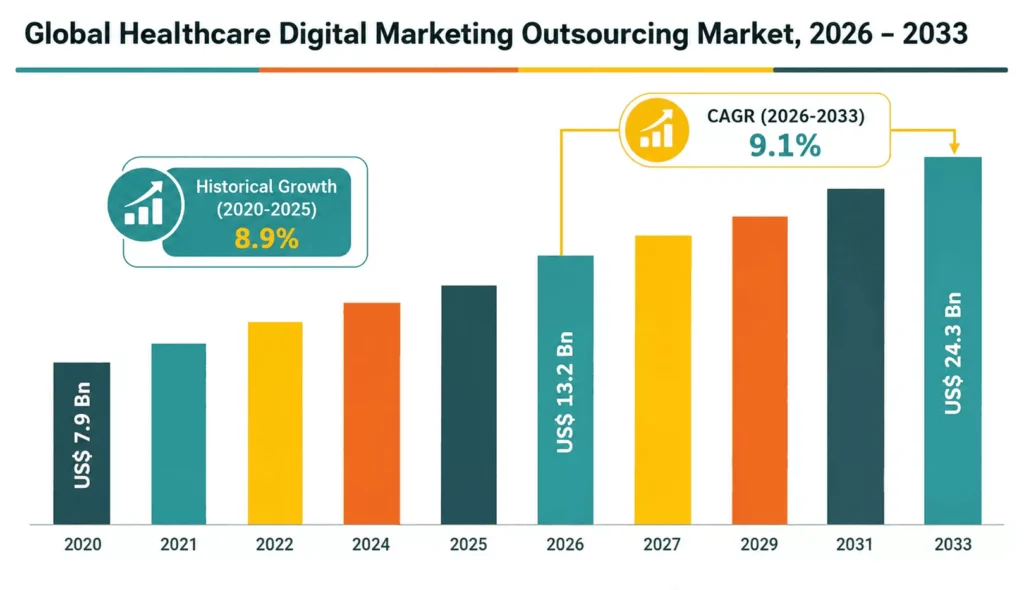
Key digital channels include organic search (SEO), local search (Google Business Profile), paid search and display advertising, social media, email and messaging, and the provider’s own website and content.
Hospitals use these channels for multi-department visibility; IVF and fertility centers use them to build emotional trust before the first consultation; dermatologists and cosmetic clinics rely heavily on visual platforms like Instagram; dentists and diagnostic labs depend on hyperlocal search; and orthopedic hospitals use a mix of SEO and paid ads to capture high-value procedures like joint replacements.
Why Digital Marketing Matters for Healthcare Providers?
- Patient searches for doctors, treatments, and symptoms online have grown steadily every year, and that volume shows no sign of slowing.
- Competition has intensified — corporate hospital chains, single-doctor clinics, and telehealth platforms are all competing for the same searches.
- Digital channels enable precise patient acquisition by location, condition, and intent rather than broad, wasted reach.
- Two-way engagement (reviews, comments, WhatsApp, chat) builds an ongoing relationship instead of a one-time transaction.
- A strong, consistent online presence signals credibility — patients trust providers who look established, reviewed, and active online.
- Compared with traditional advertising, digital campaigns generally cost less per qualified lead and can be adjusted in real time.
- Every channel is measurable, so providers can see exactly what is generating appointments and what is wasting budget.
- Done consistently, digital marketing compounds — SEO rankings, reviews, and content all build long-term brand equity rather than disappearing once a campaign ends.
10 Proven Healthcare Digital Marketing Strategies:
Each strategy below follows a consistent structure: what it is, why it matters, the benefits, best practices, common mistakes, useful tools, and a quick implementation checklist. Real-world examples show how different specialties — IVF, dermatology, dentistry, orthopedics, and diagnostics — can adapt each tactic.
Strategy 1: Build a Fast, Mobile-Friendly, Patient-Centric Website
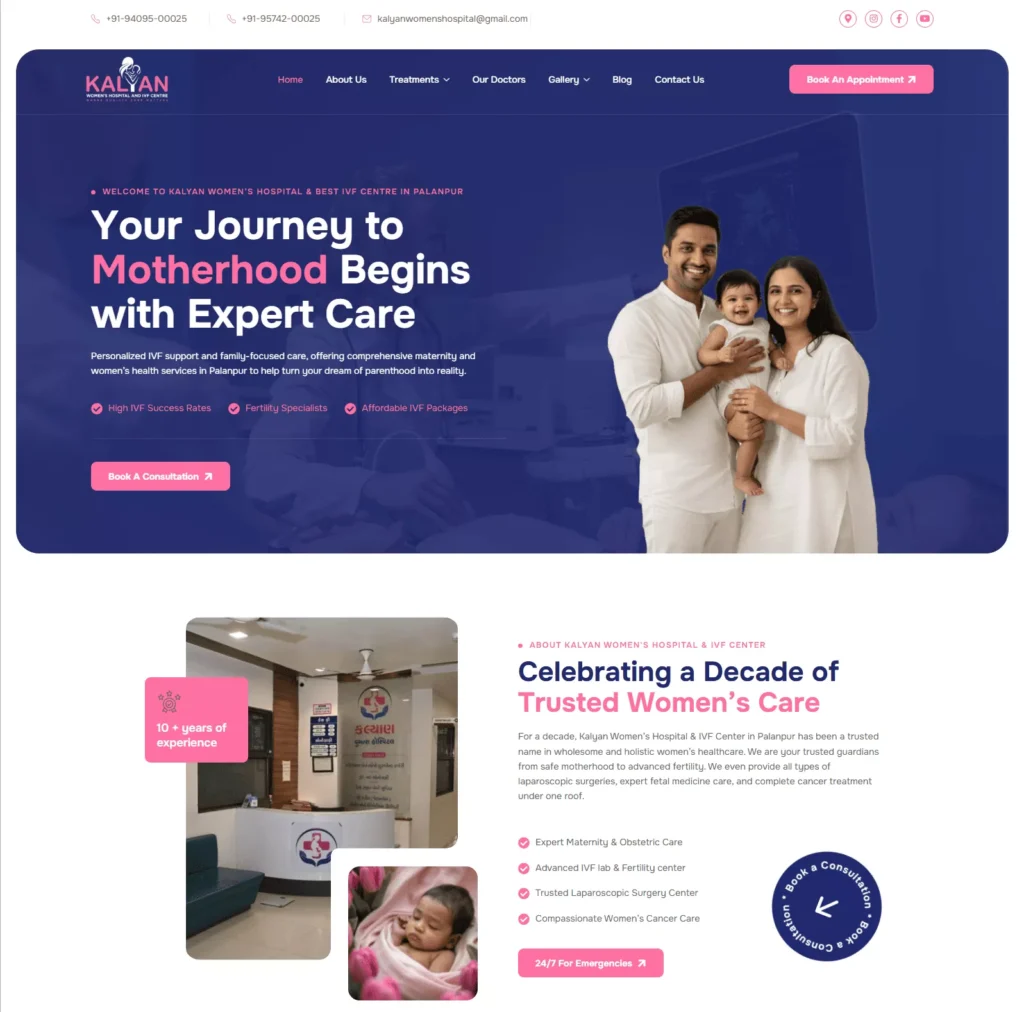
Your website is the digital front door of your practice. Most patients will judge your credibility within seconds of landing on it — long before they read a single word of your content.
A patient-centric healthcare website needs to load quickly (under three seconds on mobile), since slow sites lose visitors before the page even renders. It should have simple navigation, prominent appointment booking, click-to-call buttons, and WhatsApp integration for instant queries.
Treatment pages, detailed doctor profiles, trust badges (accreditations, certifications), patient testimonials, FAQs, accessibility features, and SSL security are no longer optional extras — they are baseline expectations.
Best Practices
- Design mobile-first; the majority of healthcare searches happen on smartphones.
- Place a click-to-call button and WhatsApp chat icon on every page, not just the contact page.
- Show real doctor credentials, photos, and experience — anonymity reduces trust in healthcare.
- Use HTTPS/SSL everywhere; browsers flag non-secure sites, which is especially damaging for a health website.
Common Mistakes to Avoid
- Stock photos instead of real doctors and real facilities.
- Burying the appointment booking option three clicks deep.
- Ignoring page speed and image compression, leading to high bounce rates.
Website Checklist
- Page load time under 3 seconds on mobile
- Online appointment booking widget
- Click-to-call and WhatsApp buttons on every page
- Doctor profiles with real photos and credentials
- Patient testimonials and trust badges
- SSL certificate active (https://)
Strategy 2: Invest in Healthcare SEO:
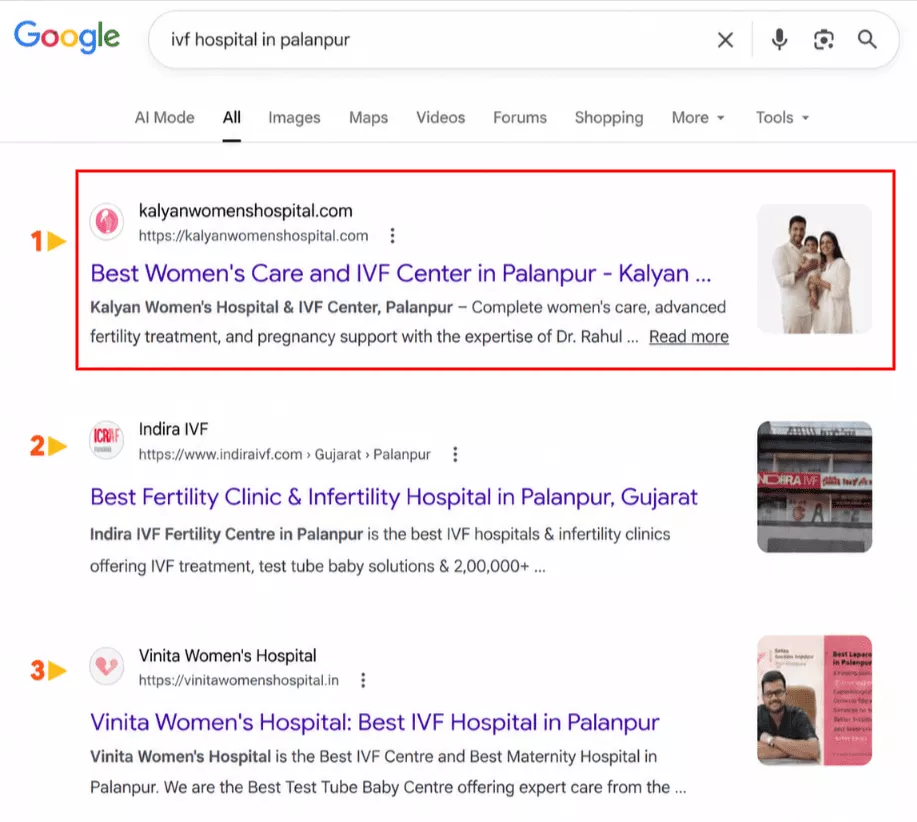
Healthcare SEO is the practice of optimizing your website so it ranks for the medical terms, symptoms, and treatments your patients are actively searching for. Because organic results capture a large share of clicks on search engines, ranking well is one of the highest-leverage long-term investments a provider can make.
It includes keyword research (targeting both broad terms like “dermatologist in [city]” and long-tail queries like “cost of IVF treatment for PCOS”), on-page optimization, technical SEO (site speed, mobile usability, structured data), local SEO, and medical content optimization aligned with Google’s E-E-A-T (Experience, Expertise, Authoritativeness, Trustworthiness) framework, which is especially strict for medical content under Google’s “Your Money or Your Life” quality guidelines.
Best Practices
- Research keywords by symptom, treatment, and location, not just by specialty name.
- Have content reviewed and credited to a licensed medical professional to satisfy E-E-A-T.
- Add schema markup (MedicalClinic, Physician, FAQ) so search engines understand your content.
- Build a logical internal linking structure between blog content and treatment/service pages.
- Optimize for AI-driven and zero-click search results, since more answers now appear directly in search summaries.
Common Mistakes to Avoid
- Publishing thin, generic content copied from other websites.
- Ignoring technical SEO issues like broken links, duplicate pages, or missing meta tags.
- Targeting only broad keywords and ignoring high-intent long-tail searches.
Healthcare SEO Checklist
- Keyword map covering symptoms, treatments, and locations
- Medical content reviewed and credited to a qualified professional
- Schema markup implemented (Physician, MedicalClinic, FAQ)
- Internal links between blogs and service pages
- Technical SEO audit completed quarterly
Strategy 3: Optimize Your Google Business Profile
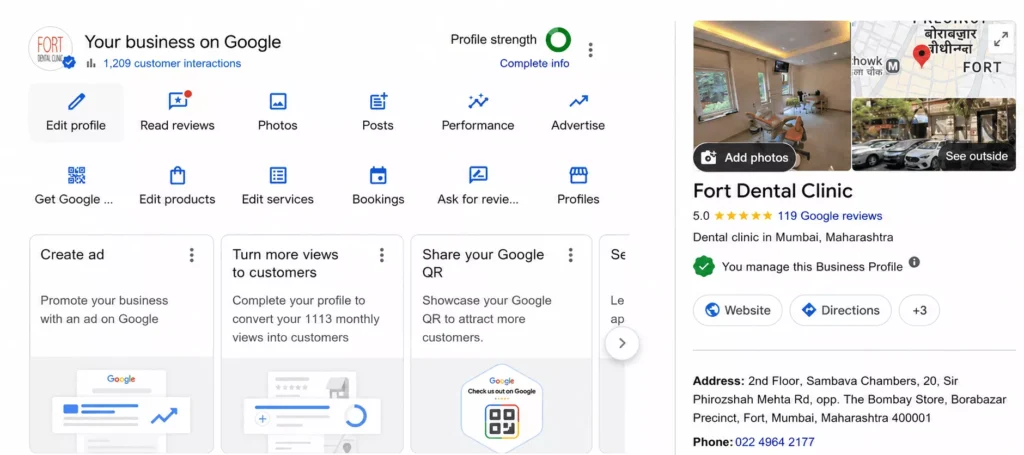
Google Business Profile (GBP) is often the first thing a patient sees when searching for a provider nearby, appearing in the local map pack above standard organic results. For single-location clinics, dentists, and diagnostic labs, this free listing can drive more calls and direction requests than any other channel.
A fully optimized profile includes complete and accurate business information, the correct primary and secondary categories, high-quality photos of the facility and team, an active review-collection habit, prompt answers in the Q&A section, weekly posts about offers or health camps, a clear services list, and a direct booking link.
Best Practices
- Keep NAP (Name, Address, Phone) consistent across the website, GBP, and all directories.
- Upload fresh photos monthly — listings with more photos generally get more engagement.
- Respond to every review, positive or negative, within 24–48 hours.
- Use GBP posts to highlight seasonal health camps, new doctors, or screening offers.
Common Mistakes to Avoid
- Leaving the profile incomplete or unclaimed entirely.
- Using a call-tracking number that doesn’t match the website (hurts local ranking).
- Ignoring the Q&A section, which competitors or random users can answer incorrectly.
Google Business Profile Checklist
- Business information 100% complete and accurate
- Correct primary and secondary categories selected
- At least 10 high-quality photos uploaded
- Weekly posts scheduled
- Review response process in place
Strategy 4: Run High-Converting Google Ads Campaigns
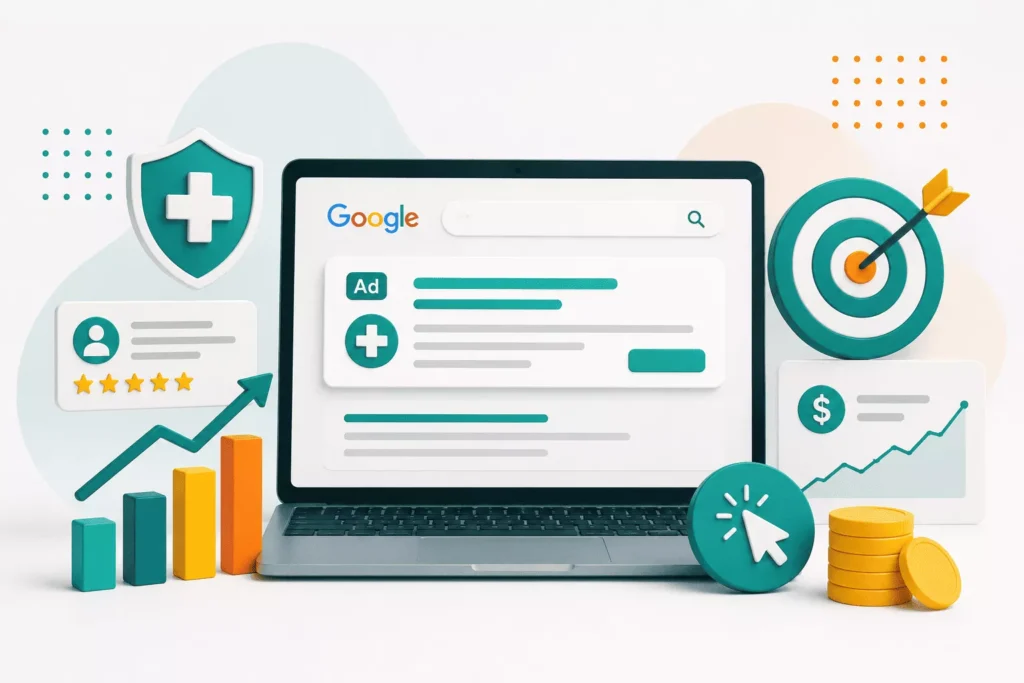
While SEO builds long-term visibility, Google Ads delivers immediate, predictable patient inquiries useful for new clinics, seasonal promotions, or high-value procedures where waiting months for organic rankings isn’t practical.
Effective healthcare ad accounts combine Search ads for high-intent keywords, Performance Max where appropriate for broader reach, precise location targeting, call-only campaigns for mobile users, dedicated landing pages, and proper conversion tracking so every rupee or dollar spent can be tied back to an actual appointment.
Best Practices
- Send traffic to a dedicated landing page, never the generic homepage.
- Set up call tracking and form-fill conversion tracking before launching any campaign.
- Write ad copy that addresses patient concerns directly (cost, safety, experience) rather than generic claims.
- Review Google’s healthcare and medical advertiser policies before launch, since misleading claims can get accounts suspended.
Common Mistakes to Avoid
- Running ads without any conversion tracking, making ROI impossible to measure.
- Using overly broad match keywords that waste budget on irrelevant clicks.
- Making medical claims that violate platform advertising guidelines.
Google Ads Checklist
- Conversion tracking configured for calls and form fills
- Dedicated landing page for each campaign
- Negative keyword list maintained
- Ad copy reviewed for compliance with healthcare advertising policy
- Budget reviewed weekly against cost-per-lead targets
Strategy 5: Use Social Media Marketing to Build Patient Trust
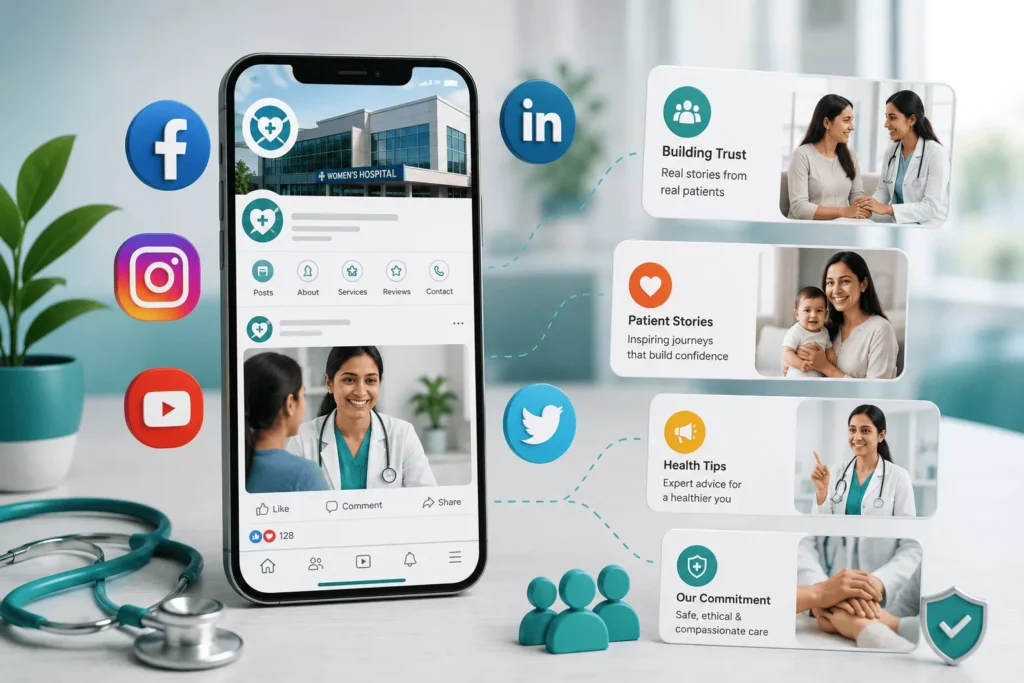
Social media doesn’t usually generate instant appointments the way ads do, but it builds the trust and familiarity that makes a patient comfortable choosing you over a competitor. Facebook still works well for reaching older demographics and community groups; Instagram is ideal for visual specialties; LinkedIn helps build a hospital’s professional credibility; and YouTube and short-form video (Reels, Shorts) are increasingly where patients go to understand a procedure before booking a consultation.
Best Practices
- Post a mix of doctor-led education, patient awareness content, and behind-the-scenes facility content.
- Use short videos to explain common procedures in plain language.
- Run periodic live Q&A sessions for community engagement and to handle common patient concerns publicly.
- Maintain a consistent posting schedule rather than sporadic bursts.
Common Mistakes to Avoid
- Posting only promotional content with no educational value.
- Sharing patient images or case details without explicit, documented consent.
- Inconsistent posting that lets the profile go dormant for months.
Social Media Checklist
- Content calendar planned at least 2 weeks ahead
- Mix of educational, awareness, and community content
- Written, documented patient consent for any shared case content
- Engagement (comments, DMs) monitored and answered within 24 hours
Strategy 6: Create Valuable Healthcare Content
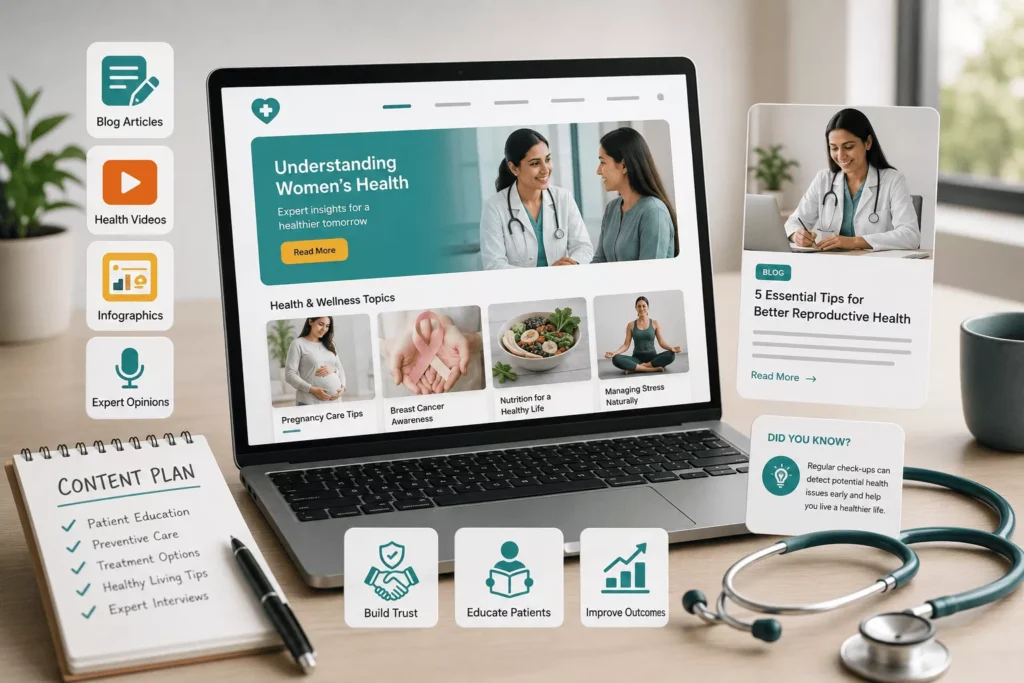
Content marketing is the engine behind both SEO and patient trust. Blogs, FAQs, treatment guides, infographics, videos, and consented case studies answer the questions patients are already typing into search engines, positioning your practice as the authority before the first appointment is even booked.
Best Practices
- Write content that answers specific patient questions, not generic overviews.
- Refresh older blog posts with current statistics and treatment information at least once a year.
- Use seasonal content (flu season, monsoon illnesses, summer skin care) to stay relevant and timely.
- Turn long-form blogs into infographics and short videos to extend reach across formats.
Common Mistakes to Avoid
- Publishing content with no medical review, risking inaccurate or outdated information.
- Writing exclusively for search engines instead of for the patient’s actual question.
- Letting the blog go stale, with no new content for months at a time.
Content Marketing Checklist
- Content calendar mapped to patient questions and seasons
- All medical content reviewed by a licensed professional
- Mix of formats: blogs, infographics, video, FAQs
- Older content audited and refreshed annually
Strategy 7: Encourage and Manage Online Reviews
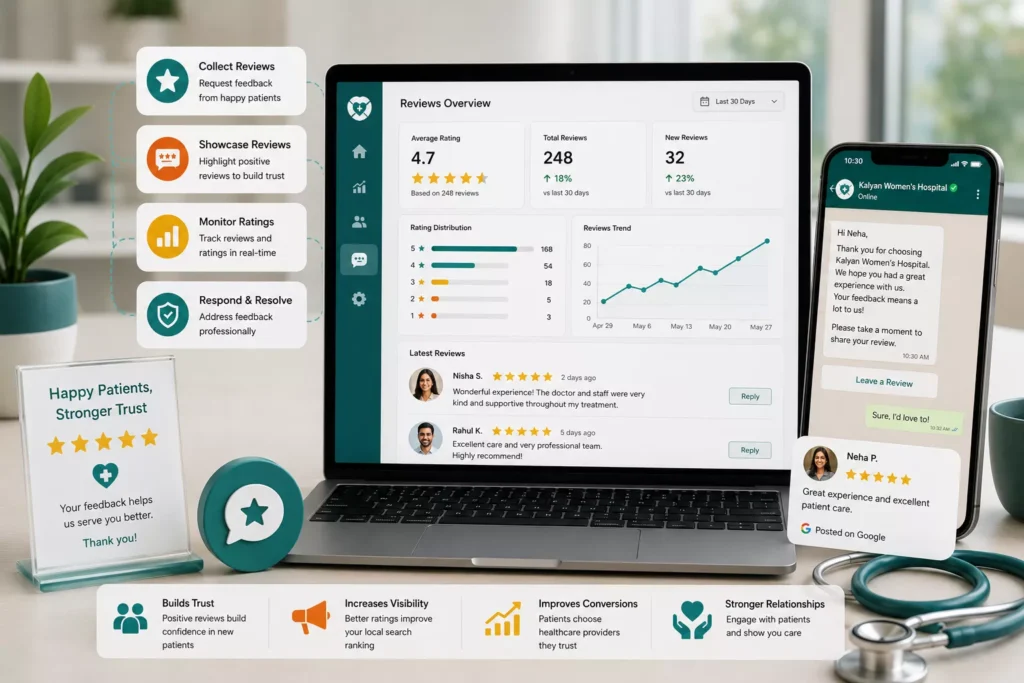
Reviews are now one of the strongest trust signals in healthcare decision-making patients routinely check a provider’s star rating and recent reviews before booking, often weighing them as heavily as a personal referral. A consistent flow of genuine, recent Google reviews also supports local SEO rankings.
Best Practices
- Ask satisfied patients for a review immediately after a positive visit, via SMS or WhatsApp link.
- Respond professionally and promptly to every review, especially negative ones.
- Never offer payment or incentives in exchange for reviews — this violates most platform policies.
- Address negative feedback calmly, take the conversation offline, and avoid sharing patient health details publicly.
Common Mistakes to Avoid
- Ignoring negative reviews instead of responding professionally.
- Asking every patient for a review with no system, leading to inconsistent results.
- Revealing any private health information in a public review response, which is both unethical and a privacy violation.
Reputation Management Checklist
- Automated review request system in place
- Review response policy documented for staff
- Negative reviews addressed within 24–48 hours
- Monthly review summary tracked against competitors
Strategy 8: Develop Dedicated Landing Pages for Every Service
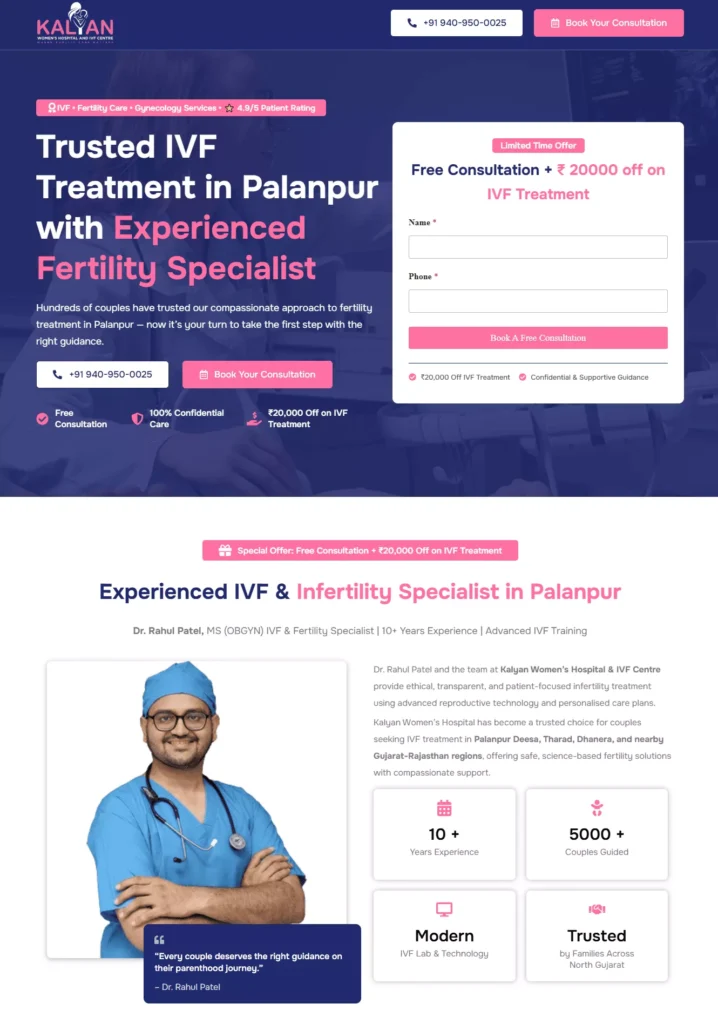
Check Full Page: kalyanwomenshospital
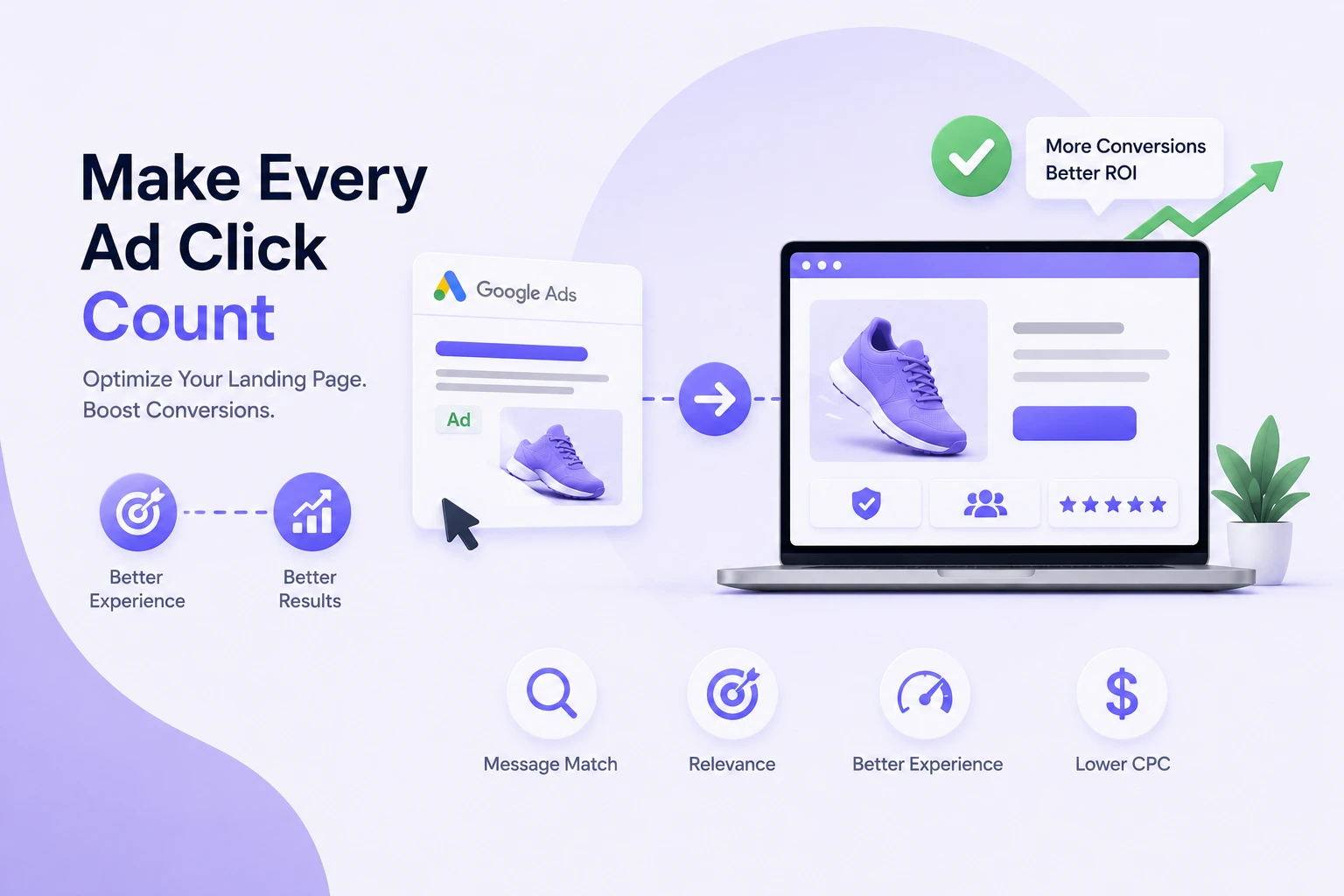
Sending all your traffic – whether from ads, search, or social to a generic homepage is one of the most common reasons healthcare campaigns underperform.
A dedicated landing page for each high-value service (IVF treatment, dental implants, hair transplant, knee replacement, cataract surgery, cosmetic procedures, cardiology, orthopedics) converts significantly better because it speaks directly to the specific concern that brought the patient there.
Best Practices
- Structure each page around the patient’s question: what it is, who needs it, the process, cost factors, and recovery.
- Include trust signals – doctor credentials, success rates, certifications – above the fold.
- Use one clear, repeated call-to-action (book a consultation, call now) rather than multiple competing options.
- Add real patient testimonials specific to that procedure, not generic clinic-wide reviews.
Common Mistakes to Avoid
- Sending paid traffic to the homepage instead of a procedure-specific page.
- Overloading the page with unrelated services, diluting the message.
- Weak or buried calls-to-action that make booking difficult.
Landing Page Checklist
- One dedicated page per high-value service
- Trust signals (credentials, certifications) above the fold
- Single, clear call-to-action repeated throughout the page
- Procedure-specific testimonials included
Strategy 9: Use Email and WhatsApp Marketing for Patient Retention
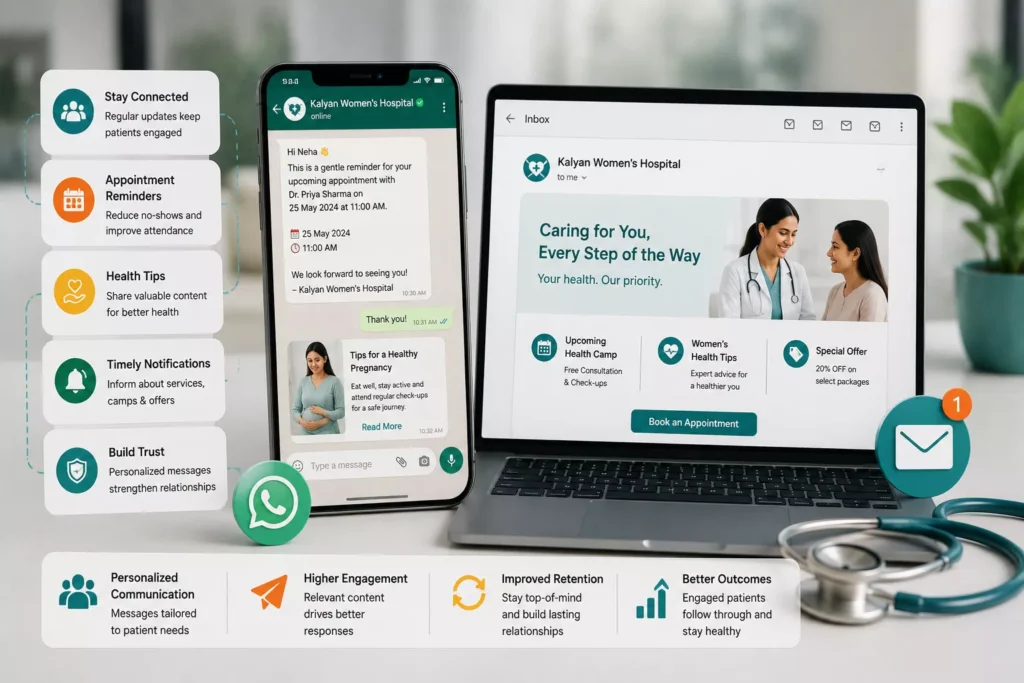
Acquiring a new patient costs far more than retaining an existing one, yet many healthcare providers focus entirely on acquisition and neglect retention. Email and WhatsApp marketing keep your practice top-of-mind through appointment reminders, health tips, follow-up communication, health camp invitations, vaccination reminders, and preventive checkup nudges.
Best Practices
- Segment your patient list by treatment type, last visit date, and follow-up needs.
- Automate appointment and preventive-checkup reminders to reduce no-shows.
- Send a regular newsletter with genuinely useful health tips, not just promotions.
- Use re-engagement campaigns for patients who haven’t visited in 6–12 months.
Common Mistakes to Avoid
- Sending generic, impersonal blasts with no segmentation.
- Over-messaging patients, which leads to opt-outs and complaints.
- Failing to get proper consent for WhatsApp or email communication, risking compliance issues.
Email & WhatsApp Marketing Checklist
- Patient list segmented by treatment and visit recency
- Automated appointment and checkup reminders set up
- Consent properly recorded for all communication
- Re-engagement campaign scheduled quarterly
Strategy 10: Track, Analyze, and Continuously Improve Performance
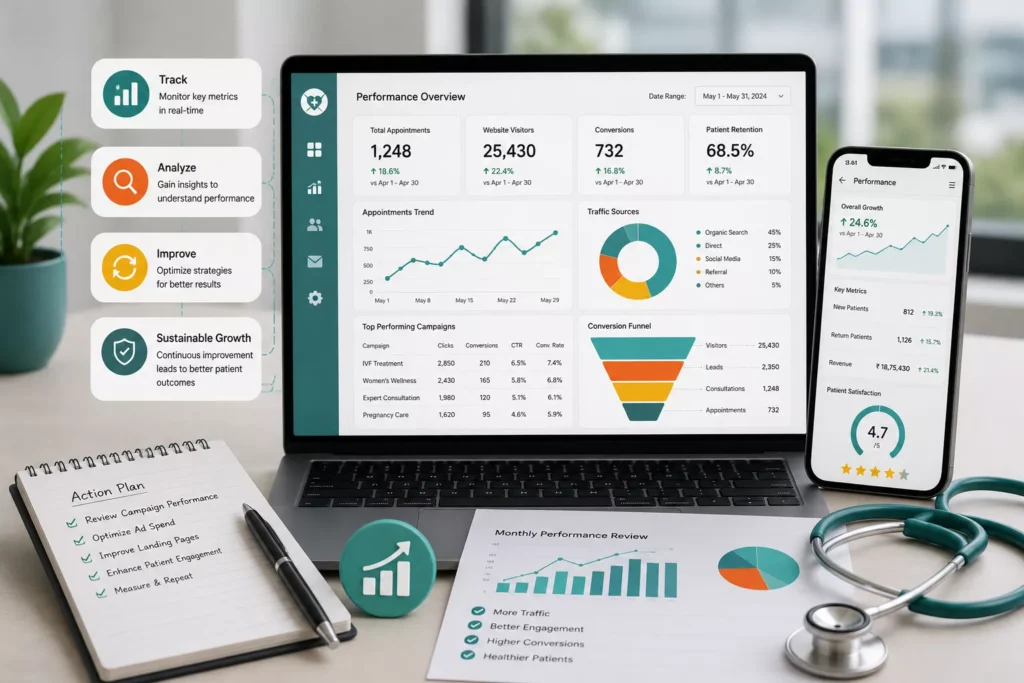
None of the previous nine strategies work in isolation, and none can be trusted without measurement. Tracking website traffic, conversion rate, cost per lead, cost per appointment, organic rankings, Google Ads metrics, social engagement, call tracking, and overall ROI is what separates a guessing-game marketing approach from a genuinely data-driven one.
Best Practices
- Set up Google Analytics 4 and Google Search Console from day one, before any campaign launches.
- Track calls and form submissions back to their specific source (organic, paid, social, referral).
- Review performance monthly and reallocate budget toward what’s actually generating appointments.
- Build a simple, recurring report covering leads, cost per lead, and conversion rate by channel.
Common Mistakes to Avoid
- Tracking vanity metrics like impressions while ignoring actual appointment conversions.
- Running campaigns for months without ever reviewing the data.
- Having no call-tracking system, leaving phone-based conversions completely invisible.
Analytics & Reporting Checklist
- Google Analytics 4 and Search Console properly configured
- Call and form tracking connected to source channel
- Monthly performance review scheduled with the team
- Reporting dashboard accessible to all stakeholders
Comparison Table: All 10 Strategies at a Glance
Use this table to quickly compare goals, ideal use cases, expected timelines, and primary benefits before deciding where to focus your budget first.
| Strategy | Primary Goal | Ideal Use Case | Timeline to Results | Primary Benefit |
| 1. Mobile-Friendly Website | Convert visitors into patients | All providers, especially specialty clinics | 2–4 weeks to launch | Higher conversion & lower bounce rate |
| 2. Healthcare SEO | Rank for medical search terms | Hospitals, multi-specialty clinics | 3–6 months | Sustainable, high-trust organic traffic |
| 3. Google Business Profile | Win local map-pack visibility | Single-location clinics, dentists, labs | 2–4 weeks | Free, high-intent local leads |
| 4. Google Ads | Generate immediate appointments | IVF, cosmetic, dental, orthopedic | Days to 2 weeks | Fast, measurable lead flow |
| 5. Social Media Marketing | Build awareness & trust | Dermatology, IVF, wellness centers | 1–3 months | Brand recall & patient engagement |
| 6. Content Marketing | Educate & build authority | All specialties, chronic care providers | 3–6 months | E-E-A-T authority & organic reach |
| 7. Review & Reputation Management | Increase trust & conversions | Dentists, surgeons, diagnostic centers | Ongoing | Higher trust, more bookings |
| 8. Service Landing Pages | Convert ad/search traffic | IVF, dental implants, knee replacement | 2–3 weeks per page | Higher campaign conversion rate |
| 9. Email & WhatsApp Marketing | Retain & re-engage patients | Diagnostic centers, hospitals, dentists | Ongoing, 30-day setup | Repeat visits & loyalty |
| 10. Analytics & Reporting | Optimize spend & strategy | All providers running paid/organic campaigns | Continuous | Data-driven ROI improvement |
Common Healthcare Digital Marketing Mistakes to Avoid
Across hundreds of healthcare marketing engagements, the same mistakes show up repeatedly. Avoiding these alone can put a provider ahead of most local competitors.
- Ignoring SEO entirely and relying only on paid ads for visibility.
- Running a slow, outdated, or non-mobile-friendly website.
- Launching ad campaigns without conversion tracking in place.
- Not responding to patient reviews, positive or negative.
- Publishing duplicate or AI-generated content with no medical review.
- Allowing poor-quality or outdated medical information to remain live.
- Using weak, generic landing pages for high-value procedures.
- Neglecting local SEO despite being a single-location practice.
- Inconsistent branding, tone, and messaging across channels.
Essential Digital Marketing Tools for Healthcare Providers
- SEO & Keyword Research: Ahrefs, SEMrush, Google Search Console
- Analytics & Heatmaps: Google Analytics 4, Hotjar, Microsoft Clarity
- Social Media Scheduling: Buffer, Later, Hootsuite
- Email Marketing: Mailchimp, HubSpot
- CRM & Patient Management: Healthcare-specific CRMs with appointment and follow-up tracking
- Call Tracking: CallRail, Convirza
Healthcare Digital Marketing Trends to Watch:
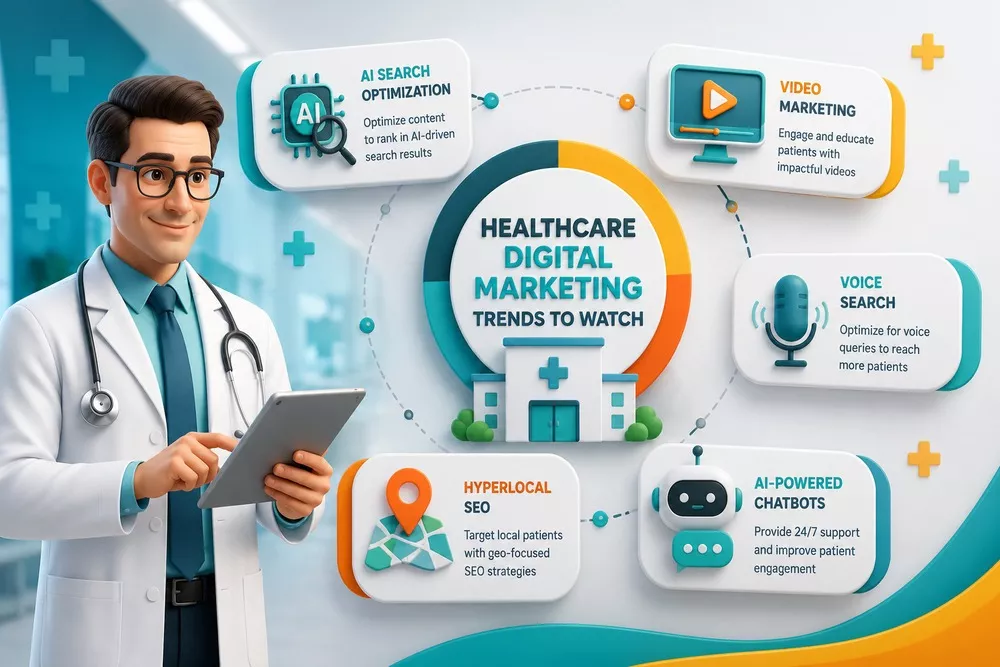
The channels above remain the foundation, but a few shifts are changing how patients discover and choose providers right now.
- AI search optimization — structuring content so it can be cited by AI-powered search summaries, not just ranked in traditional blue links.
- Voice search — patients increasingly ask conversational, question-style queries through voice assistants.
- Video-first marketing — short-form video continues to outperform static content for awareness and trust-building.
- Hyperlocal SEO — increasingly granular targeting down to specific neighborhoods, not just cities.
- Personalization and marketing automation — tailoring content and follow-ups based on a patient’s specific condition or journey stage.
- Zero-click searches — more patients get answers directly on the search results page, raising the importance of structured data and GBP.
- AI-powered chatbots — handling initial patient queries and appointment scheduling around the clock.
- First-party data strategies — becoming more important as third-party cookies phase out across browsers.
How to Measure Success
A healthy healthcare digital marketing program should be evaluated against a consistent set of KPIs rather than vanity metrics alone.
- Organic traffic growth month over month
- Local search rankings for target keywords
- Appointment bookings and qualified leads generated
- Conversion rate across website, landing pages, and ads
- Cost per acquisition (CPA) by channel
- Patient lifetime value, especially for specialties with repeat or long-term care
- Return on ad spend (ROAS) for paid campaigns
- Review growth rate and average rating
- Engagement metrics across social and email channels
How is Healthcare Marketing Unique?
Watch the video below to discover practical strategies for marketing your healthcare practice effectively. Learn how to identify your target patients, build a strong online presence, create compelling offers, nurture existing patients, and deliver valuable, educational content that enhances patient trust, engagement, and overall satisfaction.
Want Better Patient Engagement?
No single channel – not SEO, not Google Ads, not social media alone – delivers the full picture of sustainable patient growth. The healthcare providers who consistently attract more patients are the ones who combine SEO, local SEO, paid advertising, content marketing, social media, and reputation management into one integrated strategy, rather than treating each as a standalone experiment.
Attracting patients online is not a one-time project; it requires continuous optimization, high-quality patient education, and genuinely data-driven decision-making.
The strategies and checklists in this guide give you a complete, practical starting point the next step is choosing where your specific practice has the biggest gap today, and building from there.
Frequently Asked Questions (FAQs):
It is the use of online channels — SEO, paid ads, social media, content, and email — to attract, convert, and retain patients while complying with medical advertising standards.
Because the majority of patients now research providers online before booking, a weak digital presence means losing visibility at the exact moment patients are making decisions.
Google Ads typically generates the fastest leads, while SEO and Google Business Profile generate the most sustainable, lower-cost leads over time. Most providers see the best results from combining both.
Meaningful organic ranking improvements typically take three to six months, with continued growth over the following year as content and authority build up.
Neither is strictly “better” — Google Ads delivers faster results at an ongoing cost, while SEO takes longer to build but delivers more sustainable, lower cost-per-lead traffic over time.
Budgets vary widely by specialty and city, but many providers allocate a meaningful percentage of revenue toward marketing, balancing SEO, content, and paid advertising rather than relying on a single channel.
Instagram and YouTube work well for visual and video-led specialties like dermatology and cosmetic procedures, Facebook reaches broader local and older audiences, and LinkedIn is strongest for hospital branding and professional credibility.
By focusing on hyperlocal SEO, an optimized Google Business Profile, consistent reviews, and highly specific service landing pages — areas where large hospitals are often slower to optimize.
Reviews are one of the strongest trust signals in healthcare; most patients check ratings and recent feedback before booking, often weighing them as heavily as a personal referral.
Hitesh Prajapati

Digital Growth Partner for Healthcare Brands with 5+ years of experience in healthcare SEO and digital marketing. Passionate about sharing proven SEO strategies, industry insights, and growth-focused marketing approaches.
Contact Form Popup
Boost Your Business Now
This will close in 0 seconds
apply now popup
Apply Now
This will close in 0 seconds
Get free audit popup
Get Free Google Ads Account Audit Worth $999
This will close in 0 seconds
Contact page Form Popup
Contact Us
This will close in 0 seconds