
The holiday shopping season is the single biggest revenue opportunity of the year for eCommerce businesses – and it is more competitive, more mobile-first, and more AI-driven than ever before.
During the 2025 holiday season (November–December), US consumers spent a record $257.8 billion online – a 6.8% increase year-on-year, according to Adobe Analytics. More than half of all online transactions (56.4%) were completed on smartphones. AI-powered shopping assistants drove 693% more traffic to retail sites than the previous year.
If your strategy is still built around the same playbook from a few years ago, you are already behind. This guide gives you 6 data-backed tips – plus a 2026 key dates calendar and website readiness checklist – to help your online store capture its share of the season.
2025 Holiday eCommerce by the Numbers
| $257.8B US online holiday sales | 6.8% YoY growth vs 2024 |
| 56.4% Holiday transactions on mobile | 693% AI-driven traffic growth to retail sites |
| $20B Spent via BNPL during 2025 holiday season | +40.3% Social commerce revenue growth YoY (Adobe) |
These numbers set the context for everything that follows. The 2026 holiday season — running from Amazon Prime Day in July through Christmas and beyond — will build on these trends. Brands that prepare early and execute across the right channels will disproportionately capture that growth.
2026 Holiday eCommerce Key Dates Calendar
Planning starts now. Here are the critical dates your marketing calendar must be built around:
| Event | Date (2026) | What to Prepare |
| Amazon Prime Day | ~July 8–11, 2026 | Competitor deals, parallel promotions, retargeting campaigns |
| Amazon Prime Big Deal Days | ~October 7–15, 2026 | Early holiday gift guides, VIP early-access launches |
| Campaign Launch Window | Early October 2026 | Email warm-up, social content calendar, paid media budget allocation |
| Black Friday | 27 November 2026 | Your biggest offers, flash deals, SMS urgency sequences |
| Small Business Saturday | 28 November 2026 | Local angle, brand story content, community-first messaging |
| Cyber Monday | 30 November 2026 | Tech/electronics focus, BNPL prominently featured, email re-send to non-openers |
| Giving Tuesday | 1 December 2026 | Charity tie-ins, loyalty rewards for social good actions |
| Last Shipping Dates | ~December 18–20, 2026 | Urgency emails, digital gift card push, click-and-collect promotion |
| Christmas Day | 25 December 2026 | Mobile-first (66.5% of sales are on mobile on Christmas Day) |
| Post-Christmas & New Year | 26 Dec – 7 Jan | Returns management, clearance sales, loyalty re-engagement |
Key insight from 2025 data: 47% of holiday shoppers bought early to avoid price increases, and 38% started shopping before October (Bazaarvoice). Marketers who wait until Black Friday risk missing shoppers who have already bought elsewhere.
Tip 1: Start Early and Build a Phased Campaign Calendar
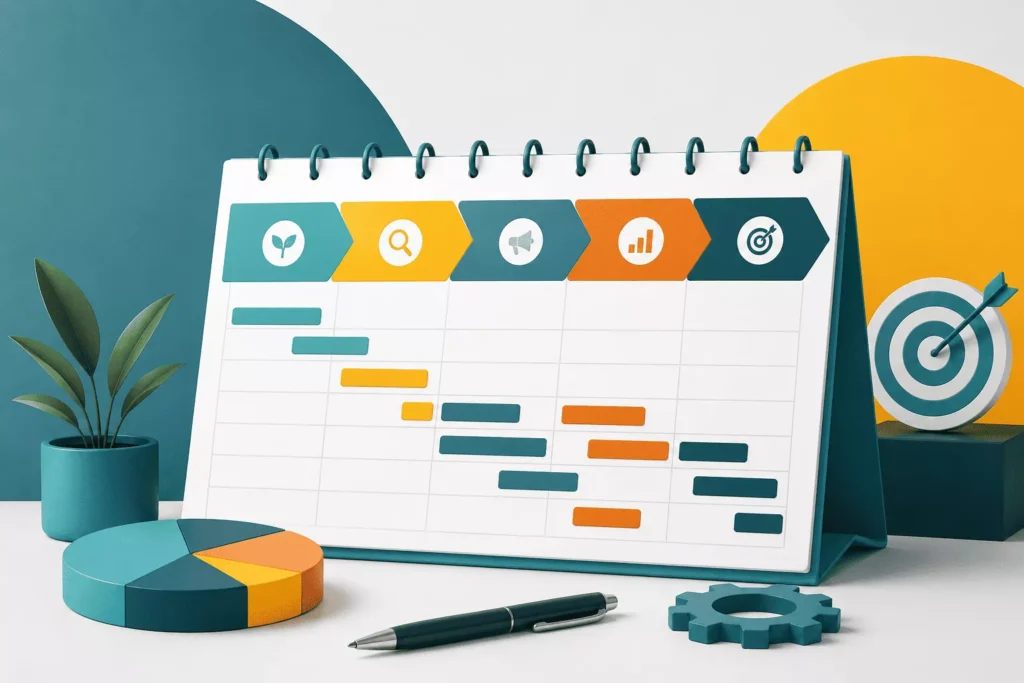
The single biggest strategic mistake online retailers make every year is launching their holiday campaigns too late. The data is unambiguous: holiday shopping now begins in July with Prime Day and accelerates steadily through October – well before the traditional Thanksgiving starting gun.
In 2025, Amazon extended Prime Day to four days for the first time (July 8-11), generating significant early-season consumer spending and establishing a summer holiday shopping mindset. According to Bazaarvoice’s 2025 Holiday Shopping Report, 38% of shoppers start holiday shopping before October, with just 9% waiting until December.
How to Structure Your Holiday Campaign Timeline
July-August: Leverage Prime Day and summer deal events. Run parallel promotions. Build your email and SMS subscriber list aggressively – every subscriber gained now is an asset for BFCM.
September: Finalise inventory, test site performance under load, activate gift guide content, brief your paid media team on budgets and creative. This is also the right time to audit your eCommerce SEO strategy – gift guide content indexed in September has time to rank before peak traffic arrives.
October: Launch early-bird campaigns. Target Prime Big Deal Days. Send teaser emails to your list. Activate retargeting audiences on Meta and Google. A properly structured eCommerce marketing plan covers this full funnel from awareness to conversion.
Early November: Ramp up paid media. Push VIP early-access offers to loyal customers. Begin SMS sequences for cart urgency. Finalise your BFCM offer structure.
BFCM Week: Execute your full multi-channel campaign: email, SMS, paid social, Google Shopping, influencer content. Treat each day separately – Black Friday, Saturday, Sunday, Cyber Monday each have distinct shopper behaviour.
December: Shift to gift guide content, last shipping date urgency, and digital gift cards as physical delivery windows close. Prepare your returns management process.
Understanding Holiday Shopping Micro-Moments (and How to Win Them)
Google defines micro-moments as the instant a consumer reflexively turns to a device to act on a need – to know something, to go somewhere, to do something, or to buy something. During the holiday season, these moments multiply: a shopper searches “best gifts for dad under $50” on their lunch break, sees a TikTok about a product at 10pm, and completes the purchase on their phone the next morning. Each of those touchpoints is a micro-moment – and a brand that is absent from any one of them loses the sale. The practical implication for retailers is straightforward: show up across every channel (search, social, email, AI assistants) with the right message at the right stage, rather than concentrating everything on a single Black Friday push.
Pro Insight: According to Sinch’s 2025 BFCM consumer survey of 3,180 shoppers, 37.3% expect promotions to begin by October 28 – a full month before Black Friday – and 18.6% want them even earlier. Only 19.4% are comfortable waiting until Cyber Week.
Tip 2: Make Mobile Your Primary Channel – Not an Afterthought
Mobile commerce is no longer a secondary channel. In the 2025 holiday season, 56.4% of all online transactions were completed on smartphones – up from 54.5% in 2024. On Christmas Day, that figure reached 66.5%, and on Cyber Monday, 57.5% of sales were mobile. If your store is not genuinely optimised for mobile, you are losing more than half your potential transactions.
Mobile Optimisation Checklist for the 2026 Holiday Season
- Page speed: Target under 2 seconds on mobile. Use Google PageSpeed Insights and compress all images.
- Single-column layout: Eliminate two-column grids that collapse poorly on small screens. Prioritise thumb-friendly navigation.
- Streamlined checkout: Remove unnecessary form fields. Enable one-click payment options including Apple Pay, Google Pay, and Shop Pay. Guest checkout must be prominent.
- Mobile-first product imagery: Use high-resolution images with pinch-to-zoom capability. Consider 360-degree or short product video for high-ticket items.
- Above-the-fold promotions: Holiday deals should be visible without scrolling on a mobile screen. Use a sticky header banner for your key offer.
- No pop-ups that block content: Pop-ups that are difficult to close on mobile frustrate users and increase bounce rate. Use non-intrusive banners instead.
- Test on real devices: Use BrowserStack or physical devices to test on iOS Safari, Chrome Android, and Samsung Internet – not just desktop browser emulators.
Augmented Reality: The Emerging Mobile Conversion Tool
For retailers in fashion, furniture, beauty, and home goods, AR features are increasingly mainstream. Virtual try-ons reduce return rates — a major concern given the record holiday return volumes seen after the 2025 season (returns were down 1.2% overall, but up 4.7% in the days following Christmas, per Adobe).
If full AR implementation is not viable this season, begin with high-quality 360-degree product photography as a minimum. This alone measurably improves conversion rates on mobile for complex or higher-ticket products.
Tip 3: Leverage AI-Powered Personalisation Across Every Touchpoints
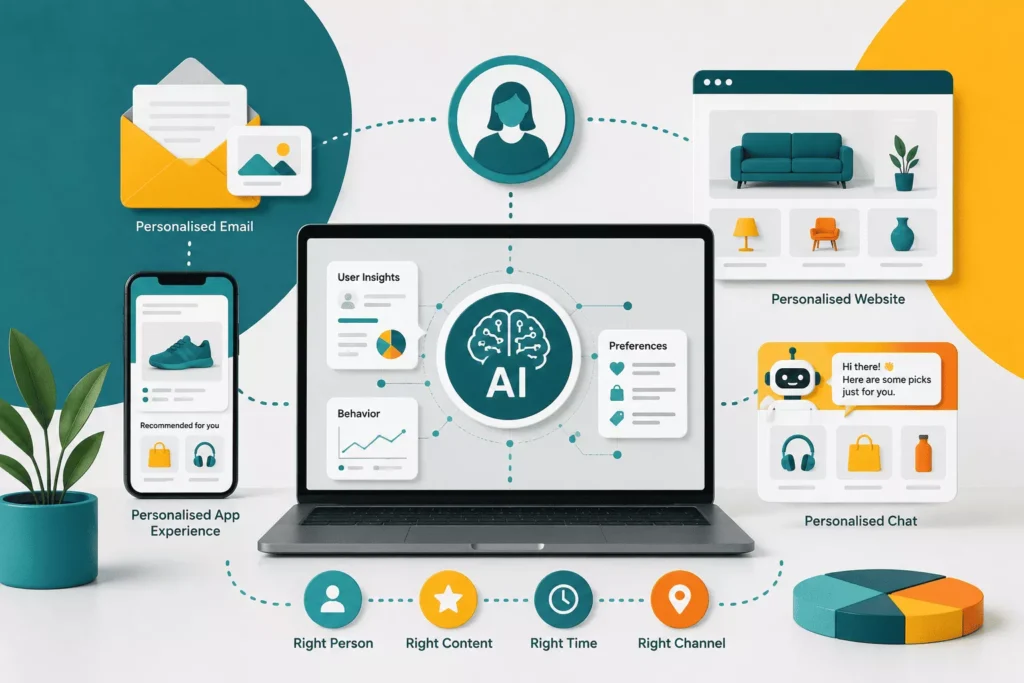
The 2025 holiday season marked what Salesforce called a definitive shift to a new era of agentic shopping. AI agents handled a 142% surge in tasks including returns, shipping updates, and product recommendations. Generative AI chat services drove 693% more traffic to retailers’ websites than the prior holiday season.
In 2026, AI personalisation is not an experimental advantage – it is a baseline competitive requirement. Retailers using AI-driven personalisation report increased engagement, higher repeat visit rates, and significantly better cart conversion.
Where to Apply AI Personalisation for Holiday Sales
| Channel / Touchpoint | AI Application |
| Homepage & Product Pages | Dynamic product recommendations based on browse history, past purchases, and real-time session behaviour. Returning visitors should see different content from new visitors. |
| Email Marketing | AI-generated subject lines, send-time optimisation per subscriber, personalised product blocks, predictive next-best-offer modelling. |
| On-Site Search | AI-powered search that understands natural language queries (‘red dress under $50 for a wedding’) and surfaces results by intent, not just keyword match. |
| Gift Finders & Quizzes | Interactive gift quizzes powered by AI drive higher conversion rates from completers vs standard browse — ideal for undecided shoppers during the gift-giving season. |
| Customer Service | AI chatbots handle returns queries, order status, and product questions 24/7. During the 2025 BFCM, AI agents handled a 142% surge in tasks per Salesforce. This reduces support costs while maintaining response speed. |
| Paid Advertising | AI-driven bidding strategies (Target ROAS on Google, Advantage+ on Meta) automatically allocate budget toward the highest-converting audience segments in real time. |
Retailers who make their products discoverable through AI chat interfaces – through structured data, clear product titles, and rich product descriptions — are positioning themselves for the growing share of AI-referred shopping traffic. Our eCommerce SEO services cover exactly this kind of structured data and product page optimisation.
Tip 4: Build a Multi-Channel Customer Engagement Strategy
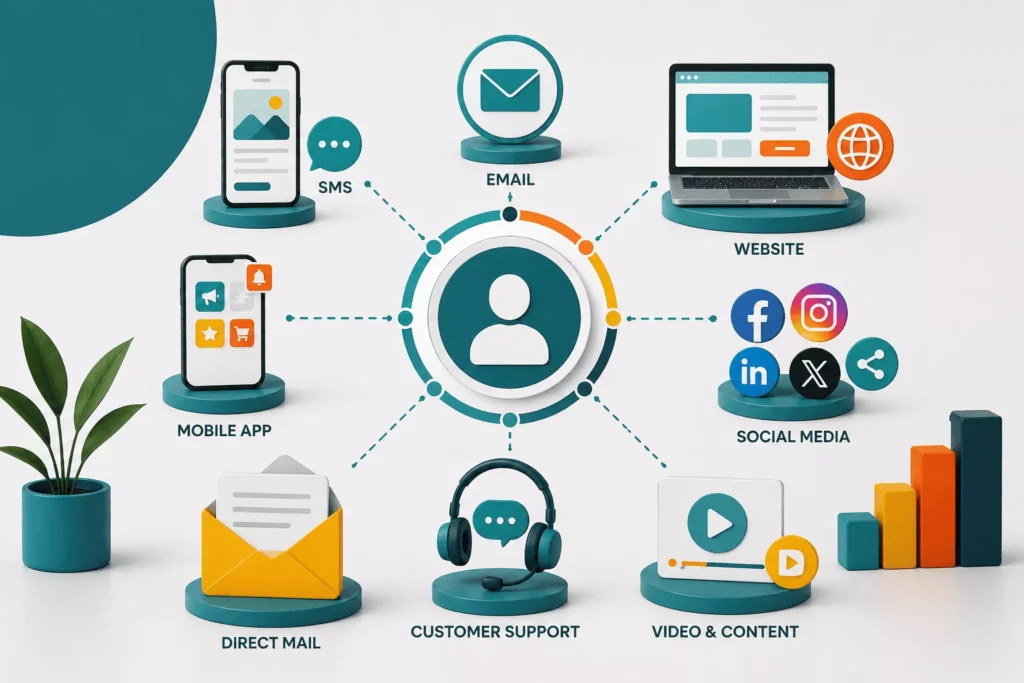
Omnichannel is no longer a differentiator – it is the standard. According to Aberdeen Group research, companies with strong omnichannel customer engagement strategies retain an average of 89% of their customers, compared to 33% for brands with weak omnichannel execution. During the holiday season, where acquisition costs spike, retention is everything.
Email + SMS: The Proven Revenue Combination
Email remains the dominant channel for holiday communication. Sinch’s 2025 BFCM consumer survey of 3,180 shoppers found that 56.5% prefer email for promotional messages and 73.9% depend on it for transactional communications like order confirmations. But SMS is now the urgency layer that email cannot provide alone.
- Use email for depth: gift guides, curated product recommendations, brand storytelling, multi-day campaign sequences
- Use SMS for urgency: cart expiry alerts, flash sale windows (‘Ends in 4 hours’), back-in-stock notifications, last shipping date reminders
- Coordinate, do not duplicate: email and SMS should handle different jobs in the same campaign, not repeat the same message
Omnisend’s 2025 platform data shows merchants using its combined email and SMS tools generate $79 for every $1 spent – significantly above the industry average.
Social Commerce: The Fastest-Growing Holiday Channel
Social commerce revenue grew 40.3% year-on-year during the 2025 holiday season (Adobe). According to Bazaarvoice’s Holiday Shopping Report, 21% of shoppers purchased holiday gifts directly on social media in 2025, up from 12% in 2024. This is no longer fringe behaviour — it is mainstream.
- TikTok Shop: Set up your TikTok Shop and create product-linked video content. Partner with micro-influencers (10K–100K followers) for authentic product demonstrations during the BFCM period.
- Instagram & Facebook Shops: Use shoppable posts and Stories. The native checkout removes friction entirely – shoppers convert without leaving the app. For a deeper playbook, see our guide on selling products on Instagram.
- Live shopping events: Host live streams featuring product demos, flash discounts exclusive to live viewers, and real-time Q&A. Live shopping generates urgency and connection that static content cannot match.
- User-generated content: Customer unboxing videos, reviews, and photos convert better than brand-produced content during gift-giving season. Incentivise UGC with small discounts or feature opportunities.
Omnichannel Fulfilment: BOPIS and Click-and-Collect
For retailers with both online and physical presence, BOPIS (Buy Online, Pick Up In Store) is a critical holiday strategy. According to Salesforce’s 2025 holiday data, nearly one in five online orders globally was BOPIS during the 2025 holiday season, peaking at 35% of all orders in the last five days before Christmas. Research shows that 47% of BOPIS customers make additional in-store purchases during pickup — making it a meaningful revenue multiplier.
Ensure real-time inventory visibility across channels, clear BOPIS eligibility signalling on product pages, and fast turnaround (same-day or next-day pickup) to make it a genuine competitive advantage during the December crunch.
Customer Engagement Throughout the Shopper Journey
| Stage | Shopper State | Engagement Action |
| Awareness | Browsing, researching gifts, comparing options | Gift guides, social content, influencer partnerships, AI chat recommendations |
| Consideration | Has specific products in mind, comparing prices | Retargeting ads, price comparison tools, BNPL messaging, free shipping offer |
| Conversion | Ready to buy, in checkout | Streamlined checkout, trust signals (reviews, security badges), BNPL at checkout |
| Retention | Post-purchase, gift recipient | Post-purchase email, cross-sell, loyalty invite, review request, win-back in January |
Managing paid media across all these stages is where a dedicated PPC management partner makes a significant difference – especially during BFCM when auction costs spike and every wasted click compounds.
Tip 5: Offer Flexible Payment Options – Especially BNPL
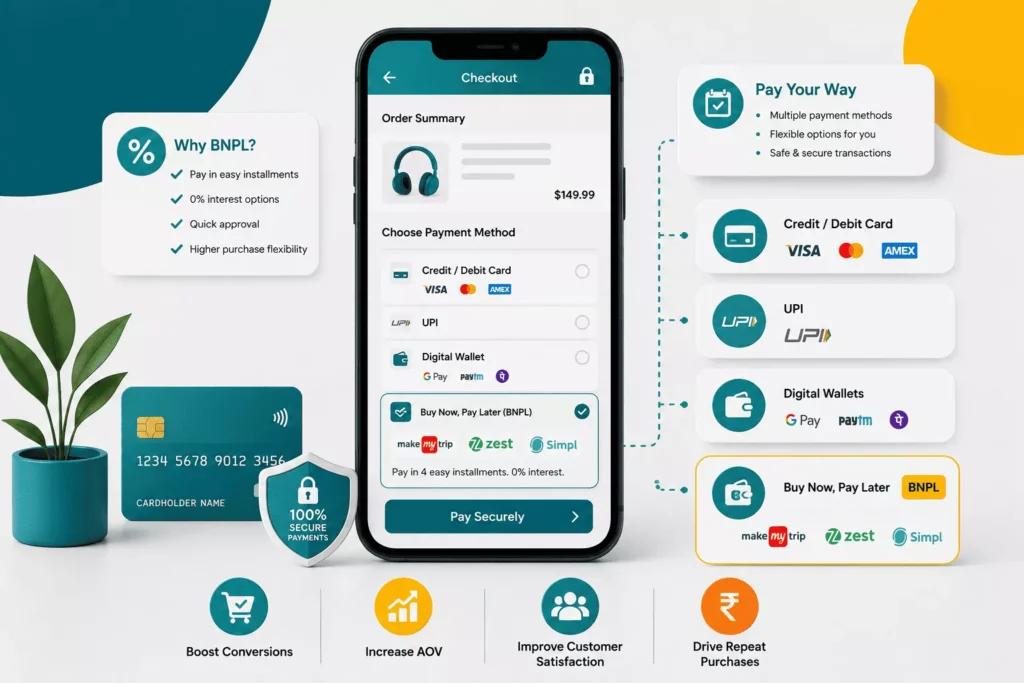
Payment flexibility is one of the most overlooked conversion levers in holiday eCommerce. During the 2025 holiday season, US consumers spent $20 billion via Buy Now, Pay Later (BNPL) – and Cyber Monday 2025 set a single-day BNPL record of $1.03 billion, per Adobe. Smartphones drove 82.2% of all BNPL purchases during the season.
The reason is simple: holiday purchases tend to be higher-value than typical everyday orders, especially when gifting is involved. BNPL makes higher-priced items feel accessible. Research shows BNPL availability at checkout reduces abandonment rates by an average of 20% for orders over $100, and by up to 29% for the 18–34 age group (DigitalApplied, 2026). Retailers also report higher average order values when BNPL is prominently featured.
How to Implement BNPL Effectively for the Holiday Season
- Partner with Klarna, Afterpay, or Affirm – the three leading BNPL providers in eCommerce. Integrations are available for Shopify, WooCommerce, and Magento.
- Show BNPL pricing on product pages, not just at checkout. ‘4 interest-free payments of $25’ displayed on a product listing outperforms ‘$100’ for many budget-conscious holiday shoppers.
- Feature BNPL in your holiday email and ad creative – ‘Get it now, pay in January’ is a compelling seasonal message.
- For higher-ticket items (above $100/$150), make BNPL the default first payment option displayed at checkout – before credit card.
Other Payment Options That Drive Holiday Conversions
- Digital wallets: Apple Pay and Google Pay are essential for mobile checkout. They eliminate form-filling entirely — a major friction reducer for the 56%+ of holiday shoppers on mobile.
- PayPal: Still trusted by a significant portion of shoppers, particularly over-35s who feel it provides an added safety layer.
- Gift cards and store credit: Digital gift cards are the ultimate last-minute holiday product. Push these heavily from December 18 onwards as shipping deadlines pass.
Important: A generous returns policy reduces purchase hesitation. Offer an extended holiday return window (e.g., 60 or 90 days for purchases made in November–December), make it free and easy to find on your site. A clear, generous returns policy measurably improves conversion from first-time and gift-focused buyers.
Tip 6: Optimise for Search, Social Discovery, and AI Visibility
Shoppers no longer follow a simple path from Google search to product page to checkout. In 2026, product discovery happens across Google Shopping, social feeds, TikTok’s For You Page, AI chat recommendations (ChatGPT, Gemini, Perplexity), influencer content, and email. Your visibility strategy must address all of these.
Google Shopping and Paid Search
Google Shopping campaigns remain the highest-ROI paid channel for most eCommerce retailers during the holiday season. As a Google Premier Partner agency, OLBUZ manages campaigns across these exact levers:
- Audit your product feed titles and descriptions now – holiday-intent keywords like ‘Christmas gifts for [recipient]’ or ‘stocking fillers under $20’ should be woven naturally into product titles.
- Enable Performance Max campaigns to let Google’s AI automatically optimise placements across Search, Shopping, YouTube, Gmail, and Display.
- Set bid strategy to Target ROAS. During BFCM, increase your target ROAS by 15–20% to maintain competitive auction positions.
- Activate dynamic remarketing to show personalised product ads to visitors who browsed specific products but did not purchase.
SEO and Content: Gift Guides That Rank
Gift guide content is one of the highest-converting, longest-lived SEO assets for eCommerce brands. A well-structured gift guide targeting ‘gifts for [persona] under [price point]’ can rank for years and drive consistent organic traffic every holiday season. Our SEO services are built around exactly this type of commercial-intent content strategy.
- Publish gift guides early – September or October – to allow time for indexing and ranking before peak traffic arrives.
- Target specific, commercial-intent phrases: ‘best gifts for runners 2026’, ‘tech gifts under $50’, ‘luxury Christmas gifts for her’.
- Include real product imagery, genuine editorial commentary, and pricing. Thin gift guides that are just lists of links do not rank or convert well.
- Update existing gift guide content annually – Google rewards freshness. Simply updating the year, refreshing pricing, and adding 2–3 new products can significantly boost rankings.
AI Search Visibility: Optimising for Generative AI Recommendations
AI-powered shopping assistants drove 693% more traffic to retail sites during the 2025 holiday season (Adobe). Being recommended by these systems is increasingly important alongside traditional SEO.
- Use structured data (schema.org Product markup) comprehensively: price, availability, reviews, shipping time. AI tools surface this data in recommendations.
- Write product descriptions in plain, natural language – AI models parse conversational descriptions better than keyword-stuffed technical specs.
- Earn and display reviews prominently. AI recommendation engines weight review volume and sentiment heavily when suggesting products.
- Build brand entity authority: ensure your brand, products, and category are well-represented in Wikipedia, industry publications, and news – AI models use this for brand trust signals.
Influencer and Social Discovery
Social media accounted for 4.6% of total holiday revenue in 2025 – up 40.3% YoY (Adobe). The social commerce flywheel works because discovery, social proof, and purchase can all happen within a single platform session.
- Micro-influencers (10K–100K followers) typically deliver higher engagement and authenticity than macro-influencers at a fraction of the cost – ideal for mid-market eCommerce brands.
- Brief influencers in September for October content – rushed November partnerships produce lower-quality content and miss the early-season shoppers.
- Repurpose high-performing influencer content as paid ad creative – UGC- style ads consistently outperform polished brand ads across Meta and TikTok during the holiday season.
Bonus: Holiday Website Readiness Checklist
Beyond marketing, your website infrastructure needs to be ready for the traffic surge. A single site outage during BFCM can cost a mid-size retailer tens of thousands in lost revenue.
- Load test your server for 10x normal peak traffic – use tools like k6 or BlazeMeter
- Enable a CDN (Content Delivery Network) to serve assets from servers close to your customers
- Confirm real-time inventory sync across all channels – overselling during BFCM is a reputation killer
- Test checkout flow end-to-end on mobile (iOS Safari + Chrome Android) – fix any friction points
- Activate all BNPL, digital wallet, and payment integrations and test in staging before November
- Update holiday return policy, shipping cut-off dates, and FAQs – and make them visible site-wide
- Prepare AI chatbot or live chat staffing plan for the BFCM spike in customer service enquiries
- Prepare post-holiday clearance and retention campaigns now – January is a critical win-back window
For small businesses in India: The festive season, from Diwali through New Year, is India’s equivalent of the Western BFCM window. The same principles in this guide apply directly: start campaigns in September (pre-Diwali), go mobile-first (India’s smartphone penetration makes this non-negotiable), and use targeted paid media on platforms your audience actually uses, including Google, Meta, and increasingly WhatsApp Business for direct customer communication. If you are wondering where small businesses in India should advertise during holiday shopping periods, the short answer is: wherever your customers spend their screen time, with a budget allocation that front-loads October rather than waiting for December.
Ready to Make This Your Best Holiday Season Yet?
The brands that win the 2026 holiday season are not the ones with the biggest budgets – they are the ones that prepare earliest, execute across the right channels, and meet shoppers where they already are: on mobile, on social, and increasingly, through AI.
Whether you need a complete holiday eCommerce campaign strategy, help with paid media and Google Shopping, eCommerce SEO, or a full digital marketing audit – OLBUZ has been helping online retailers maximise their holiday seasons for over 18 years.
Talk to OLBUZ About Your 2026 Holiday Strategy →
Frequently Asked Questions
Start in September at the latest – ideally earlier. According to Sinch’s 2025 BFCM consumer survey, 37.3% of shoppers expect promotional communications by October 28 – a full month before Black Friday. Brands that launch their first holiday email or gift guide in September capture early-bird shoppers before competition intensifies and paid media costs spike.
Start in September at the latest – ideally earlier. According to Sinch’s 2025 BFCM consumer survey, 37.3% of shoppers expect promotional communications by October 28 – a full month before Black Friday. Brands that launch their first holiday email or gift guide in September capture early-bird shoppers before competition intensifies and paid media costs spike.
Email remains the most reliable and highest-ROI channel – 56.5% of consumers prefer it for BFCM promotions per Sinch’s 2025 survey. But Omnisend’s 2025 platform data shows merchants using combined email and SMS generate $79 per $1 spent, significantly above email alone. Social commerce (TikTok Shop, Instagram) is the fastest-growing channel. The winning approach coordinates all three.
Critically important. More than half of all holiday transactions (56.4%) took place on mobile in 2025. On Christmas Day, 66.5% of online sales were mobile (Adobe). A site that loads slowly, has a difficult checkout, or lacks one-click payment options like Apple Pay is functionally broken for the majority of holiday shoppers.
BNPL (Buy Now, Pay Later) allows shoppers to split purchases into instalments – typically 3 or 4 payments – interest-free. During the 2025 holiday season, US consumers spent $20 billion via BNPL, with Cyber Monday setting a single-day record of $1.03 billion. Leading providers include Klarna, Afterpay, and Affirm. For most eCommerce stores, integrating at least one BNPL option is strongly recommended.
Do not try to out-discount Amazon – compete on what Amazon cannot offer: brand story, community, personalisation, and unique products. Focus your efforts on your existing customer base (email and SMS list), which you own and Amazon does not. Emphasise values-alignment content (sustainability, local, handmade), offer extended returns and gift wrapping, and leverage Small Business Saturday (28 November 2026) to position your brand authentically.
AI is now pervasive across holiday eCommerce. Generative AI tools drove 693% more traffic to retail sites in the 2025 holiday season (Adobe), while AI agents handled a 142% surge in customer service tasks (Salesforce). In 2026, the most impactful applications for most retailers are: AI-powered email personalisation, on-site product recommendations, and AI chatbots for holiday customer service.
Plan your returns strategy before the holiday season, not after. Adobe’s 2025 data shows 1 in 7 returns happened in the days immediately following Christmas. Best practices: offer a generous extended return window (60-90 days for holiday purchases), make returns free and easy to initiate online, partner with box-free drop-off services, and prepare your customer service team or AI chatbot with return workflow automation.
Keyur Valand

Hey, I’m Keyur - a Performance Marketer passionate about helping brands grow through data-driven digital marketing strategies. I specialize in Google Ads, Meta Ads, and eCommerce performance campaigns, with a strong focus on scaling revenue, improving ROAS, and generating high-quality leads through smart and result-oriented marketing.
Contact Form Popup
Boost Your Business Now
This will close in 0 seconds
apply now popup
Apply Now
This will close in 0 seconds
Get free audit popup
Get Free Google Ads Account Audit Worth $999
This will close in 0 seconds
Contact page Form Popup
Contact Us
This will close in 0 seconds