
If you have managed a Meta Ads account for more than a year, you have probably felt it: the old levers do not pull the way they used to. Narrowing an audience, layering interests, building lookalikes from your best customers none of it moves the needle the way it did in 2022. That is not a fluke in your account. It is a platform-wide shift.
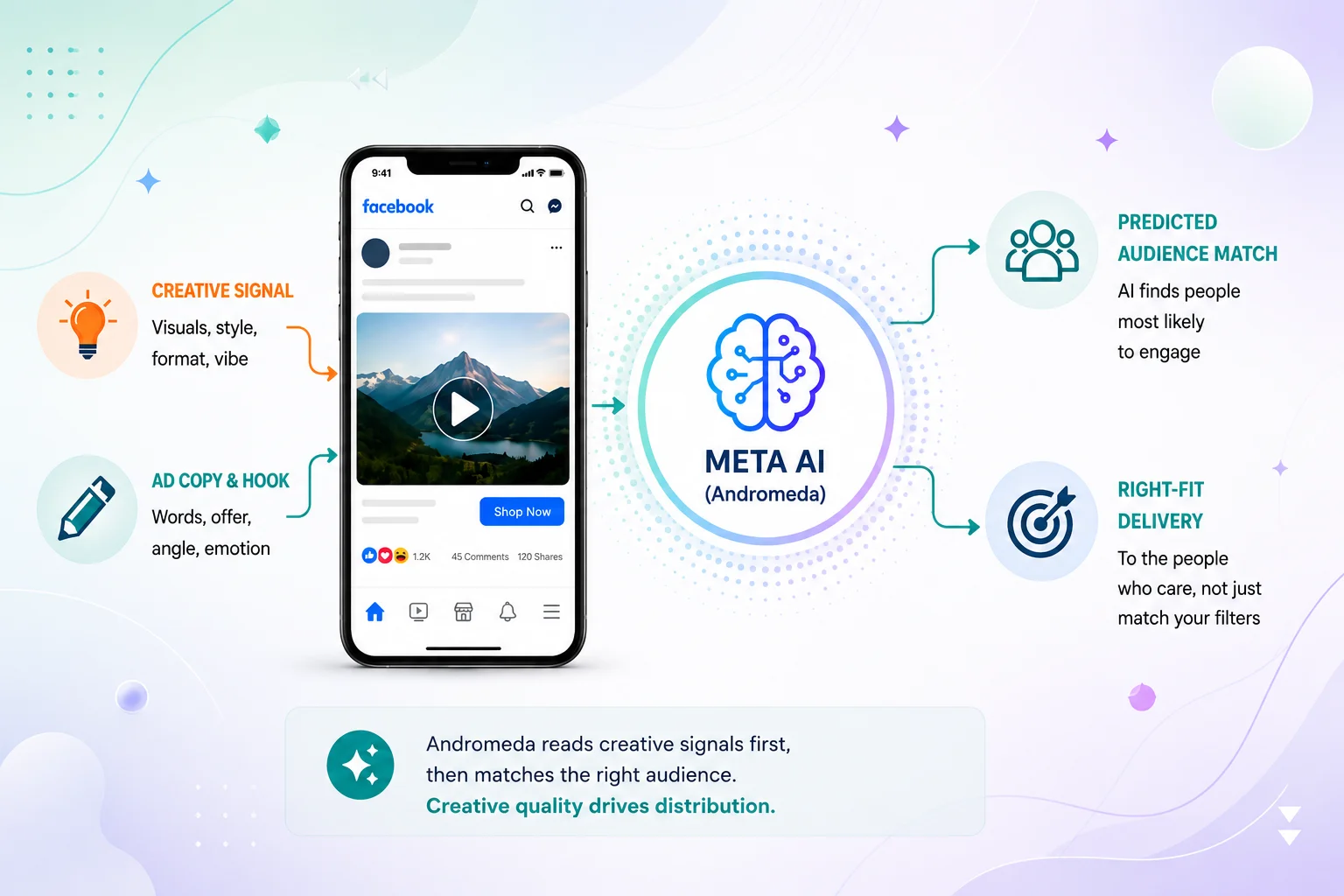
Meta rebuilt the engine that decides who sees your ads. The system, internally called Andromeda, replaced audience-based delivery with creative-based delivery. Instead of asking “does this user match the interests I selected?”, Meta’s models now ask “does this specific ad its image, video, copy, and format match what this individual is likely to respond to?” Meta’s own engineering team has confirmed the retrieval system now evaluates ad creative directly as part of matching ads to people, alongside the automation already built into Advantage+.
For advertisers, this means the job has moved. You used to be a targeting strategist. Now you need to be a creative and messaging strategist, because the creative is the targeting.
What actually changed in how Meta delivers ads
For close to a decade, Meta ad delivery worked roughly the same way: you defined an audience (interests, demographics, lookalikes, custom lists), and Meta’s algorithm found the best-matching users within that pool and bid for their attention.
Andromeda changes the order of operations. Rather than filtering a pre-defined audience, the system:
- Analyzes the actual content of your ad visuals, video pacing, on-screen text, copy tone, and offer structure using computer vision and language models.
- Builds a real-time prediction of which individual users are likely to engage with that specific creative, based on behavioral signals across the platform.
- Uses your stated interest targeting as a soft signal rather than a hard filter, and can serve your ad outside your defined audience if the creative signals point to a better match.
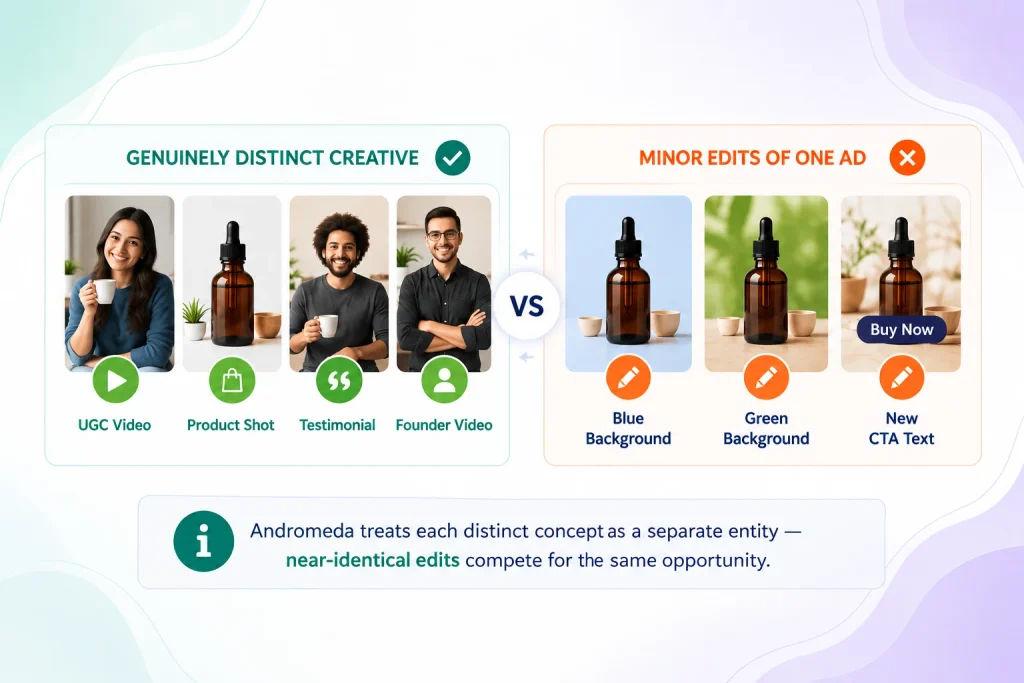
- Groups genuinely different creatives into separate “entities,” giving each distinct concept its own chance to compete in the auction while near-identical variations of the same ad compete for the same limited opportunity.
According to Meta’s engineering blog, advertisers who turned on Advantage+ audience and creative features after not using them previously saw a 22% increase in return on ad spend. That figure comes directly from Meta, not a third-party estimate, which is why it is the one hard number worth anchoring on when you talk to a client or a manager about why the account needs to change.
“Stop trying to out-target the machine. Start out-creating it.” the shift every Meta advertiser is being forced to make in 2026.
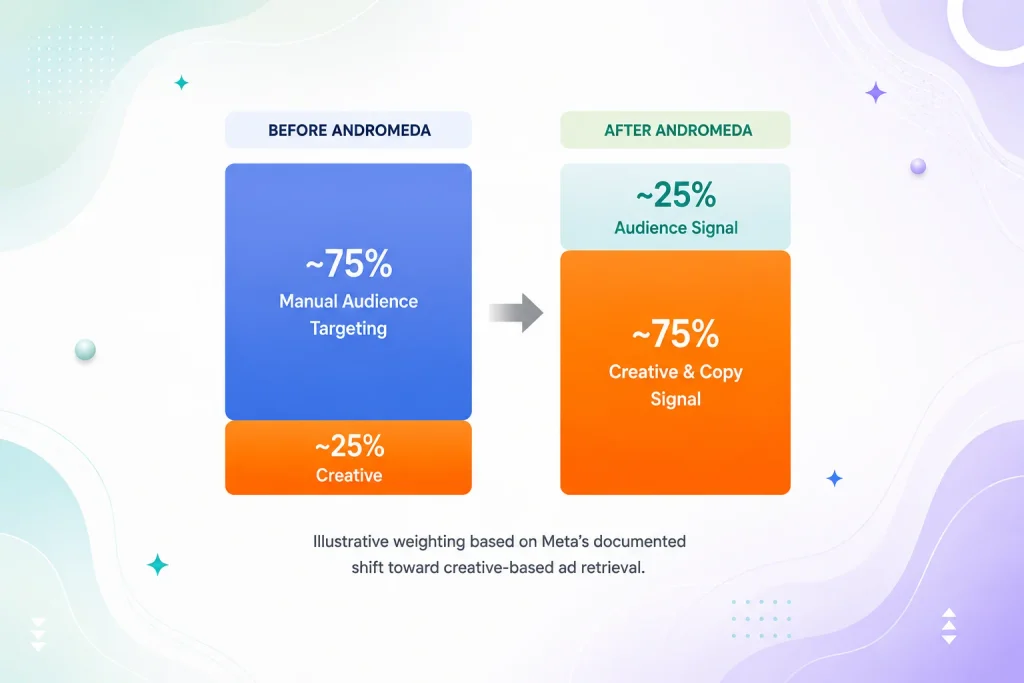
Here is the shift in one table:
Before Andromeda | After Andromeda | |
Primary delivery signal | Advertiser-defined audience | Ad creative and copy content |
Role of interest targeting | Hard filter | Soft, overridable signal |
Where strategy time goes | Audience layering, exclusions, lookalikes | Creative concepts, hooks, messaging |
Ideal account structure | Many narrow ad sets | Fewer, broader ad sets with more creative variety |
What “testing” means | Testing audience segments | Testing creative concepts and angles |
Why your targeting settings still matter, just differently
This does not mean audience research is dead. It means the output of that research moved.
You still need to know who you are selling to their pain points, their buying triggers, the objections that stop them from converting. What changed is where that knowledge gets applied.
- Before: you translated audience insight into interest layers, exclusions, and lookalike seeds inside Ads Manager.
- Now: you translate that same insight directly into the ad itself the hook in the first three seconds, the language in the primary text, the pain point shown in the thumbnail, the offer framing.
Meta’s delivery system still uses broad signals like location, language, and platform-level behavior to decide where an ad is even eligible to run. But within an eligible pool, creative relevance has become the primary lever that determines who actually sees your ad and how much you pay for that placement. Meta’s own Advantage+ documentation describes this suite of tools as using AI to optimize campaigns in real time and match ads to the people most likely to take action audience settings included, but no longer as the sole input.
Why creative volume and variety now drive performance
If creative is doing the work that targeting used to do, the practical implication is straightforward: you need more distinct creative, tested more often, than most accounts are used to producing.
A few things to get right here:
- Distinct concepts, not just distinct edits. A new background color or a swapped call-to-action button is a minor iteration, not a new concept. Andromeda rewards genuine variation different formats (UGC-style video, static product shot, founder-led talking head, testimonial graphic), different angles, and different emotional hooks.
- Enough creatives per ad set to give the algorithm real options. Two or three ads in an ad set gives Meta’s models very little to work with. A wider, well-organized set of creatives gives the system more entities to test against different micro-audiences.
- A steady replacement cadence. Creative fatigue is real. A concept that performed well a month ago can quietly decay as frequency climbs and the same users see it repeatedly. Treat creative refresh as an ongoing production line, not a one-time campaign asset.
- Copy that does more of the targeting work. Headlines and primary text are no longer just supporting the visual they are a direct signal the system reads to understand who the ad is for. Specific, benefit-led copy that speaks to one clear audience outperforms generic, broad copy that tries to speak to everyone. If your in-house team is stretched thin on production, our creative services team can help build out a variety pipeline without slowing your campaign calendar down.
None of this means spend more on production for its own sake. It means the return on a well-briefed, audience-informed creative process is now higher than the return on manual audience configuration.
Where to find creative inspiration without starting from zero
Teams running lean often stall here not because they lack strategy, but because they run out of fresh concepts. Two dependable, low-cost sources:
- The Meta Ad Library. It is free, public, and shows you every ad a competitor or comparable brand is currently running, how long each version has been live, and how often they are iterating. Consistent activity in the library is a signal of what is likely still working for them. Meta’s own Ad Library transparency tools page explains what data is available for standard commercial ads versus political and social-issue ads.
- Your own customer reviews and support conversations. Real language your customers use to describe why they bought from you is often more persuasive than anything a copywriter would invent from scratch. Turning a five-star review into a testimonial-style ad is a fast, authentic way to generate new creative variation.
A simple framework for judging what is working
Volume and variety only help if you evaluate results properly. A useful discipline:
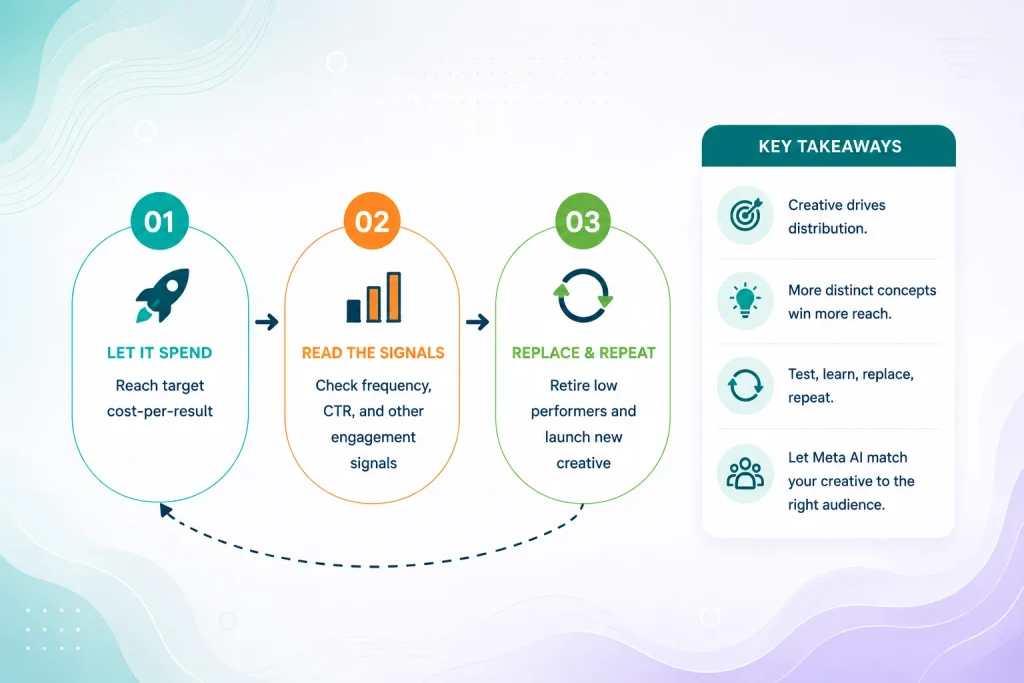
- Let an ad spend before judging it. Cutting a new creative after a few dollars of spend does not give the delivery system enough signal to show what it is capable of. A common rule of thumb is to let an ad reach roughly your target cost-per-result before deciding to kill or scale it.
- Retire low performers deliberately, and replace what you cut. Turning off an underperforming ad without adding a new one shrinks the pool the algorithm has to work with and can quietly reduce overall account performance.
- Watch frequency as an early warning signal. Climbing frequency alongside a shrinking click-through rate over the same audience window usually means it is time to introduce new creative, not push more budget behind the same ad.
- Read the whole picture, not one metric. Cost-per-result matters, but check it alongside frequency trends and engagement quality before making a scaling or cutting decision.
What this means for how you should run your Meta account
- Spend more of your planning time on creative briefs and messaging angles, and less time layering audience segments that the algorithm increasingly overrides.
- Consolidate overlapping ad sets. Splitting the same audience across multiple ad sets to test small targeting differences fragments the data Meta’s models need to learn efficiently.
- Treat your product feedback, reviews, and customer conversations as a creative input, not just a customer service function.
- Build a repeatable production and testing cadence for creative, rather than treating it as a campaign-launch task you revisit occasionally.
- Keep your conversion tracking (Meta Pixel and Conversions API running together) clean and complete, since the system still needs accurate outcome data to know which creative-to-user matches are actually working. See Meta’s guidance on Advantage+ audience for how audience signals are still used alongside creative data.
If you want a structured breakdown of how this same shift affects lead generation specifically, including cost-per-lead and lead quality, our guide on Meta lead generation ads optimization walks through it in more depth.
Conclusion
The core takeaway is simple, even if the shift itself has been disruptive: Meta’s AI now reads your ad before it reads your targeting settings. Audience strategy has not disappeared, but its output moved from the campaign-settings panel into the creative itself. Accounts that keep investing heavily in granular manual targeting while treating creative as an afterthought are working against the direction the platform has moved. Accounts that treat creative and copy as their primary lever tested often, varied genuinely, and grounded in real audience insight are the ones seeing the algorithm work in their favor.
If your account still feels like it is fighting the platform instead of working with it, that is usually a structural and creative issue rather than a budget issue. Our team at OLBUZ manages Meta Ads campaigns for businesses navigating exactly this shift. You can also start with a PPC audit to see where your current account structure is working against Meta’s AI rather than with it, or get in touch to talk through your account directly.
FAQs
No. You can still set location, age, gender, language, and interest signals. What changed is how much weight Meta’s delivery system gives those settings. They now function as a starting signal rather than a strict filter, and the system can look beyond them when creative signals point to a better match.
There is no single universal number, since it depends on budget and account maturity, but the consistent guidance from Meta’s own automation tools and experienced media buyers is to move away from two or three near-identical ads and toward a genuinely varied set of concepts, refreshed on a regular cadence rather than left static for months.
No, audience research is arguably more important now, not less. The difference is where that knowledge gets used. Instead of building it into targeting settings, you build it directly into the creative concept, the hook, and the copy.
Not inherently, but disclosure matters. Meta has expanded its AI-content transparency system, and per Meta’s Business Help Center guidance on the Ad Library, ads containing certain AI-generated elements are labeled accordingly. For businesses that rely on customer trust, it is worth deciding internally how and when you use AI-assisted creative before the platform’s labeling decides it for you.
Start by auditing your current ad sets for duplication and creative volume. Consolidate overlapping ad sets, retire creative that has been running unchanged for months, and rebuild your production process around a steady stream of genuinely distinct concepts informed by real customer language. A professional account audit is often the fastest way to see exactly where the structure is holding performance back.
Harsh Suvagiya

As a Jr. PPC Executive, I create and optimize Meta Ads campaigns that drive quality leads and measurable results.

Contact Form Popup
Boost Your Business Now
This will close in 0 seconds
apply now popup
Apply Now
This will close in 0 seconds
Get free audit popup
Get Free Google Ads Account Audit Worth $999
This will close in 0 seconds
Contact page Form Popup
Contact Us
This will close in 0 seconds