
According to Shopify’s Global Ecommerce Sales Report, global ecommerce will reach $6.88 trillion in 2026, growing 7.2% year over year and now accounting for 21.1% of all retail sales worldwide. The brands capturing a disproportionate share of that growth are not the ones spending more. They are the ones adapting faster to how consumers shop, discover, and buy in 2026.
Tracking the right ecommerce marketing trends 2026 is no longer optional – it is the difference between compounding revenue and falling behind. Three forces are reshaping digital marketing trends for ecommerce right now: AI is transforming every stage of the purchase funnel, mobile has reached functional dominance as the default shopping surface, and social platforms have become genuine commerce channels rather than just awareness tools. The top ecommerce trends below are not predictions – they are already driving measurable revenue for the brands implementing them.
At Olbuz, we work with 50+ ecommerce clients across the USA, UK, India, and Australia. This guide draws on both that real campaign experience and verified 2026 data. For a practical implementation guide alongside these trends, see our ecommerce marketing strategies guide.
2026 Ecommerce Marketing: Key Numbers at a Glance
| Trend | Key Stat | Source |
| AI Personalization | Companies using AI earn 40% more revenue than non-AI peers | McKinsey |
| Social Commerce | US social commerce will exceed $100B in 2026 | Shopify |
| SMS Marketing | 98% open rate, $71 ROI per $1 spent | Omnisend Research |
| Mobile Commerce | 78% of retail website visits come from smartphones | Capital ones hopping |
| Cart Abandonment | 70 to 78% average abandonment rate globally | Baymard Institute |
| Global Ecommerce | $6.88 trillion market size in 2026, 21.1% of all retail | Shopify |
| Video Marketing | Short-form video delivers highest ROI – 49% of marketers confirm | HubSpot State of Marketing 2024 |
| Email Automation | Automations = 2% of sends but 37% of revenue | Omnisend Email Marketing Stats |
Top 10 Ecommerce Marketing Trends for 2026
1. AI-Driven Personalization – From Optional to Essential
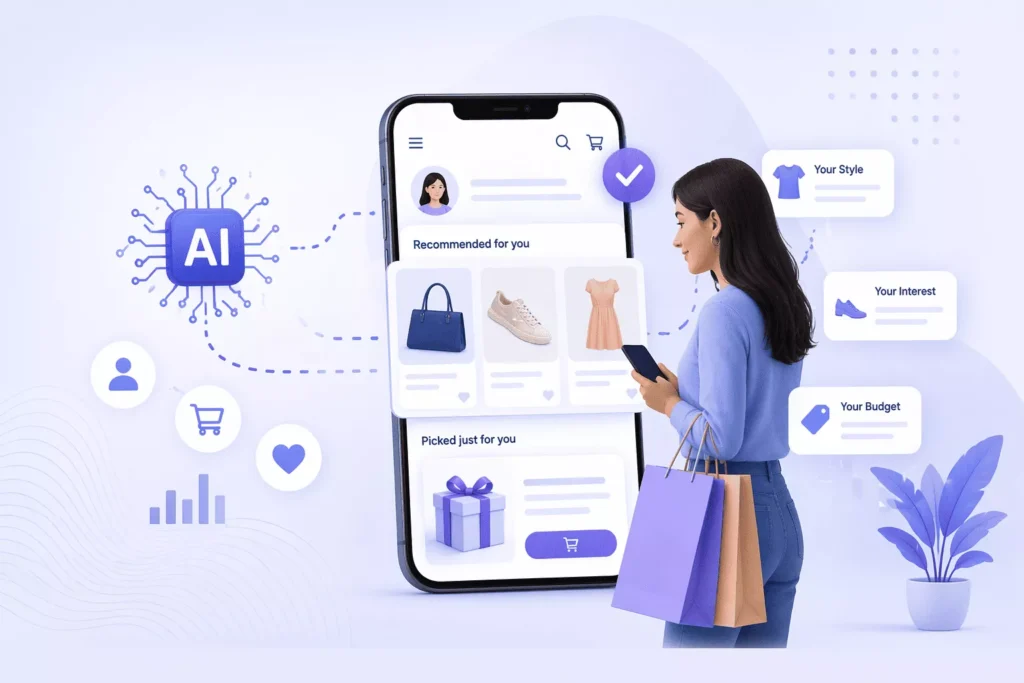
According to Twilio Research research 92% of companies now use AI-driven personalization to drive growth. The financial case is equally clear. According to McKinsey research, companies using AI personalization earn 40% more revenue than slower-growing peers, and AI-driven personalization increases revenue by 10 to 15% on average for retailers that implement it.
AI personalization in 2026 goes far beyond “customers who bought X also bought Y.” It now covers:
- Real-time product recommendations based on live browsing behavior
- Predictive search that surfaces intent before a query is complete
- Dynamic pricing that adjusts to individual customer segments
- Personalized email and SMS sequences that trigger on behavioral signals rather than time intervals
According to HubSpot’s research, personalized CTAs convert 202% better than generic ones. Product recommendations drive up to 31% of ecommerce revenue in sessions where customers engage with them, per Salesforce Commerce Cloud data. For brands not yet using AI personalization, this gap compounds every quarter.
2. Social Commerce and Live Shopping – $100 Billion and Growing
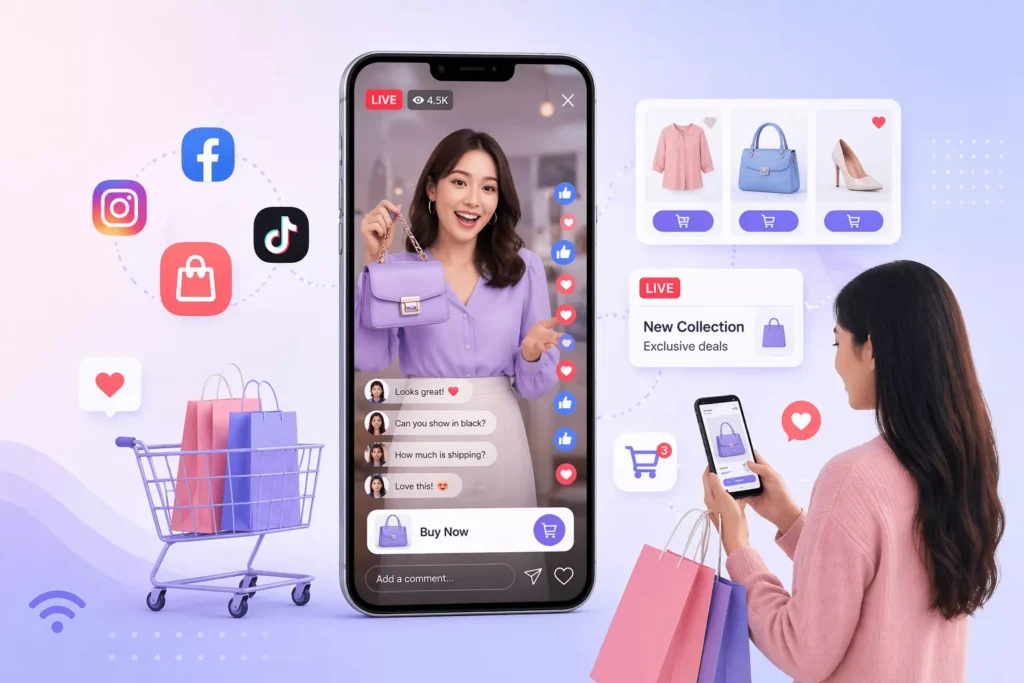
US social commerce will surpass $100 billion in 2026, according to Shopify’s Global Ecommerce Report, with TikTok Shop alone driving nearly 20% of it. Platform conversion rates in 2026 tell the full story: TikTok Shop converts at 4.7%, Instagram Shopping at 2.1%, and Facebook Shops at 1.8%.
Social platforms are no longer just awareness channels – they are full commerce infrastructure.
A note on TikTok Shop: Following a January 2026 ownership restructuring where Oracle, Silver Lake, and MGX acquired a 45% stake in TikTok’s US entity, the platform remains operational. US brands should maintain a diversified social commerce strategy across Instagram, Facebook, and TikTok rather than depending on any single platform.
Live shopping is growing in the US but behaves very differently from markets like China. According to HubSpot’s State of Marketing, US livestream ecommerce sales grew nearly 50% in 2025 to $14.64 billion – but only 21.7% of US digital buyers have purchased via livestream so far. What is actually driving TikTok Shop revenue is short, pre-recorded creator content, not live events. Creator-driven short videos account for two-thirds of TikTok Shop revenue, while livestreaming’s share has been declining since mid-2024.
The practical takeaway for US brands: invest in short-form shoppable video first. Use live events as a secondary format for product launches and limited drops where real-time urgency genuinely adds value.
For ecommerce brands building their Instagram commerce strategy, our Instagram ecommerce guide covers shoppable Reels, product tagging, and external website checkout setup in detail.
3. SMS Marketing – The Highest-ROI Channel Most Brands Underuse
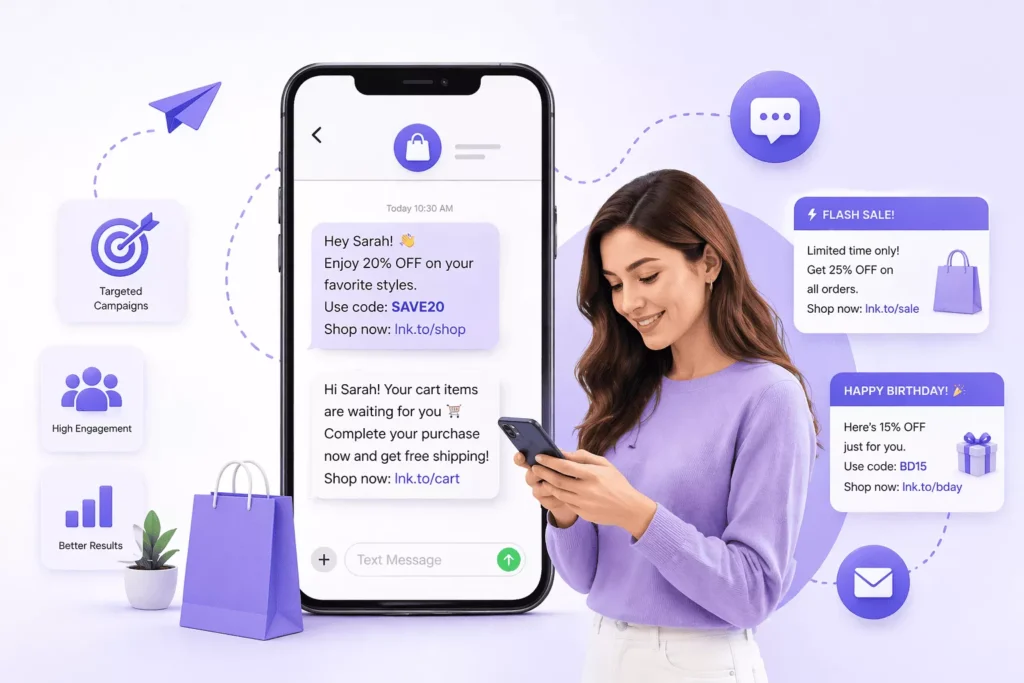
SMS has crossed from experimental to essential. According to Omnisend’s SMS marketing research, businesses earn $71 for every $1 spent on SMS marketing on average, with a 98% open rate and 82% of messages read within 5 minutes. Compare this to email’s average open rate of 28.6% and the channel advantage becomes clear.
The highest-performing SMS use cases for ecommerce in 2026, per Omnisend’s automation data:
- Abandoned cart recovery – converting at 24 to 39%
- Post-purchase follow-up sequences – generating 14 to 33% conversion on upsells
The key shift is treating SMS as a sales channel rather than a notification channel. Automated SMS flows generate up to 30x more revenue per recipient than one-off broadcasts, according to Omnisend data.
4. Mobile-First Commerce – 78% of Traffic, Still Losing at Checkout
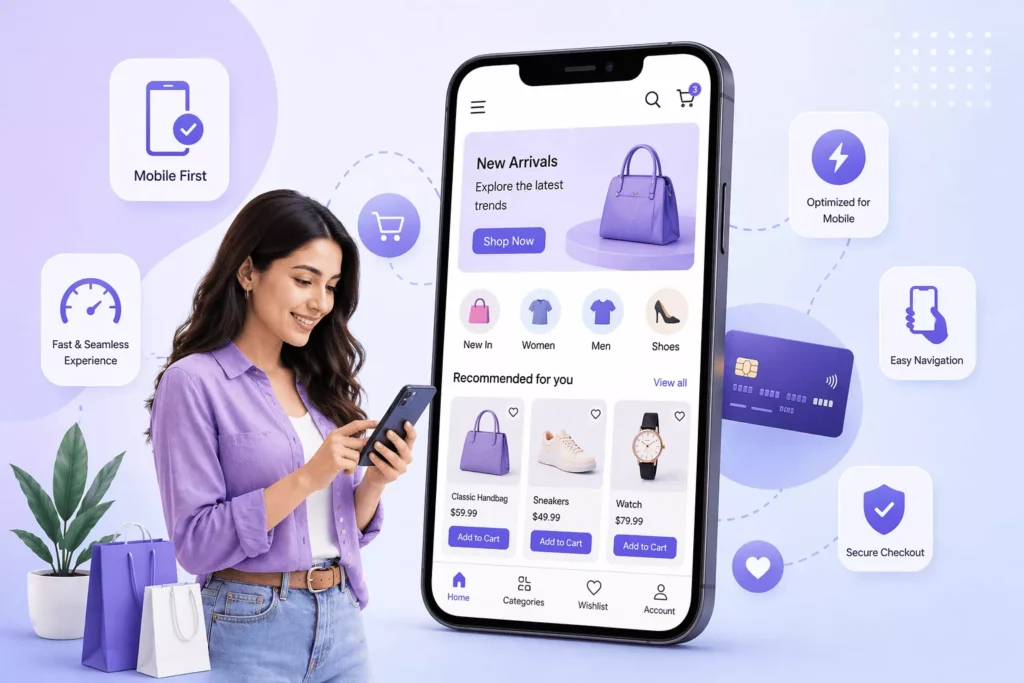
Mobile devices drive 78% of retail website visits and 75% of ecommerce traffic in 2026, per Shopify’s Commerce Report. Yet mobile cart abandonment reaches 85%, per Baymard Institute’s device-level research – 10 to 15 percentage points higher than desktop – because most ecommerce checkout experiences are still not built for how people actually use their phones.
The mobile-first ecommerce trends driving results in 2026:
- One-tap checkout with stored payment methods
- Behavior-triggered push notifications for abandoned carts and price drops
- AI personalization that closes the conversion gap between mobile and desktop
Practical checklist:
- Optimize checkout to one page – unexpected costs are the number one abandonment reason at 48%, per Baymard Institute
- Deploy push notifications for back-in-stock and price drop alerts
- Ensure product images, CTAs, and filters are thumb-friendly on 375px viewports
- Hit Core Web Vitals targets: LCP under 2.5s on mobile is a direct ranking and conversion factor
5. Cart Abandonment Recovery – $260 Billion Left on the Table
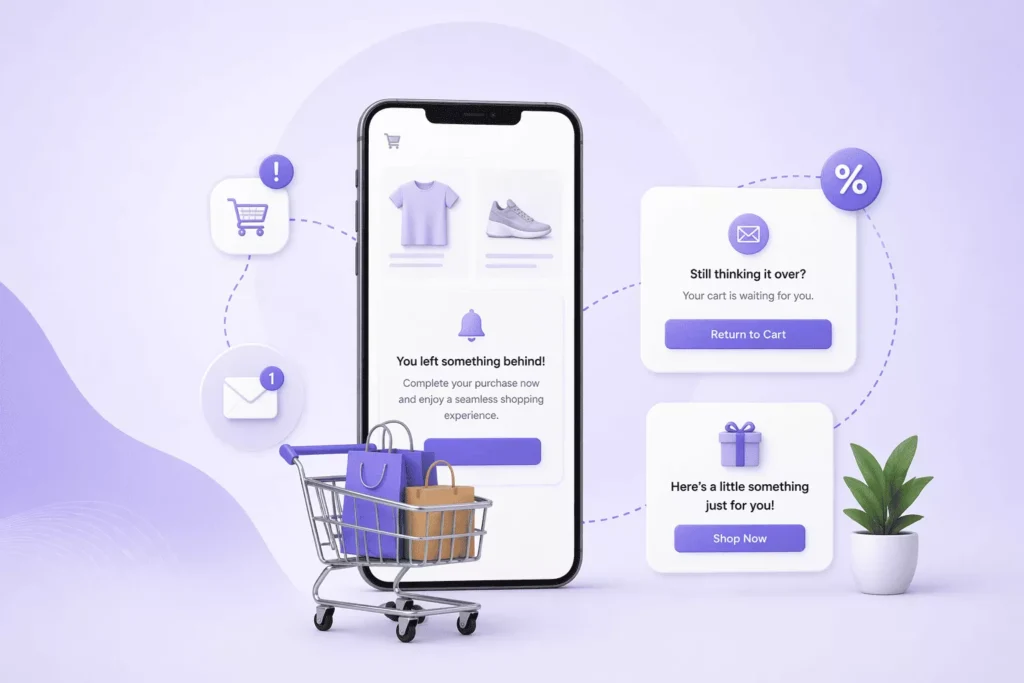
The average cart abandonment rate in 2026 is 70 to 78% globally, according to Baymard Institute, representing an estimated $260 billion in recoverable revenue in the US alone. Unexpected shipping costs remain the number one reason at 48%, followed by forced account creation and a complicated checkout process.
Brands using multi-channel recovery – combining SMS and email – significantly outperform single-channel approaches. The optimal sequence:
- SMS reminder within 1 hour of abandonment
- Email at 24 hours
- Final SMS with a time-limited offer at 72 hours
SMS alone recovers 10 to 15% of abandoned carts. Email recovers 3 to 5%. Together, the recovery rate climbs toward 20%.
AI-powered abandonment recovery – including personalized retargeting, dynamic pricing adjustments, and predictive exit-intent detection – recovers 15 to 20% of abandoned carts, compared to 3 to 5% for static email-only approaches.
For ecommerce brands running Meta retargeting campaigns, our Facebook and Instagram ads guide for ecommerce covers dynamic product ads for retargeting in detail.
6. Short-Form Video and Reels – The Top ROI Content Format
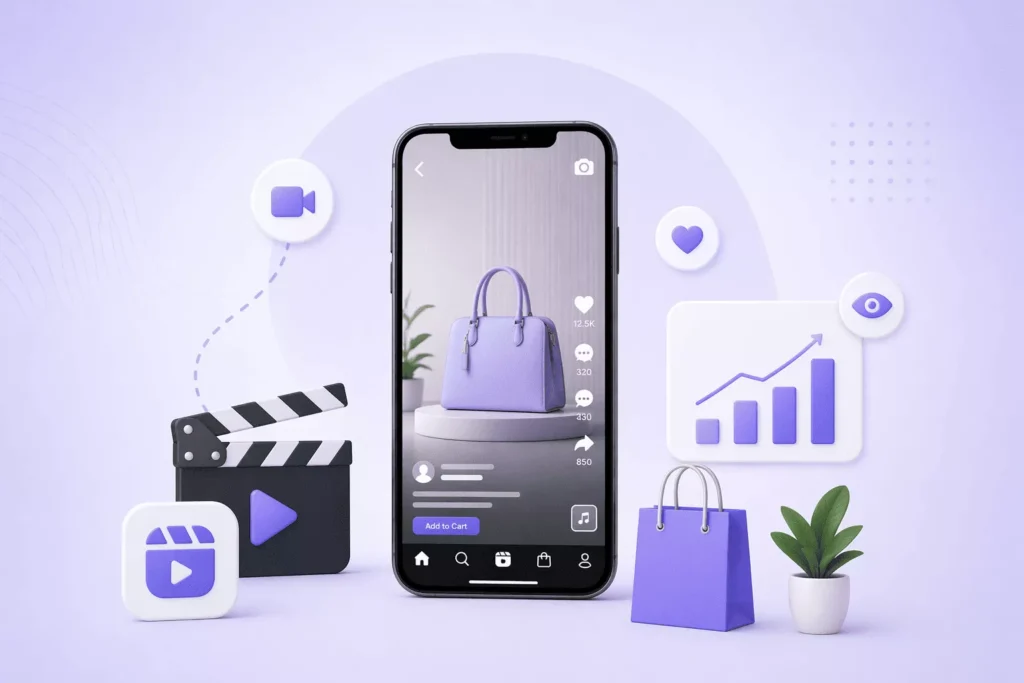
Short-form video delivers the highest marketing ROI of any content format in 2026, with 49% of marketers citing it as their top-performing format according to HubSpot’s State of Marketing report. Long-form video (29%) and live-streaming (25%) round out the top three.
For ecommerce specifically, Reels with product tags drive discovery-to-purchase in a single content interaction. According to HubSpot’s Social Media Marketing Report, Reels consistently deliver 2x higher visibility than other post types and dominate reach across all Instagram formats. Only 20.7% of creators post Reels monthly – making consistent Reels publishing a significant competitive advantage for brands that commit to it.
Video content works at every funnel stage:
- Top of funnel: Product demonstrations and unboxing content
- Middle of funnel: Customer transformation stories and UGC content
- Bottom of funnel: Time-limited offers and live drops
Brands that maintain a consistent Reels posting schedule – three to five per week – see compounding algorithmic reach growth that standalone posts cannot replicate.
7. Email Marketing Automation – 2% of Sends, 37% of Revenue
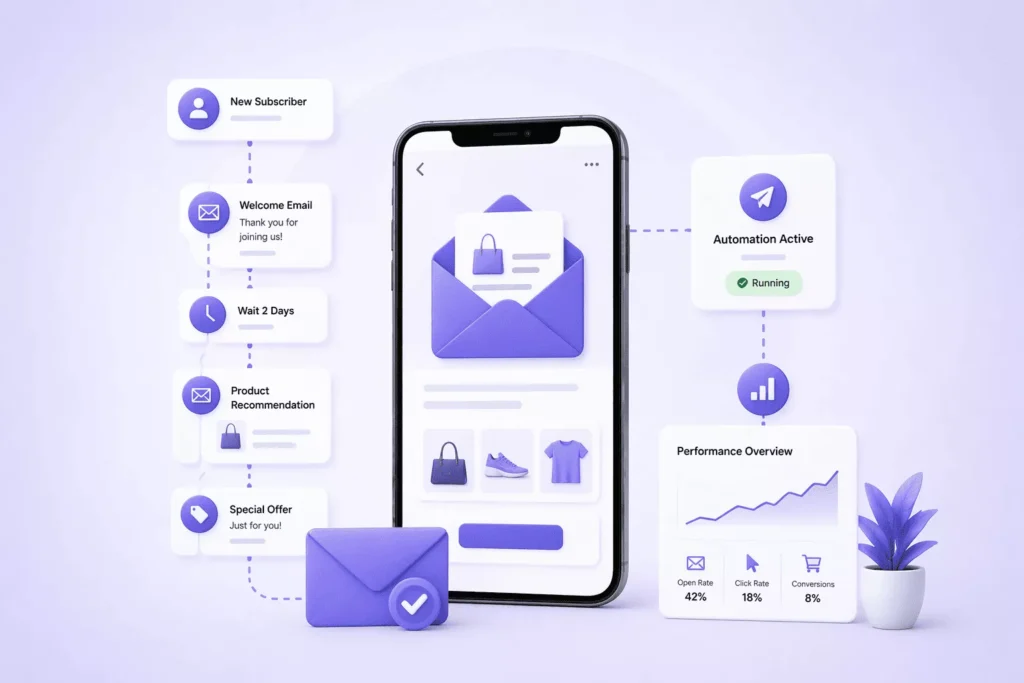
Email marketing returns $42 for every $1 spent and remains the top ROI channel for B2C ecommerce brands, according to Omnisend’s 2026 email ROI benchmarks. The distribution of that return is highly uneven: automated flows represent just 2% of total email sends but generate 37% of total email revenue, per Omnisend’s 2024 data. Abandoned cart and welcome series alone account for 76% of all automation-generated orders.
The key ecommerce email automations every brand needs running in 2026:
- Welcome series – 3 to 5 emails introducing brand, products, and first-purchase incentive
- Abandoned cart sequence – email at 1 hour, 24 hours, and 72 hours
- Post-purchase flow – order confirmation, shipping update, review request, cross-sell
- Win-back campaign – for lapsed customers at 60 and 90 days
According to HubSpot’s Email Marketing research, personalized emails are 6x more likely to drive conversions than generic campaigns.
Key actions:
- Build your email list actively as a core revenue priority
- Segment by purchase history, browse behavior, and customer lifetime value
- Combine email and SMS: send email for initial outreach, SMS for cart recovery follow-up
8. Omnichannel Marketing – More Channels, More Revenue
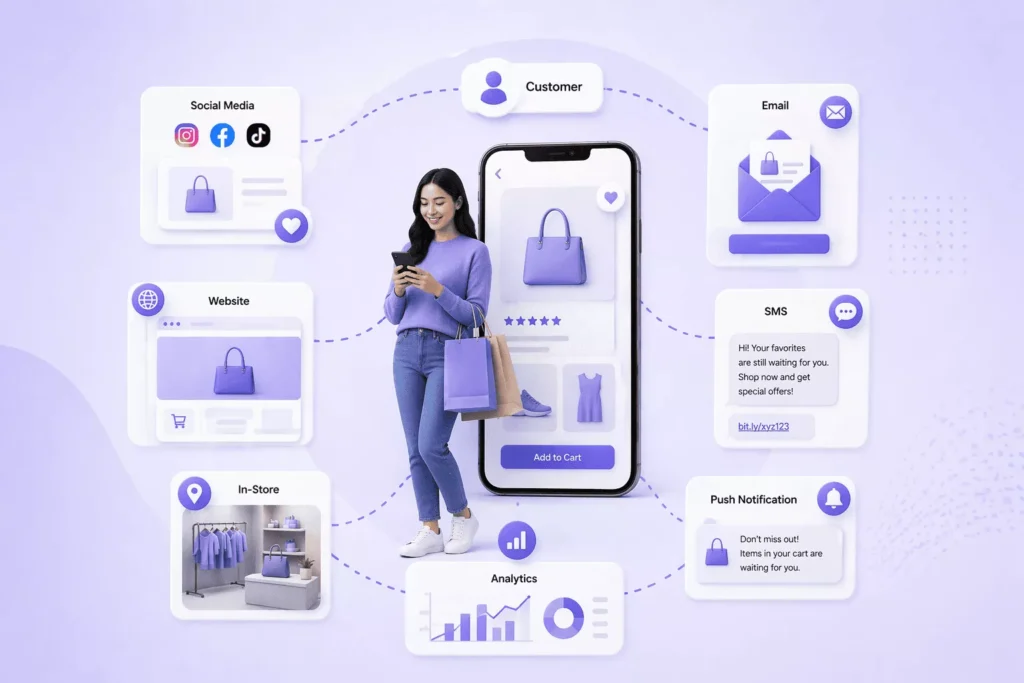
According to Omnisend’s omnichannel marketing data, omnichannel campaigns deliver a 287% higher purchase rate than single-channel campaigns. Multi-channel personalization combining 4 or more channels drives significantly more sessions and purchases compared to single-channel approaches.
The modern ecommerce customer path is not linear. A shopper might discover a product on Instagram, research it on Google, add to cart on mobile, and complete checkout on desktop three days later after receiving an abandoned cart email. Brands that track and optimize across this full journey consistently outperform those optimizing each channel in isolation.
The practical omnichannel stack for ecommerce brands in 2026:
- Google Shopping and Search – high-intent discovery
- Meta Ads – product discovery and retargeting
- Instagram and TikTok – social commerce and organic reach
- Email automation – lifecycle marketing
- SMS – high-urgency recovery and reorder triggers
For ecommerce brands building their Meta ads strategy, our Facebook and Instagram ads guide covers funnel-based campaign structures and attribution setup.
9. Sustainability and Transparent Commerce – 78% of Shoppers Demand It
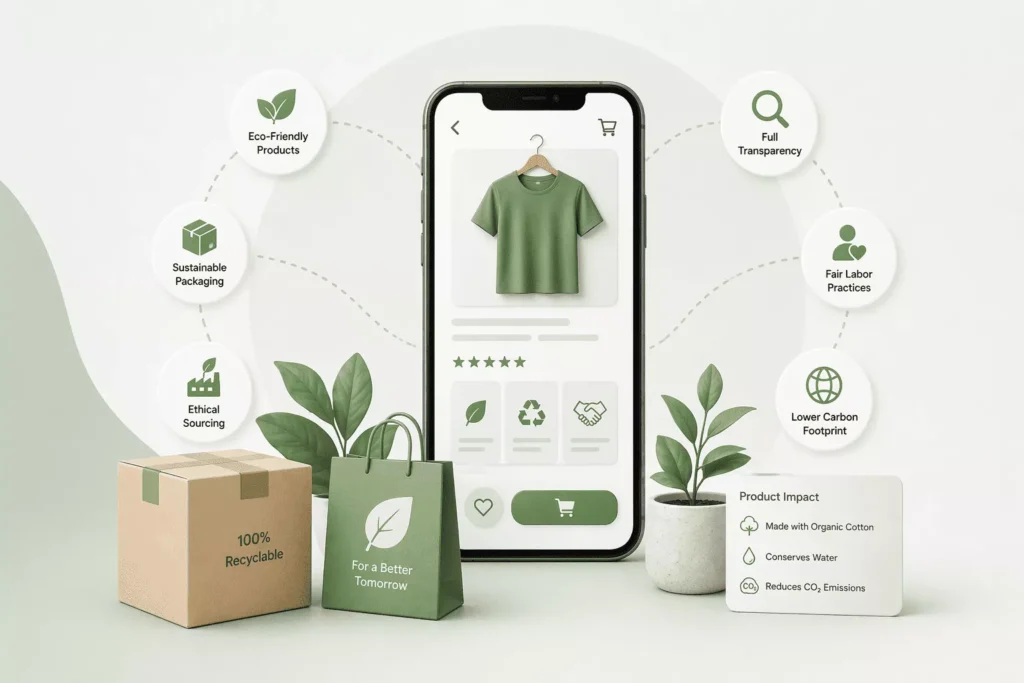
Sustainability has moved from brand differentiator to baseline customer requirement. According to Salesforce research, 78% of shoppers want to buy from environmentally friendly companies. For ecommerce brands ignoring this, the cost is not just reputation – it is conversion rate.
The brands winning on sustainability in 2026 are proving it, not just claiming it:
- Showing product origin and supply chain data on product pages
- Offering carbon-neutral delivery as a checkout option
- Building resale or trade-in programs that create circular revenue streams
- Using packaging that visibly signals environmental responsibility
Customers who engage with sustainability features show 33% higher customer lifetime value than those who do not.
10. Agentic AI and Predictive Commerce – The Next Revenue Frontier
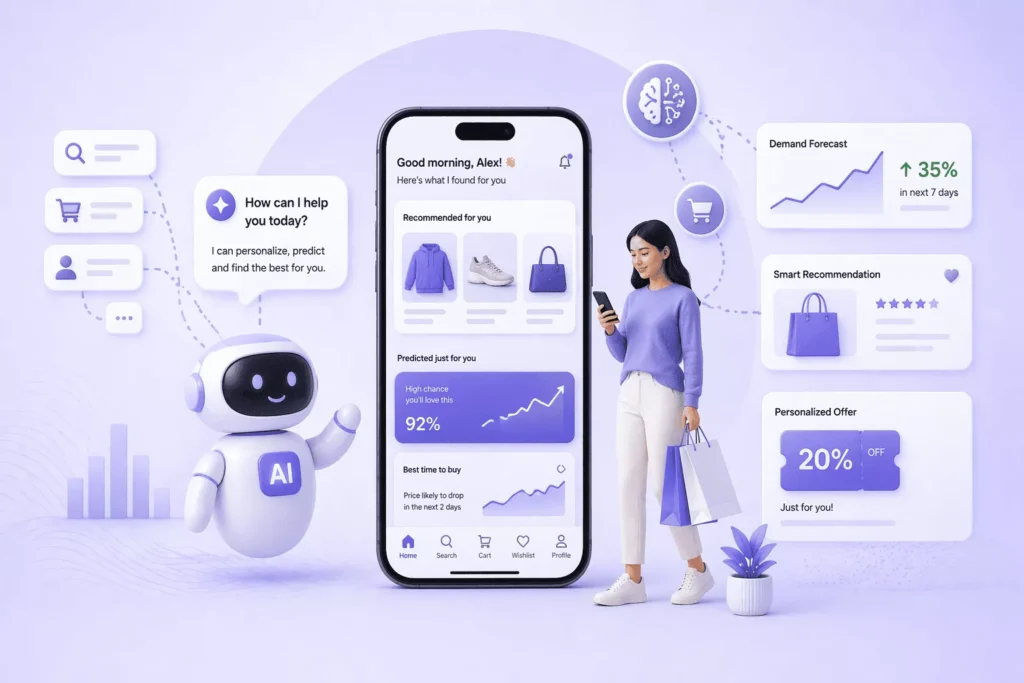
Agentic AI represents the next phase of ecommerce automation: AI that does not just recommend, but acts. According to McKinsey, agentic AI could mediate up to $1 trillion in US retail revenue by 2030. Gartner projects that 60% of brands will use agentic AI to deliver one-to-one customer interactions by 2028.
In practice, agentic AI for ecommerce in 2026 looks like:
- AI assistants that handle repeat purchases automatically based on consumption patterns
- Predictive reorder systems that surface the right product before the customer realizes they need it
- AI-powered customer support that resolves up to 75% of routine inquiries without human intervention, per Zendesk’s AI in Customer Service report
- Dynamic pricing engines that adjust in real-time based on demand, inventory, and customer segment
According to industry research, around 84% of ecommerce businesses are integrating or prioritizing AI initiatives, and early adopters are increasingly seeing competitive and revenue advantages over slower adopters.
Ecommerce Marketing Trends for US Brands in 2026
The USA remains the world’s most competitive and highest-value ecommerce market. Here is what matters most for US-focused brands:
- Social commerce: US social commerce exceeds $100B. TikTok Shop drives $15.82B in US sales alone – Shopify Global Ecommerce Report
- Mobile: 78% of US adults report buying products on mobile. Mobile-first checkout is non-negotiable
- SMS: 84% of US consumers have opted in to receive SMS from at least one brand. $71 average ROI per $1 spent – Omnisend
- AI personalization: Fast-growing US brands derive 40% more revenue from personalization than slower peers – McKinsey
- Cart abandonment: $260 billion in recoverable revenue – Baymard Institute. AI-powered recovery is the highest-ROI fix
- AI search commerce: 14% of ecommerce traffic now originates from AI-powered interfaces and assistants – an entirely new acquisition channel that did not exist 18 months ago
The US market also shows the widest AI adoption gap: brands deploying AI personalization are pulling away from competitors who are not, with the gap widening each quarter.
Conclusion
Ecommerce marketing in 2026 rewards brands that move with data, not instinct. The $6.88 trillion global market is growing – but the distribution of that growth is increasingly concentrated among brands that have adopted AI personalization, built omnichannel recovery flows, and treated mobile as the primary commerce surface.
These ecommerce strategies 2026 are not future-facing experiments – they are the operating standard for brands already pulling ahead. The highest-ROI ecommerce advertising trends to act on right now are not complex: build SMS automation for cart recovery, activate AI product recommendations, optimize mobile checkout to remove friction, and create a consistent short-form video presence that drives organic discovery. None of these require enterprise budgets – they require execution.
For ecommerce brands looking to implement these ecommerce trends 2026 with expert support across SEO, Meta Ads, and full-funnel strategy, explore Olbuz’s ecommerce marketing services. Our team manages $500K+ in monthly ecommerce ad spend and has been a Google Premier Partner agency since 2023.
Frequently Asked Questions
AI-driven personalization, social commerce growth, SMS marketing, mobile-first strategy, video content, and cart abandonment recovery are the dominant trends shaping ecommerce in 2026.
AI now powers product recommendations, predictive search, dynamic pricing, and personalized email and SMS campaigns. According to McKinsey, companies using AI personalization earn 40% more revenue than those without it.
Yes. SMS delivers a 98% open rate and returns $71 for every $1 spent on average. Abandoned cart SMS converts at 24 to 39%, significantly outperforming email recovery rates of 3 to 5%.
US social commerce is expected to exceed $100 billion in 2026, per Shopify’s Global Ecommerce Report, with TikTok Shop driving nearly 20% of it. TikTok Shop converts at 4.7%, compared to Instagram Shopping at 2.1%. Note that TikTok completed a US ownership restructuring in January 2026 – brands should run a diversified social commerce strategy across multiple platforms.
Cart abandonment remains the biggest revenue leak, with 70 to 78% of carts abandoned globally according to Baymard Institute. This represents an estimated $260 billion in recoverable revenue in the US alone.
Critical. Mobile devices drive 78% of retail website visits and 75% of ecommerce traffic. Mobile cart abandonment reaches 85%, significantly higher than desktop. Brands that optimize for mobile-first experiences – one-page checkout, stored payment methods, and thumb-friendly UX – see meaningful improvements in conversion and revenue recovery.
Agentic AI is AI that acts on behalf of users – handling repeat purchases, predicting reorders, and managing customer support without human input. McKinsey projects it could mediate up to $1 trillion in US retail revenue by 2030.
According to Omnisend, omnichannel campaigns deliver a 287% higher purchase rate than single-channel campaigns. It ensures your brand is present at every stage of the customer journey – from discovery to recovery – which consistently drives higher conversion and customer lifetime value.
Jignesh Gohel

Jignesh Gohel is a Founder and Digital Marketing head at OLBUZ (Google Premier Partner Agency 2023, 2024 and 2026) and India's leading travel portal TheIndia. With over 18 years of experience in digital marketing Jignesh has helped many large, medium and small businesses to grow multi-fold.
Contact Form Popup
Boost Your Business Now
This will close in 0 seconds
apply now popup
Apply Now
This will close in 0 seconds
Get free audit popup
Get Free Google Ads Account Audit Worth $999
This will close in 0 seconds
Contact page Form Popup
Contact Us
This will close in 0 seconds