
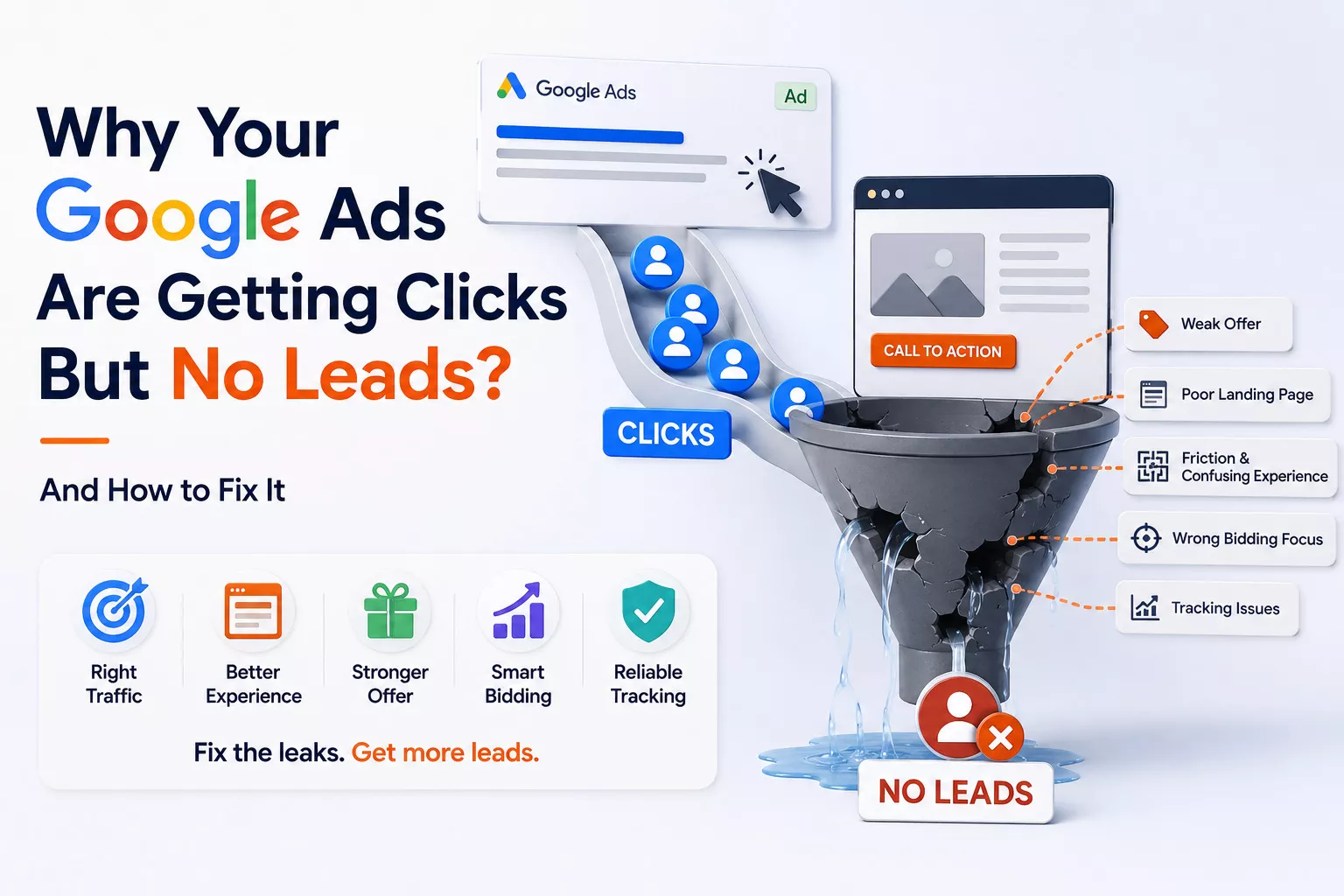
Getting Clicks Doesn’t Always Mean Getting Results
A Google Ads campaign can show a healthy stream of impressions and clicks while your sales team waits for the phone to ring. That does not automatically mean the campaign is failing. It means the useful action is happening somewhere after the click, and that part of the journey needs to be diagnosed.
The mistake is to treat clicks as the finish line. For lead generation, the click is only the handoff from the ad to your website. If tracking is wrong, the search intent is weak, the landing page breaks the promise, or the offer does not create enough confidence, the visitor can disappear before becoming a lead.
The real problem: a broken click-to-lead path
| Stage | What you should see | Warning sign | What to check |
| Search | Relevant people find the ad | Irrelevant queries | Search terms, locations, match behaviour |
| Ad | The promise fits the search | High clicks but weak intent | Message, CTA, offer |
| Landing page | The visitor understands the next step | Fast exits or hesitation | Headline, speed, trust, form |
| Conversion | The intended lead is recorded | Leads exist but Ads shows none | Tags, events, CRM, calls |
This model is more useful than staring at CTR alone. A strong CTR can tell you the ad is attracting attention, but it cannot tell you whether the visitor was the right person or whether the page convinced them to act.
Why Google Ads get clicks but no leads
1. Conversion tracking is missing, broken, or measuring the wrong action
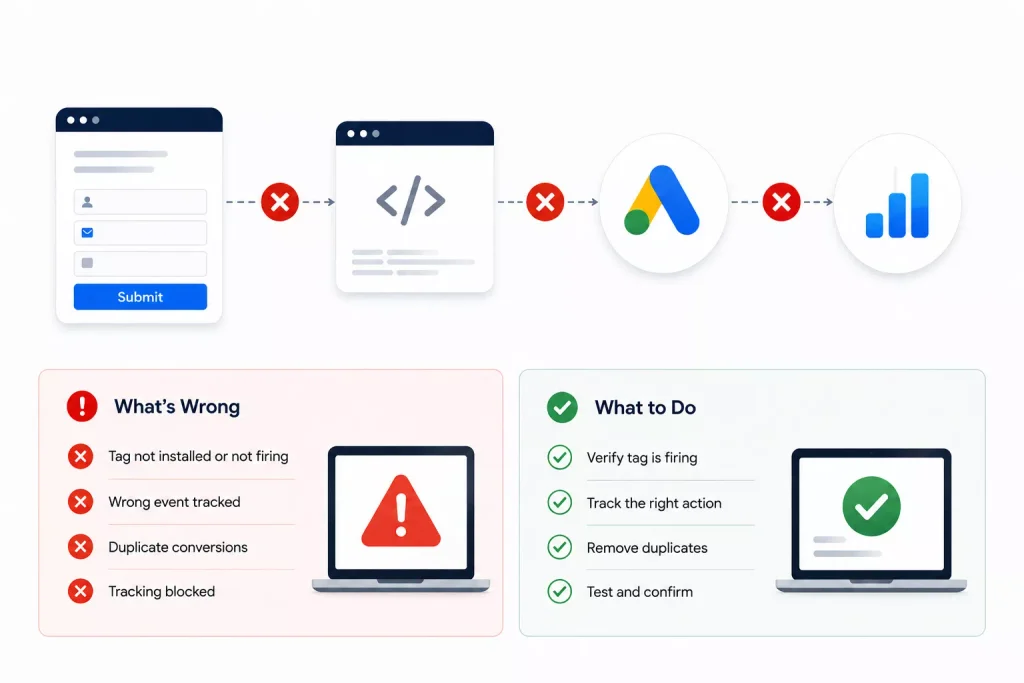
Before changing keywords or ads, prove that the lead is being recorded correctly. A form submission, phone call, booking request, or other business outcome should be mapped to the right conversion action. Also check for duplicate tags, broken triggers, thank-you-page issues, consent-related measurement gaps, and CRM leads that never return to Google Ads.
This matters even more when automated bidding is used. Smart Bidding relies on conversion signals to optimize auctions, so a noisy or incorrect primary conversion can push the campaign toward the wrong outcome.
2. The search intent is weaker than the keyword looks
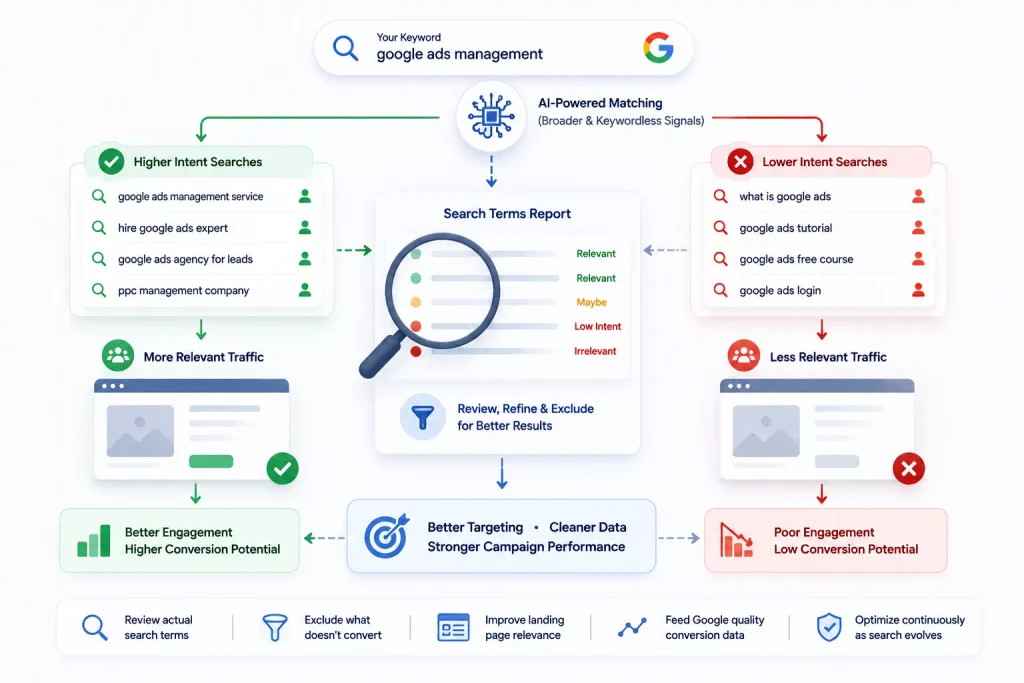
A keyword can be closely related to your service and still attract people who are researching, comparing, learning, looking for free information, or searching outside your service area. The Search terms report is where this becomes visible. Review the actual queries, not only the keywords you added.
In 2026, this check is even more important as Google expands AI-driven matching and search features. AI Max for Search can use broader and keywordless signals, while still providing reporting and controls for understanding how traffic was matched. That makes clean conversion data, strong landing pages, and disciplined exclusions more important, not less.
3. The ad makes a promise the landing page does not continue
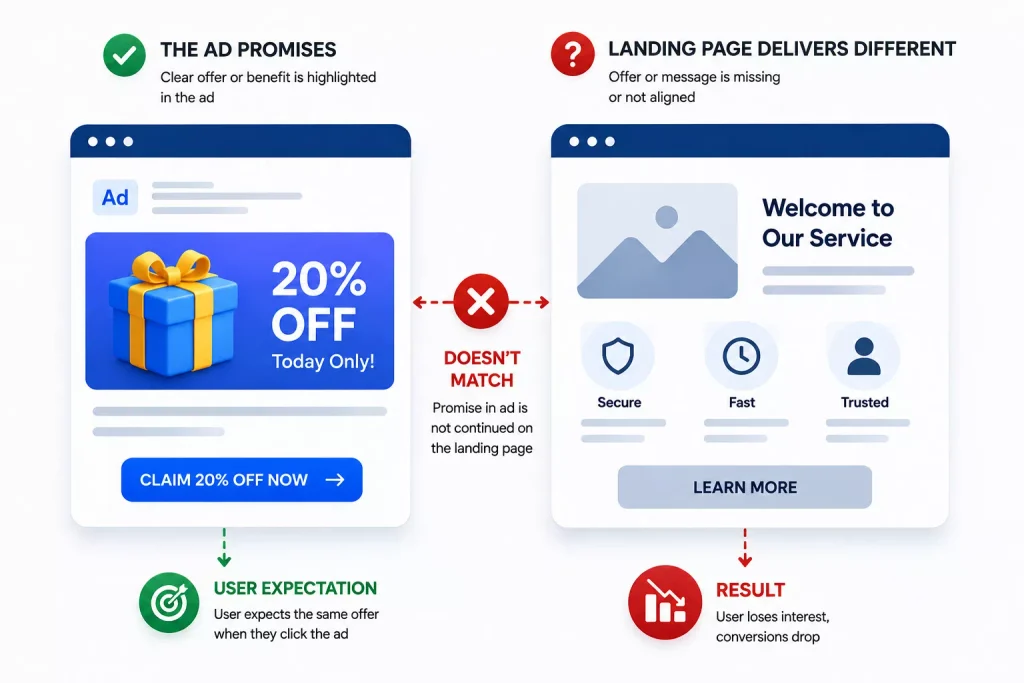
Think of the ad and landing page as one conversation. If the ad says ‘Book a Free Consultation’ but the landing page opens with a generic company introduction and hides the form, the visitor has to work to find what they expected.
Match the search theme, headline, offer, proof, and call to action. A visitor should understand what the page is about and what to do next without hunting through the site.
4. The landing page creates friction
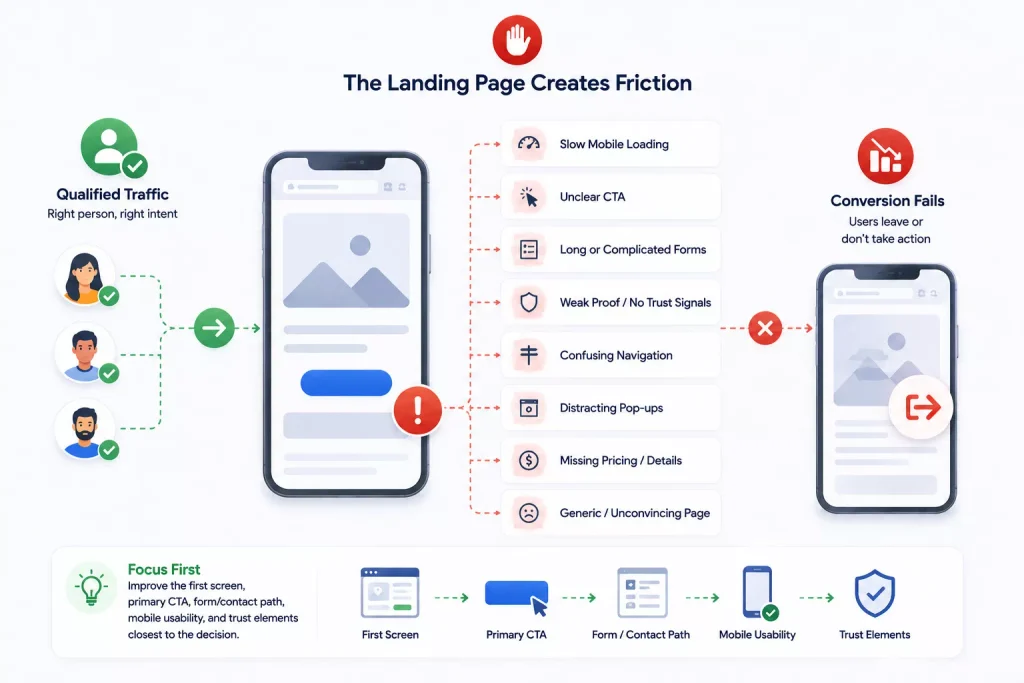
A conversion can fail even when the traffic is qualified. Common blockers include slow mobile loading, unclear calls to action, long forms, weak proof, confusing navigation, distracting pop-ups, missing pricing or service details, and a page that feels generic.
Do not redesign everything at once. Start with the first screen, the primary CTA, the form or contact path, mobile usability, and the trust elements closest to the decision.
5. The offer is not strong enough for the traffic
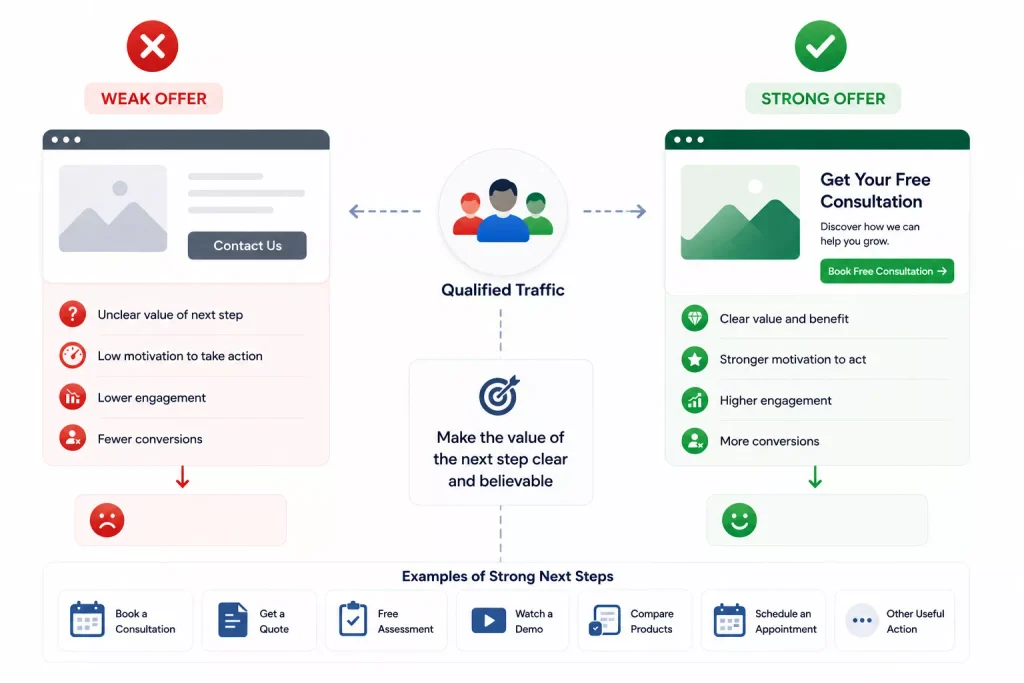
Sometimes the campaign and landing page are technically sound, but the reason to act is weak. ‘Contact us’ is not always a compelling offer. Depending on the business, the next step could be a consultation, quote request, assessment, demo, product comparison, appointment, or another useful action.
The goal is not to manufacture urgency. It is to make the value of the next step clear and believable.
6. Bidding is optimized around the wrong outcome
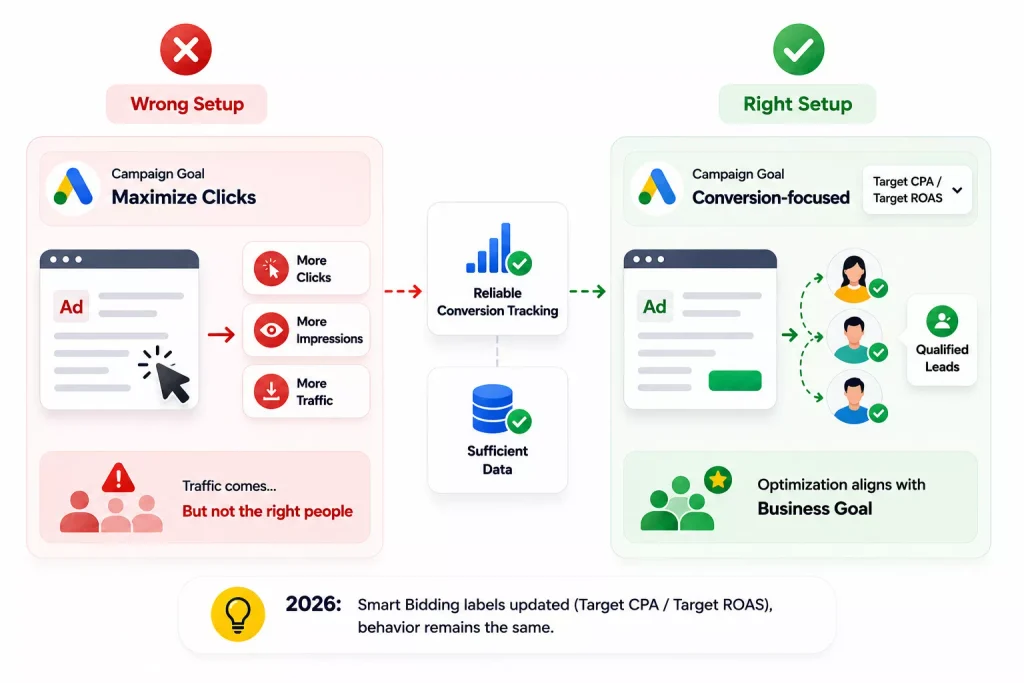
If a campaign is built to maximize clicks while the business needs qualified leads, the platform is being asked to solve the wrong problem. Once conversion tracking is reliable and the account has suitable data, conversion-focused Smart Bidding can align optimization more closely with the business goal.
Google updated Smart Bidding labels in 2026, including the move toward Target CPA and Target ROAS naming. The underlying bidding behaviour did not change because of the label update.
A better troubleshooting order
Do not change five things at once. Use a controlled diagnosis so you can identify the actual leak.
1. Verify the conversion: Test the real form, call, booking, or lead path and confirm the intended conversion action records correctly.
2. Inspect search terms: Classify queries by intent and remove or exclude traffic that cannot become a customer.
3. Check the ad-to-page promise: Make sure the landing page immediately continues the message and CTA from the ad.
4. Review the landing experience: Check mobile speed, above-the-fold clarity, trust, form friction, and the next step.
5. Review targeting: Look at location, device, schedule, audience signals, networks, and other settings that can affect traffic quality.
6. Then review bidding: Only after the signal is clean, decide whether the bidding strategy matches the actual business objective.
A simple diagnostic matrix
| What you observe | Likely area | First action |
| Clicks but no recorded leads | Tracking | Test the conversion path |
| Relevant clicks but weak page engagement | Landing page | Review message match and friction |
| Many irrelevant searches | Intent / targeting | Review search terms and exclusions |
| Leads are recorded but poor quality | Qualification | Inspect query intent, form fields and CRM outcomes |
| Traffic looks good but spend is inefficient | Bidding / structure | Review goals, conversion signals and campaign settings |
What to avoid
Do not rewrite every ad before checking tracking.
Do not judge the campaign only by CTR, clicks, or impressions.
Do not add negatives blindly without understanding the intent behind the query.
Do not send every paid visitor to the homepage when a more relevant page exists.
Do not feed Smart Bidding low-quality or accidental conversion actions.
Do not publish AI-generated copy without adding original insight, examples, evidence, and a human editorial pass.
What is different about Google Ads in 2026?
Automation is becoming a larger part of Search campaign management. Google AI can expand query matching, adapt ad assets, and select more relevant landing pages through features such as AI Max for Search. The practical lesson is not to fight automation with endless manual settings. It is to give the system better inputs: accurate conversion goals, clear business intent, useful landing pages, strong exclusions, and enough control to protect the brand and service area.
Final takeaway
Clicks without leads are not a mystery. They are a diagnostic signal. The right question is not ‘Why is Google Ads not working?’ It is ‘At which stage does the visitor stop moving toward a real business outcome?’
Start with tracking. Then inspect the actual search terms. Then compare the ad promise with the landing page. After that, remove friction, strengthen the offer, and review bidding against the conversion goal. That sequence turns a vague performance problem into a measurable optimization process.
Need help finding the leak in your Google Ads funnel? Explore OLBUZ PPC Audit Services or Google Ads Management Services.
Do not stop at the form submission
A lead is not always the same as a sales opportunity. If your account reports every tiny interaction as a primary conversion, Google may learn from actions that look successful inside the platform but have little value to the business. Connect campaign reporting with what happens after the form or call. Review whether leads are qualified, whether sales teams can contact them, and whether the original search intent matches the customers who eventually buy.
This is also where CRM feedback becomes valuable. A campaign can appear to have a healthy conversion rate while producing weak enquiries. The stronger optimization loop is: search query to ad, ad to landing page, landing page to lead, and lead to qualified opportunity. When those stages are connected, you can optimize toward business quality rather than simply increasing the number of recorded conversions.
Sunil Rawal

As a Jr. PPC Executive, I plan and manage search campaigns that generate quality leads. From audience targeting to bid optimization and reporting, I help businesses get the most out of their ad spend.
24 Sep 2026
How to Scale Ad Spend Without Killing Your ROAS
Contact Form Popup
Boost Your Business Now
This will close in 0 seconds
apply now popup
Apply Now
This will close in 0 seconds
Get free audit popup
Get Free Google Ads Account Audit Worth $999
This will close in 0 seconds
Contact page Form Popup
Contact Us
This will close in 0 seconds