
Most businesses optimizing for Google are solving the wrong problem. They focus on keyword frequency while Google has spent the last decade moving toward something more precise: understanding what real-world things a page is about.
That shift makes what is entity linking in SEO one of the highest-leverage questions to answer right now. Businesses that implement it correctly get surfaced in traditional search, local map packs, and AI Overviews. Those that skip it rely on keyword signals that weaken every year.
This guide covers how Google scores your entities and the exact steps to implement entity linking for local, ecommerce, and AI search visibility. If you want a team to handle this end-to-end, explore OLBUZ’s SEO services.
What Is Entity Linking in SEO?
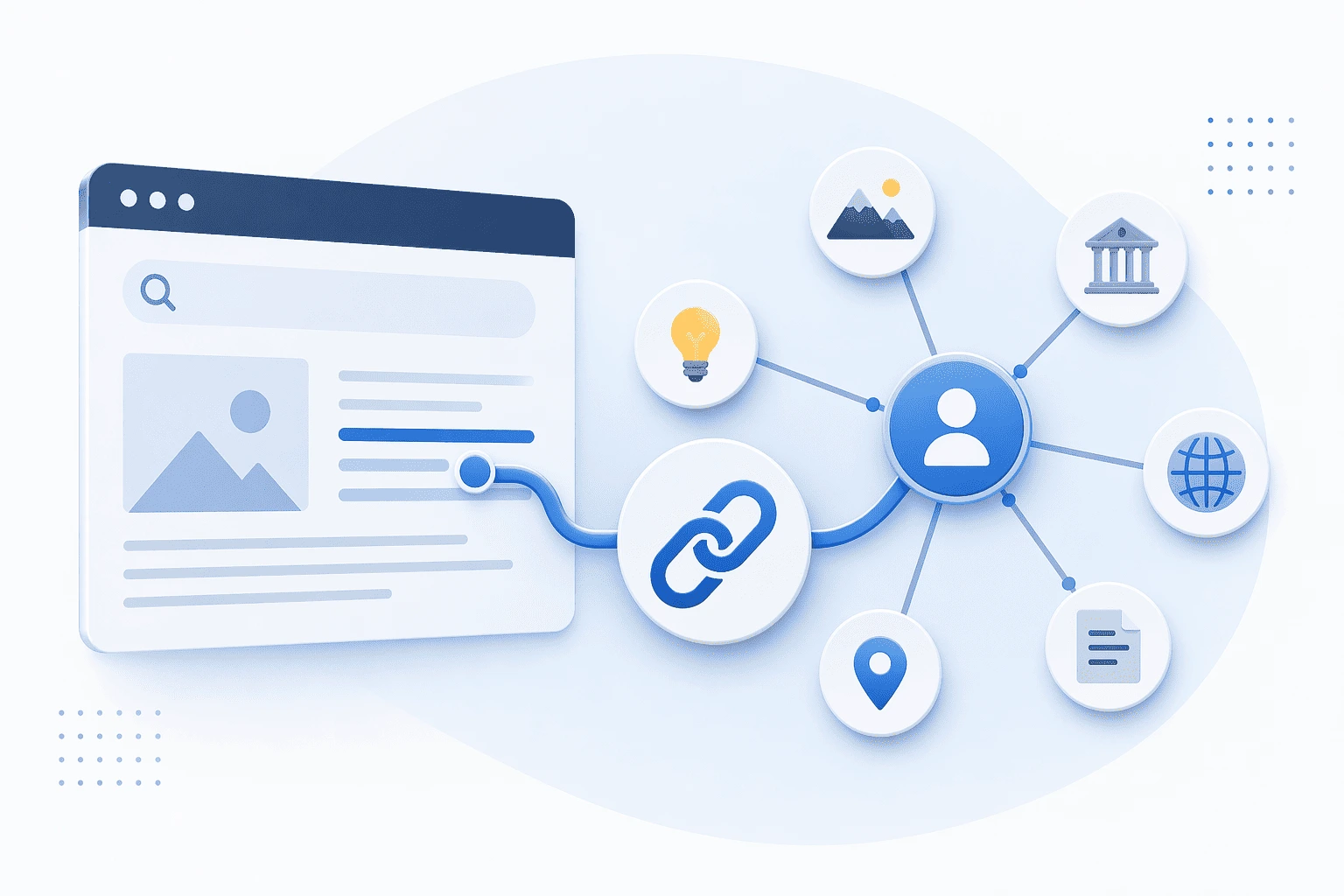
Entity linking in SEO is the process of connecting the concepts on your website to recognizable, verifiable things that Google already understands – stored in its Knowledge Graph.
A keyword is the word someone types. An entity is the actual thing that word represents. “Apple” as a keyword is ambiguous. As an entity, Google knows from context it means the technology company. Entity linking creates that same clarity for your own business, services, and products.
Google’s Hummingbird update (2013) started the shift from matching words to understanding meaning. RankBrain (2015) and BERT (2019) deepened it. Every page published today is processed through that NLP stack, and clear entity signals make that processing faster and more favorable.
Entity SEO vs Keyword SEO
| Keyword SEO | Entity SEO | |
| Optimizes for | Exact phrases, frequency | Meaning and relationships |
| How Google reads it | String matching | NLP + Knowledge Graph lookup |
| Works across query variations | No | Yes |
| Works in AI search | Partially | Yes |
| EEAT signal strength | Low | High |
Both matter. As AI systems handle more of how people discover businesses and products, entity clarity is becoming the dominant ranking signal.
How Google’s NLP Pipeline Processes Entities
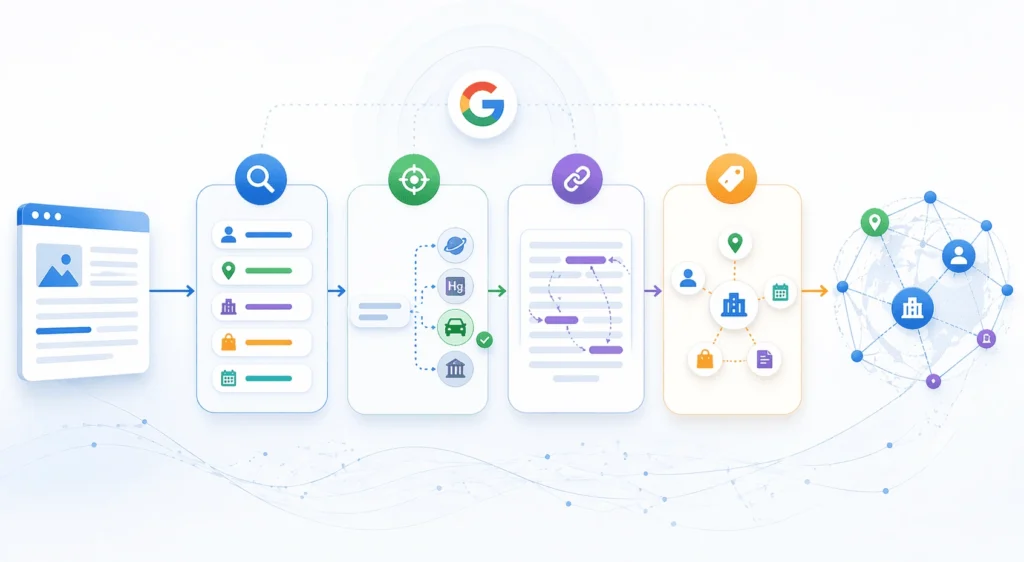
Understanding what Google does with your content shapes every implementation decision. The pipeline runs through four stages.
Entity Recognition scans text and identifies named entities: people, places, organizations, products, events, and concepts.
Entity Disambiguation resolves the correct meaning using surrounding context. “Mercury” could be the planet, the element, or the car brand. Google reads contextual signals across the entire document to make that call.
Co-reference Resolution links multiple references to the same entity within a document. When a page says “the clinic” after establishing “Smith Dental,” Google connects both. Inconsistent naming – using “Smith Dental,” “Smith Dentistry,” and “the dentist” interchangeably – weakens this and dilutes entity clarity.
Entity Classification categorizes recognized entities into types: Person, Organization, Location, Event, Work, Consumer Good, and others. Classification determines which Schema.org types apply and how the entity connects to others in the Knowledge Graph.
Entity Salience: The Score Google Assigns to Every Page
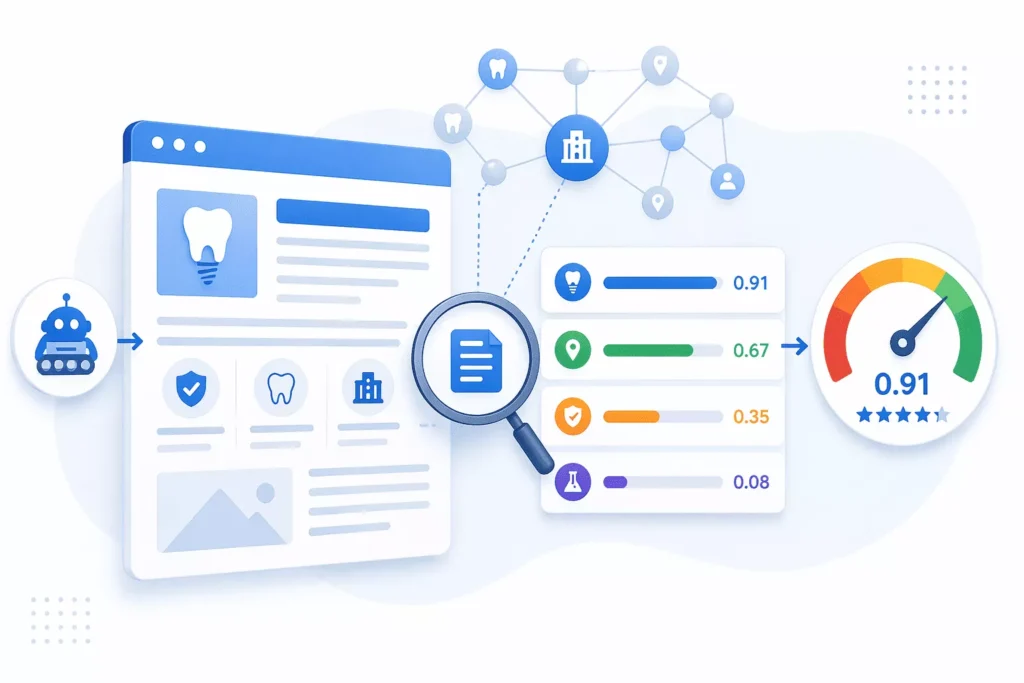
When Google extracts entities from a page, it assigns each one a salience score between 0 and 1. A score near 1 means that entity is the central subject. A score near 0 means it is a peripheral mention.
A service page for “dental implants in Chicago” might have dental implants at 0.91, Chicago at 0.67, and a passing mention of fluoride at 0.08. Pages that try to cover too many entities dilute salience across all of them and rank strongly for none.
How to improve entity salience: Keep one primary entity per page. Use the entity name in the H1, URL, opening paragraph, and image alt text.
You can check entity salience using Google’s Cloud Natural Language API. Note: this requires a free Google Cloud account and API key setup – it is not a simple online paste tool. Target a salience score of 0.7 or above for your primary entity.
How Co-citation and Co-occurrence Build Entity Authority
Not every entity starts with a Wikipedia page. For new businesses or niche local services, co-citation and co-occurrence fill that gap.
Co-occurrence is when two entities appear together repeatedly across the web. If “Smith Dental” and “dental implants Chicago” appear together across your website, Google Business Profile reviews, Yelp, and Healthgrades, Google begins associating these entities even without a formal schema link.
Co-citation is when third-party sources mention your entity alongside other recognized entities. A local news article mentioning your clinic alongside the “American Dental Association” creates a co-citation that strengthens your entity’s credibility in Google’s model.
Practical steps for local businesses:
- Ask customers to write reviews mentioning specific service names alongside your business name and city
- Post on GBP consistently using the same entity name, service names, and location
- When local press covers your business, confirm they use your exact business name – “Smith Dental” and “Smith Dentistry” are different strings to Google
Internal vs External Entity Linking
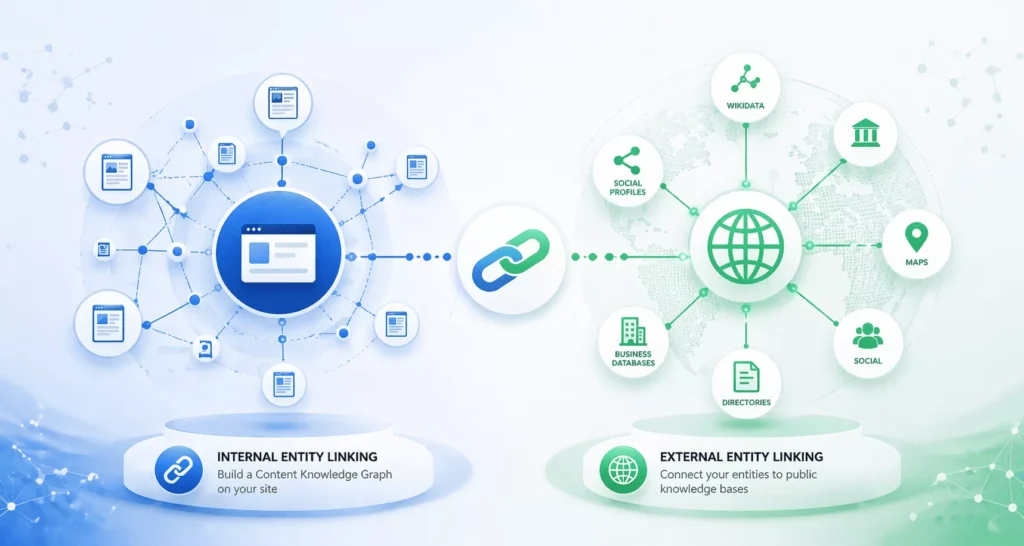
| Type | Purpose | Implementation |
| External | Connect your entities to public knowledge bases | sameAs, about, mentions in schema |
| Internal | Build a Content Knowledge Graph on your site | Consistent links back to entity anchor pages |
External Entity Linking
External entity linking uses Schema.org properties to tell Google your entities match authoritative public references.
sameAs establishes that your entity matches an external reference. Valid sources include Wikipedia, Wikidata, Google Maps, Yelp, Healthgrades, Crunchbase, LinkedIn, Facebook, and Twitter/X. Social media profiles are legitimate sameAs URIs – most local businesses have active social profiles long before they earn Wikidata entries.
"sameAs": [
  "https://www.facebook.com/smithdental",
  "https://www.linkedin.com/company/smith-dental",
  "https://www.yelp.com/biz/smith-dental-chicago",
  "https://www.healthgrades.com/dentist/smith-dental"
]
about signals that your page is primarily about a specific entity. Used for service pages and blog posts.
mentions signals that your page references an entity in passing. Used for supporting content that touches on an entity without being the main focus.
Internal Entity Linking
Internal entity linking means every mention of “dental implants” on your blog links back to your dental implants service page. Every mention of “Chicago” links to your location page. This builds a Content Knowledge Graph on your site – a structure that search engines navigate with confidence.
If your business serves multiple locations or service lines, OLBUZ’s local SEO services include full internal entity architecture across every page type.
Entity Linking for Local SEO: The EAP Framework
When someone searches “dental clinic in Chicago,” Google looks at which dental clinic entities it understands well enough to recommend. Businesses with clear entity linking local SEO signals appear. Those without stay invisible even with strong keyword optimization.
The EAP Framework builds that entity clarity across three layers.
Entity means your business is consistently named and categorized across every digital touchpoint. Your GBP category, website schema, and directory listings must use identical business name and category language. A business listed as “physical therapy clinic” on GBP and “wellness center” on its website creates entity ambiguity Google cannot resolve.
Attributes are structured facts: hours, price range, services, service area, certifications. Schema markup makes these directly machine-readable. A clinic listing 14 structured services ranks for 14 intent types. One listing none ranks for zero.
Proof is third-party validation through reviews mentioning specific services, GBP posts with photos, and citations on directories like Yelp, Healthgrades, and Zocdoc. Proof converts self-asserted attributes into verified entity data Google treats with higher confidence.
LocalBusiness schema with full EAP implementation:
{
  "@context": "https://schema.org",
  "@type": "LocalBusiness",
  "name": "Smith Dental",
  "address": {
    "@type": "PostalAddress",
    "streetAddress": "123 N Michigan Ave",
    "addressLocality": "Chicago",
    "addressRegion": "IL",
    "postalCode": "60601",
    "addressCountry": "US"
  },
  "telephone": "+1-312-555-0000",
  "openingHours": "Mo-Fr 09:00-18:00",
  "priceRange": "$$",
  "sameAs": [
    "https://www.facebook.com/smithdental",
    "https://www.yelp.com/biz/smith-dental-chicago",
    "https://www.healthgrades.com/dentist/smith-dental"
  ],
  "hasOfferCatalog": {
    "@type": "OfferCatalog",
    "name": "Dental Services",
    "itemListElement": [
      {"@type": "Offer", "itemOffered": {"@type": "Service", "name": "Dental Implants"}},
      {"@type": "Offer", "itemOffered": {"@type": "Service", "name": "Teeth Whitening"}},
      {"@type": "Offer", "itemOffered": {"@type": "Service", "name": "Root Canal Treatment"}}
    ]
  }
}
Validate all markup using Google’s Rich Results Test before publishing. For healthcare businesses, OLBUZ’s healthcare marketing services include full EAP implementation.
EEAT Entity Linking: Person Schema for High-Trust Verticals
For businesses in medical, legal, financial, or educational verticals, EEAT entity linking – establishing the key people behind your brand as named entities – is a direct trust signal.
A dentist whose name, qualifications, and professional affiliations are structured in schema is a recognized entity. A dentist mentioned only in plain text on an About page is not.
{
  "@context": "https://schema.org",
  "@type": "Person",
  "name": "Dr. Sarah Smith",
  "jobTitle": "Lead Dental Surgeon",
  "worksFor": {
    "@type": "LocalBusiness",
    "name": "Smith Dental"
  },
  "hasCredential": {
    "@type": "EducationalOccupationalCredential",
    "credentialCategory": "DDS, Board Certified Prosthodontist",
    "recognizedBy": {
      "@type": "Organization",
      "name": "American Dental Association"
    }
  },
  "sameAs": [
    "https://www.linkedin.com/in/drsarahsmith",
    "https://www.healthgrades.com/dentist/dr-sarah-smith"
  ]
}
For blog posts, add an author property linking to the Person entity. This connects the content creator to a recognized entity and strengthens the EEAT signal for every piece of content they produce.
Entity Linking and Topic Clusters
Entity linking and topic clusters produce compounding results when built together.
A dental clinic’s entity cluster works like this: the clinic is the central entity. Each service is a sub-entity with its own dedicated page and schema markup. Every blog post covering those services links back to the relevant service page using anchor text that includes the entity name.
Each internal link reinforces topic cluster authority and signals the entity relationship between pages simultaneously.
Entity Linking for Ecommerce
For ecommerce, schema markup entity linking operates across three levels: each product is an entity, each category is an entity, and the brand is an entity connecting all of them.
Complete product schema – including dimensions, materials, compatibility, certifications, pricing, and return policy – matters beyond traditional rankings. In 2026, AI shopping agents read this structured data directly. Products with complete entity markup get considered. Products with incomplete data get skipped.
As Google’s structured data documentation states, providing complete and accurate structured data helps Google understand page content and display it in relevant Search results.
For businesses scaling ecommerce visibility, OLBUZ’s ecommerce SEO services include product-level entity architecture and brand entity establishment.
Entity Linking for AI Search and GEO
AI tools like Google AI Overviews, ChatGPT, and Perplexity synthesize answers from sources they trust. The selection criteria map directly onto entity strength:
- Is this source clearly about a recognizable thing?
- Are the facts consistent and verifiable across multiple sources?
- Is the content structured for direct machine extraction?
Generative Engine Optimization (GEO) is the practice of optimizing content for entity linking for AI search. Without clear entity signals, AI systems lack the confidence to cite your content.
Three GEO requirements entity linking fulfills:
Citability – Strong schema and external references make your content citable by name.
Extractability – Schema markup puts your facts in a format that requires no interpretation.
Consistency – Consistent entity attributes across GBP, website, schema, and directories pass AI cross-referencing checks.
Tools to Find and Monitor Google Knowledge Graph Entities
| Tool | Purpose | Cost |
| Google Cloud NLP API | Check entity salience (requires API key) | Free tier available |
| Cloud Enterprise Knowledge Graph API | Find KGMIDs for your entities | Free tier available |
| Rich Results Test | Validate schema markup | Free |
| Wikidata | Find and create sameAs references | Free |
How to Do Entity Linking: Step-by-Step
Step 1: List your core entities For each key page, identify: business name, service categories, locations, key people, and products. One entity per page.
Step 2: Find your KGMID
Use the Google Cloud Enterprise Knowledge Graph API to search by business name. Note: the legacy kgsearch.googleapis.com endpoint is being migrated to Cloud Enterprise Knowledge Graph – new users should use the updated API. Both require a Google Cloud project and API key; they are not public open endpoints.
A successful response returns a @id value like kg:/g/11b7_xyz123. That is your KGMID. If your business returns no result, complete the remaining steps first. Consistent entity signals trigger automatic Knowledge Graph inclusion over time.
Step 3: Create a Wikidata entry
Wikidata is one of Google’s most trusted sameAs sources. A Wikidata entry gives Google a permanent, structured external reference for your entity.
- Go to wikidata.org, create a free account, and click “Create a new item”
- Add a label (business name), description (e.g., “dental clinic in Chicago, Illinois”), and aliases
- Add statements for instance of, country, located in the administrative territory, official website, and social media account URLs
Once published, add the Wikidata URL to your sameAs property. Google’s crawlers typically process new entries within a few weeks.
Important: Always verify Wikidata Q-codes directly on wikidata.org before adding them to schema markup. Using an incorrect Q-code links your business to the wrong entity entirely.
Step 4: Map external references Find each entity’s public reference: Wikidata URL, Google Maps URL, LinkedIn, Yelp, Healthgrades, and social profiles.
Step 5: Implement schema with sameAs, about, and mentions Validate using Google’s Rich Results Test before publishing.
Step 6: Build internal entity links Link every mention of each entity back to its authoritative page. Use descriptive anchor text – “dental implants in Chicago” is correct; “click here” is not.
Step 7: Build external proof Complete your GBP. Maintain consistent NAP across Yelp, Healthgrades, Zocdoc, and Google Maps. Get reviews mentioning specific services by name. Pursue local press coverage that co-cites your business alongside recognized industry entities like the ADA or your state dental board.
For local businesses looking to run this systematically, OLBUZ’s local business marketing covers EAP implementation, directory consistency audits, and GBP optimization.
How to Measure Entity Linking Results
Knowledge Panel: Search your business name directly. A panel on the right confirms Knowledge Graph recognition. Timelines vary based on entity signal strength and niche.
Entity salience scores: Run key pages through the NLP API before and after optimization. Target 0.7 or above per page.
GSC keyword expansion: Compare how many unique queries a page appears for in Google Search Console. Entity-optimized pages tend to rank for a broader range of query variations over time.
AI Overview citations: Search your target queries monthly and track how often your domain appears in AI-generated answers.
Rich result CTR: Track CTR per page in GSC. Schema-triggered rich result features tend to improve click-through rates.
Build Your Entity Foundation Before Your Competitors Do
What is entity linking in SEO comes down to this: it is the infrastructure layer underneath every other SEO tactic. Get it right and your keyword optimization, content creation, and link building all perform better because Google understands what your pages are actually about.
The steps are clear: identify entities using the four-stage NLP model, find KGMIDs, create Wikidata entries, implement schema with sameAs, about, and mentions, build co-occurrence signals through consistent naming, add EEAT author entity markup, and create external proof through reviews and directories.
Every signal added compounds the ones before it. Businesses building this foundation today hold a structural advantage in both traditional and AI-driven search.
Explore OLBUZ’s SEO services or review our case studies to see how entity-focused SEO has produced measurable organic growth.
Frequently Asked Questions
It is the practice of connecting your website’s concepts to things Google already recognizes – like linking your business to its Wikidata entry or your location to the Knowledge Graph. This removes ambiguity so Google can surface your content confidently.
Entity salience is the score between 0 and 1 that Google assigns to each entity on a page. Pages where the primary entity scores below 0.5 rarely rank strongly. Keeping each page focused on one clearly defined entity is the most direct way to increase salience. Test any page using Google’s Cloud Natural Language API – a Google Cloud account and API key are required.
Link building acquires backlinks to build authority. Entity linking connects concepts through schema and internal structure to build comprehension. Both are necessary. Entity linking is the prerequisite for AI search visibility, where backlink counts matter far less than entity clarity.
No. Wikidata entries, Crunchbase profiles, Google Business Profile, social media profiles, and consistent directory listings on Yelp and Healthgrades all contribute to entity recognition.
KGMID is Google’s unique internal identifier for each entity in the Knowledge Graph. Use the Google Cloud Enterprise Knowledge Graph API to search by business name. If your business returns no result, complete EAP implementation and check again after a few weeks of consistent entity signals.
AI tools cite sources they can trust and extract facts from easily. Complete schema markup, external sameAs references, and consistent structured data make your content more extractable and citable – the foundation of Generative Engine Optimization (GEO).
Yes. LinkedIn, Facebook, Twitter/X, and Instagram profile URLs are valid sameAs URIs in schema markup. For businesses that have social profiles before Wikidata entries, these are a practical and immediate first step.
Timelines vary based on your niche, existing entity strength, and crawl frequency. Local ranking improvements from GBP and directory consistency often appear faster than Knowledge Panel recognition, which depends on how quickly Google processes new entity signals.
Vikram Raj Gurjar

Vikram Raj Gurjar is an SEO Executive at OLBUZ, working at the intersection of AI, search, and growth. He builds scalable SEO systems focused on topical authority, intent mapping, and search experience optimization, helping brands achieve sustainable visibility in an AI-driven search landscape.

Contact Form Popup
Boost Your Business Now
This will close in 0 seconds
apply now popup
Apply Now
This will close in 0 seconds
Get free audit popup
Get Free Google Ads Account Audit Worth $999
This will close in 0 seconds
Contact page Form Popup
Contact Us
This will close in 0 seconds