

Many marketers running Meta Lead Ads have experienced this pattern:
A campaign launches, leads start flowing in at a low CPL, and everything looks promising – until the sales team starts following up. Suddenly, a large portion of those leads turn out to be unresponsive, irrelevant, or low intent.
This is a common challenge in lead generation campaigns.
In most cases, the issue is not the campaign setup – it’s the Instant Form itself.
Meta Instant Forms are designed to maximise conversions with pre-filled data and minimal friction. While this increases lead volume, it can also reduce lead quality if not structured carefully.
The real challenge is not generating more leads, but generating the right leads.
The Real Problem: Easy Forms vs. Useful Leads
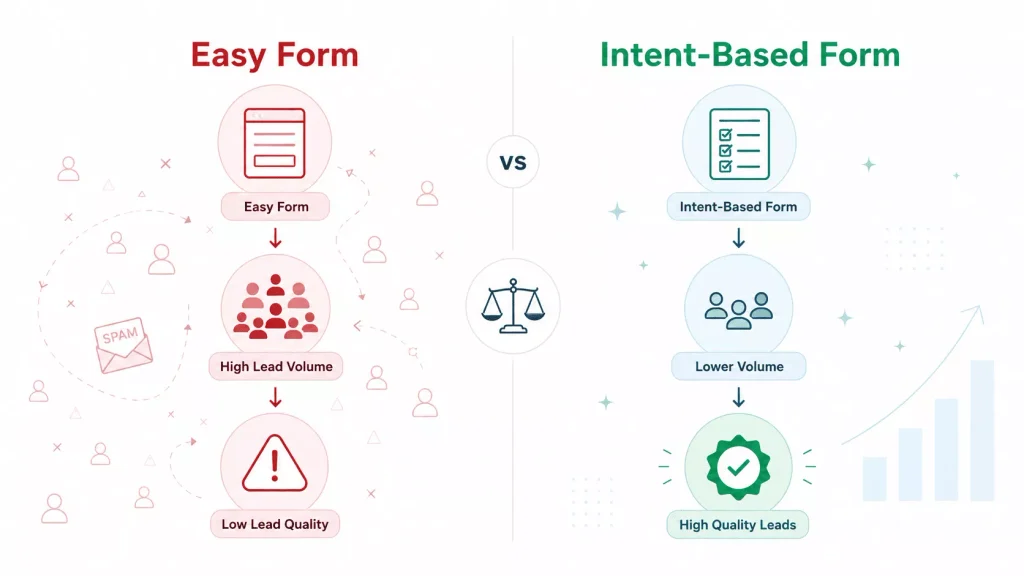
Meta’s lead form experience is built for convenience. Users can submit their details within seconds, often without much consideration.
This leads to a fundamental trade-off:
- Easier forms increase lead volume
- Stricter forms improve lead quality
If a form is too simple, it allows low-intent users to submit easily. If it is too complex, even genuinely interested users may drop off.
The objective, therefore, is not simply to maximise submissions – but to create a balance where the form attracts high-intent users while discouraging irrelevant ones.
Designing Forms with Intent, Not Assumption
An effective Instant Form is not built by adding multiple fields – it is built with purpose.
Every question should serve a clear function.
Before adding a field, marketers should ask:
“Does this help qualify the lead or improve follow-up?”
If the answer is no, the question is likely unnecessary.
What Makes a Good Qualifying Question?
Strong qualifying questions typically:
- Filter out irrelevant users
- Indicate seriousness or intent
- Provide actionable insights for the sales team
Examples include:
- Budget range
- Location preference
- Purchase timeline
- Specific requirements related to the offering
As you can see, this is a format many marketers use to get more leads, keeping the form limited to just the name, phone number, and email fields. While this can increase the number of leads, it can also attract a lot of irrelevant or low-quality leads.
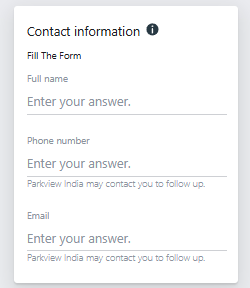
We work with several real estate businesses and commercial property projects, so we take a slightly different approach. We carefully structure the Instant Form and add relevant qualifying questions to understand the lead better before it reaches the sales team.
You can check below how we structure our Instant Forms and the type of qualifying questions we use.
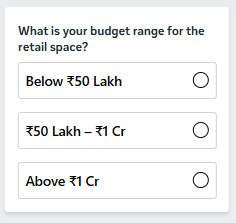


These questions go beyond data collection – they help assess whether a lead is worth pursuing.
However, adding questions without purpose only increases friction without improving lead quality.
Friction Isn’t Bad – Unnecessary Friction Is
There is often hesitation around adding more fields to a form due to fear of reducing conversion rates.
While additional friction can lower submission volume, it does not necessarily harm performance.
Relevant friction can actually improve efficiency.
When a form filters out low-intent users early, it reduces wasted effort in follow-ups and improves overall lead quality.
In many cases, a slight drop in volume leads to a significant improvement in lead intent – resulting in better downstream conversions.
Why Testing Is Non-Negotiable
One of the most common mistakes in Meta Lead Ads is treating the first version of an Instant Form as final.
In reality, form optimisation should be an ongoing process.
Different audiences, offers, and industries respond differently to form structures.
Testing should focus on:
1. Form Structure
Short vs. medium-length forms
Minimal vs. structured qualification
2. Question Types
Multiple choice vs. open-ended
Direct vs. indirect qualification
3. Messaging Within the Form
Headlines, descriptions, and clarity of next steps
The goal is not just to optimise for CPL, but to identify which variations generate leads that actually convert into customers.
The Underrated Role of Form Messaging
While most attention goes to ad creatives, the Instant Form itself plays a critical role in influencing lead quality.
The headline and description within the form act as a second layer of communication.
This is where marketers can:
- Set clear expectations
- Highlight the offer
- Explain the next steps
- Reinforce user intent
Effective form messaging is:
- Clear and specific
- Offer-driven
- Action-oriented
When users understand what they are signing up for, the likelihood of receiving high-intent leads increases.
Continuous Optimisation Is Now Easier Than Before
With newer improvements in Meta Instant Forms, marketers now have greater flexibility to edit and refine forms.
This shift allows Instant Forms to be treated as dynamic assets rather than static setups.
Based on lead quality feedback, marketers can:
- Modify qualifying questions
- Adjust messaging
- Add or remove friction points
This enables a more performance-driven and iterative approach to lead generation.
What Marketers Should Focus On
To achieve the right balance between lead volume and quality:
- Avoid optimising solely for the lowest CPL
- Do not overcomplicate forms unnecessarily
- Focus on relevance rather than volume
- Use questions strategically for qualification
- Continuously test and refine form variations
Ultimately, performance should be measured not just by cost per lead – but by the quality and conversion potential of those leads.
Conclusion
Meta Instant Forms are a powerful tool for lead generation – but their effectiveness depends on how they are structured.
The goal is not to eliminate friction or maximise it, but to apply it intelligently.
A well-designed form should:
- Feel simple and seamless for high-intent users
- Introduce enough friction to discourage low-intent submissions
When marketers shift their focus from “cost per lead” to “quality per lead,” the entire strategy evolves – and so do the results.
Frequently Asked Questions (FAQs)
There is no fixed number. The ideal length depends on the campaign objective, but every question should serve a clear qualification or follow-up purpose.
Yes, in most cases. However, they can significantly improve lead quality by filtering out low-intent users.
Questions related to budget, timeline, location, and specific needs are effective in identifying serious prospects.
While CPL is important, lead quality and conversion rate are more meaningful performance indicators in the long term.
Forms should be reviewed and tested regularly, especially when there are changes in lead quality or campaign performance.
Garv Pandya

Hi, I’m Garv Pandya, a PPC Executive at Olbuz. I enjoy understanding audience behavior and creating ad strategies that connect brands with the right people. Along with paid advertising, I’m also interested in AI prompting and digital marketing trends. Through these blogs, I love sharing practical insights, ideas, and learnings that can help marketers and businesses grow online.


Contact Form Popup
Boost Your Business Now
This will close in 0 seconds
apply now popup
Apply Now
This will close in 0 seconds
Get free audit popup
Get Free Google Ads Account Audit Worth $999
This will close in 0 seconds
Contact page Form Popup
Contact Us
This will close in 0 seconds