
Running Google Ads today is, in some ways, easier than it’s ever been. Google’s AI writes ad copy, suggests keywords, builds campaign structures, and adjusts bids on its own. You almost don’t need to lift a finger.
And yet – every week, businesses pour real money into Google Ads and land on the same disappointing dashboard. Leads that don’t convert. Sales that swing wildly month to month. A return on ad spend that never quite gets where it should.
Here’s the thing nobody likes to hear: it’s rarely Google Ads itself. After auditing countless Google Ads accounts, we’ve seen the same pattern repeat – the same handful of mistakes quietly draining budget. Fix those, and the platform tends to behave the way it’s supposed to.
Here are the eleven we see most often.
Key Takeaways
┃Most Google Ads accounts don’t fail because of budget – they fail because of avoidable mistakes. This guide shows you exactly what to fix.
In this guide, you’ll learn how to:
- Choose the right keywords
- Improve conversion tracking
- Use AI Max & Performance Max correctly
- Write ads that earn more qualified clicks
- Avoid wasting your ad budget
1. Launching Campaigns Without Real Research First
Someone opens an account, picks a few keywords that sound right, sets a budget, and hits publish – all before actually understanding who they’re trying to reach. That’s not a campaign. That’s an expensive guess.
Before spending a rupee or a dollar, get clear on:
- Who your ideal customer actually is, and what problem they’re solving
- How they phrase their searches – their words, not yours
- What competitors are already doing in the same auction
- Seasonal demand that may affect your budget and campaign timing.
Use what’s already free: Keyword Planner and Google Trends cost nothing and remove most of the guesswork.
Before You Launch, Follow This Process
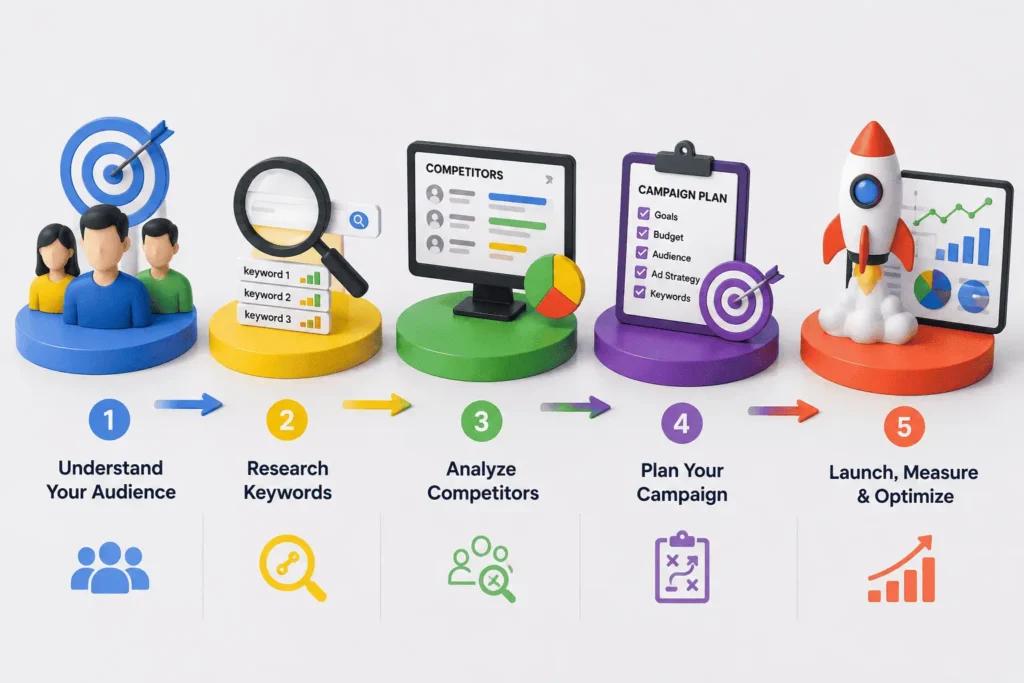
┃ Good campaigns start with research. Great campaigns never stop gathering it.
2. Choosing the Wrong Campaign Objective and Campaign Type
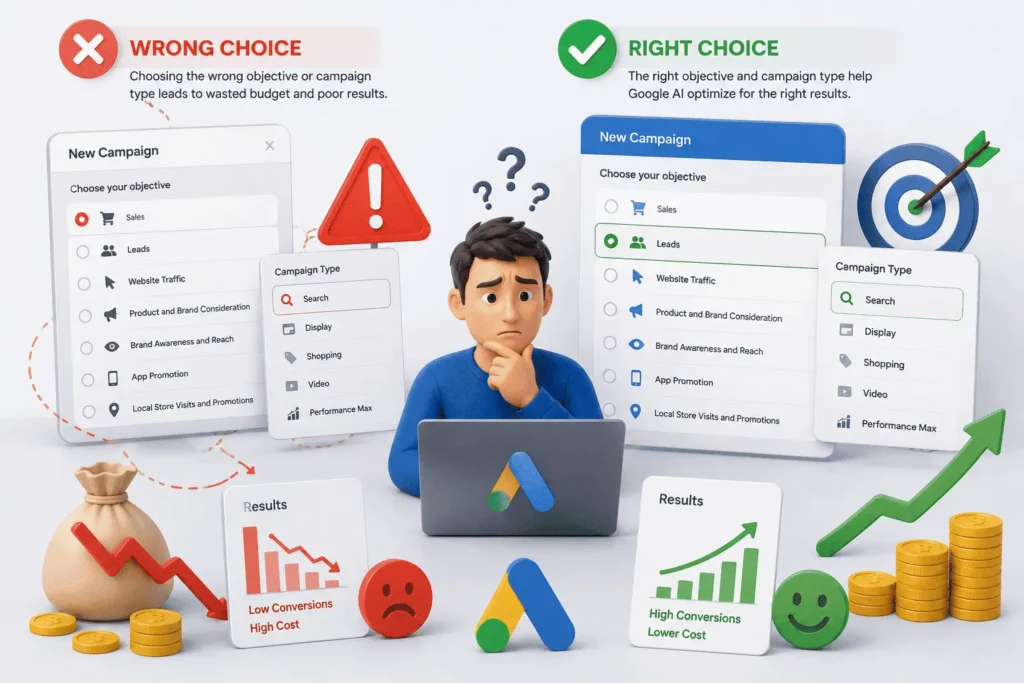
One of the most common mistakes we see is advertisers launching campaigns without first defining what success looks like. As a result, they choose the wrong campaign objective or campaign type, making it harder for Google’s AI to optimize for the right outcome.
Match Your Campaign to Your Business Goal
| Business Goal | Campaign Objective | Recommended Campaign Type |
| Lead Generation | Leads | Search Campaign |
| Website Traffic | Website Traffic | Search Campaign |
| Online Sales | Sales | Shopping or Performance Max |
| Brand Awareness | Brand Awareness & Reach | Display or Video Campaign |
| Local Business | Local Store Visits | Performance Max |
We recommend choosing your campaign objective based on your business goal, rather than selecting a campaign type simply because it’s new or heavily automated. The right campaign structure gives Google’s AI the best chance to deliver meaningful results.
┃ In our experience, successful campaigns start with the right objective and campaign type – not simply the latest Google Ads feature.
3. Chasing Search Volume Instead of Search Intent
High search volume feels reassuring. It also misleads a lot of advertisers.
“Running shoes” attracts a huge number of searches – but it tells you very little about what the searcher actually wants. “Buy men’s running shoes online” is a smaller search, but that person has basically already decided to buy.
Understanding Search Intent
| Search Query | Search Intent | Buying Stage | Conversion Potential |
| Running shoes | Informational | Researching | ⭐ |
| Best running shoes for men | Commercial | Comparing Options | ⭐⭐⭐ |
| Buy men’s running shoes online | Transactional | Ready to Buy | ⭐⭐⭐⭐⭐ |
Transactional keywords convert higher, simply because the person is closer to the finish line. This doesn’t mean ignore volume – it means stop treating volume as the whole story.
Quick Tip:- Don’t chase traffic – chase intent. A keyword with 100 highly relevant searches is often more valuable than one with 10,000 irrelevant searches, because it attracts people who are actually ready to buy.
4. Ignoring Search Terms and Skipping Negative Keywords
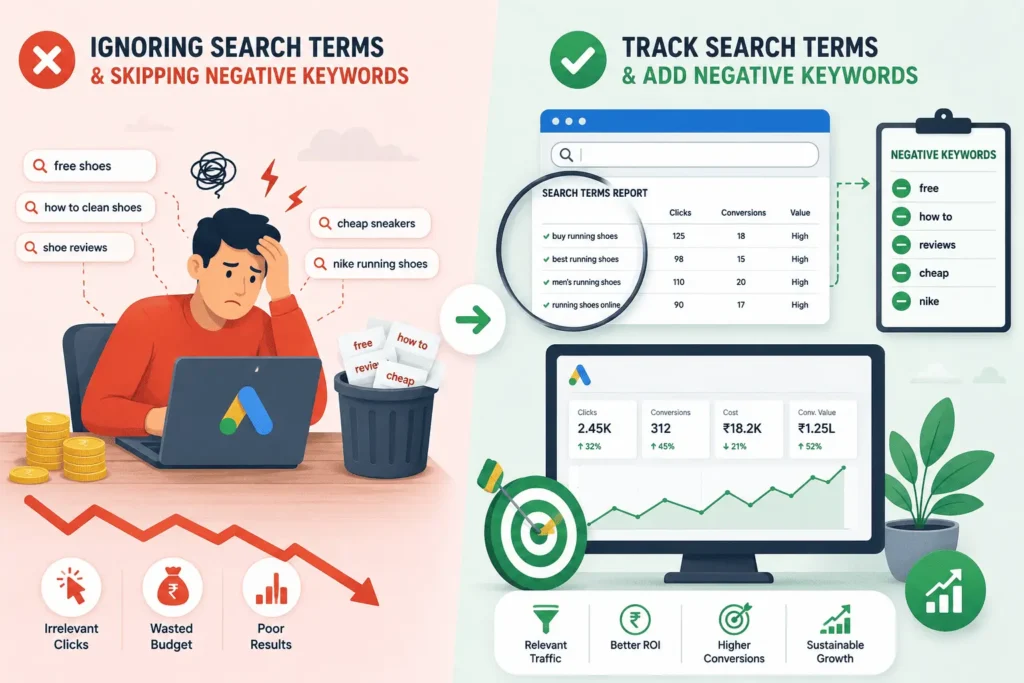
Even with AI handling more targeting than before, irrelevant searches still slip through. That hasn’t gone away.
The fix is a habit, not a one-time task:
- Pull the Search Terms report regularly
- Flag searches with nothing to do with what you sell
- Watch for competitor brand names you don’t want to pay to appear beside
- Add them as negative keywords – note these don’t match close variants, so be specific
Worth knowing: Performance Max can now use negative keywords too, at the account and campaign level – a control PMax simply didn’t offer before. If you’ve never touched it, that’s a free fix sitting in your account right now.
5. Setting Up Conversion Tracking Incorrectly (Or Not at All)
If we had to pick the single most expensive mistake on this list, it’s this one. Without accurate tracking, Google’s bidding has no idea what success looks like – so it defaults to optimizing for clicks instead of what you actually care about.
Track Every Valuable Action:
- Purchases and form submissions
- Phone calls
- Any other action that actually matters to your business
How Conversion Tracking Works
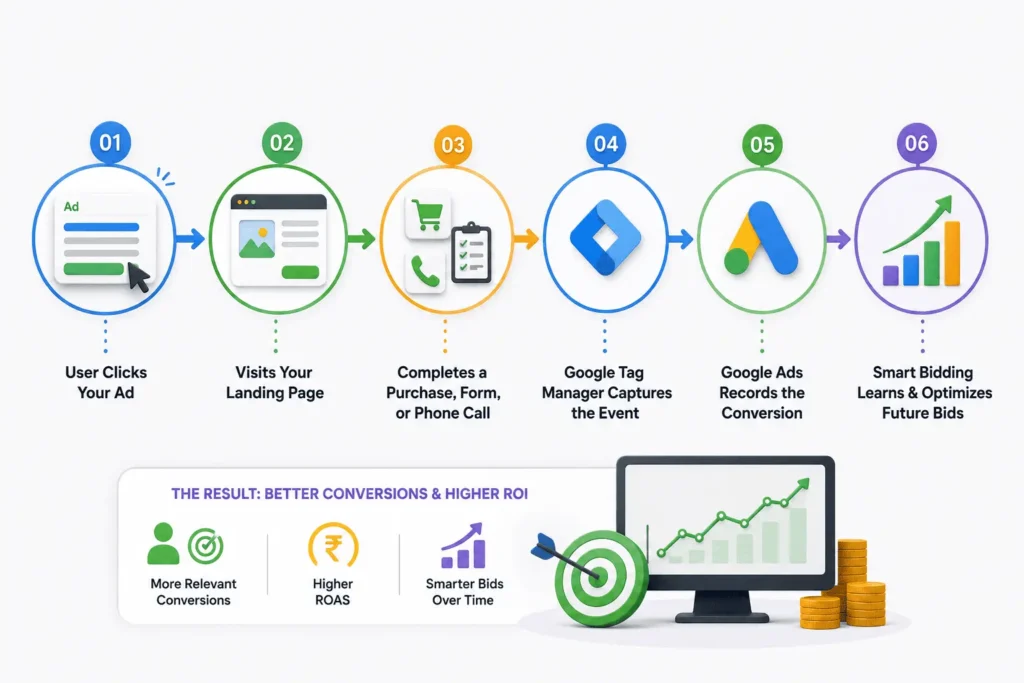
The standard modern stack: Google Ads’ own conversion tracking, GA4, Google Tag Manager, and Enhanced Conversions for accuracy, as third-party tracking gets less reliable.
What Each Tool Does
| Tool | Why It Matters |
| Google Ads Conversion Tracking | Tracks conversions and powers Smart Bidding |
| Google Tag Manager | Simplifies tag implementation and management |
| Google Analytics 4 (GA4) | Measures user behavior and customer journeys |
| Enhanced Conversions | Improves conversion measurement accuracy |
┃Better data makes the bidding smarter. Garbage in, garbage out – it’s that direct.
6. Writing Weak, Generic Responsive Search Ads
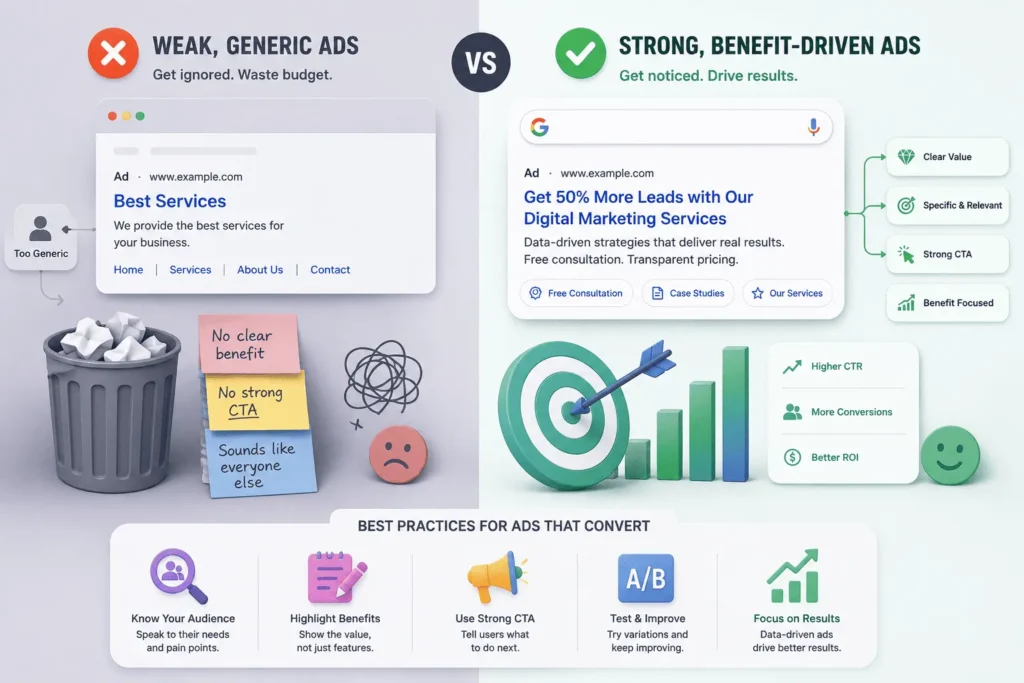
Responsive Search Ads (RSAs) are the standard now. Google mixes your headlines and descriptions automatically – but it can only test what you give it.
Headline Comparison: What Works vs. What Doesn’t
| Generic Headlines | High-Converting Headlines |
| Best Services | Get Your Free Demo Today |
| Contact Us Today | Same-Day Consultation Available |
| Welcome to Our Website | Save Up to 30% This Month |
Strong ad copy usually has:
- Your primary keyword is somewhere in it
- A real benefit, not just a feature
- A trust signal
- A call to action that says exactly what to do next
7. Overlooking Assets – and Sitting on a Format Google Already Killed
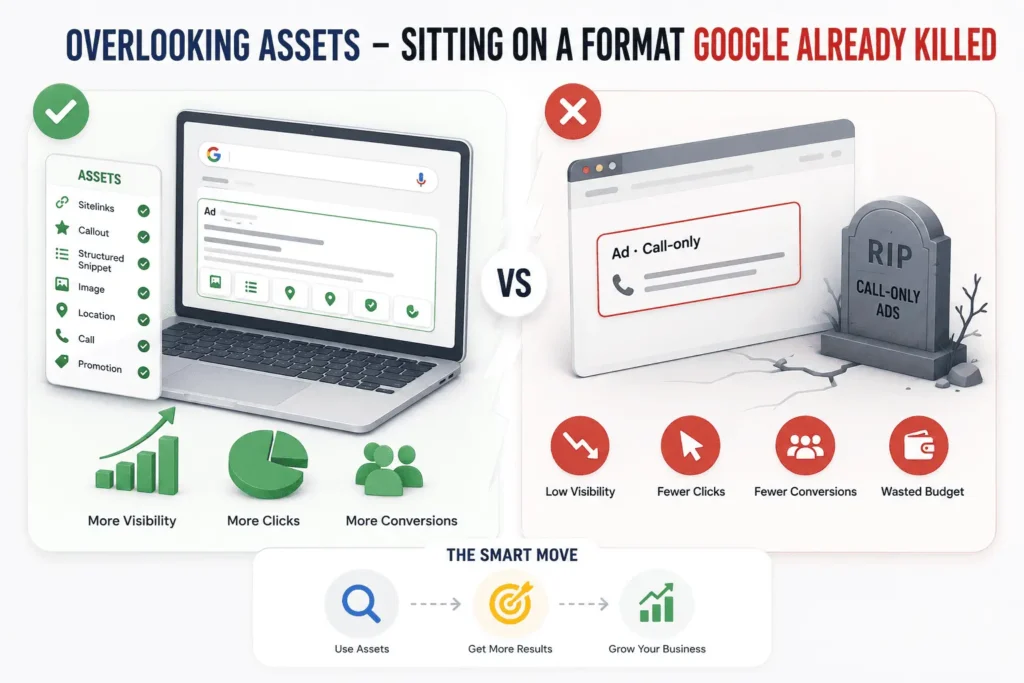
Assets (formerly “extensions”) buy your ad more room on the page and more reasons to click.
Assets Every Search Campaign Should Use
| Asset | Benefit |
| Sitelink | Send users to your most important pages |
| Call | Let customers call your business directly |
| Callout | Highlight key selling points |
| Structured Snippet | Showcase products or services |
| Image | Make your ads more visually engaging |
| Promotion | Promote discounts and special offers |
| Lead Form | Capture leads directly from Google |
┃If your ads run with zero assets, you’re handing the auction to whoever bothered to set theirs up. This isn’t polish anymore – it’s table stakes.
A real deadline hiding in here: Call-only ads are being retired. Creating new ones was already removed from the platform in February 2026, and existing ones will stop serving entirely by February 2027. If phone leads matter to your business, move to Responsive Search Ads with call assets now – not eventually.
8. Evaluating AI Max for Search Instead of Relying Only on Dynamic Search Ads
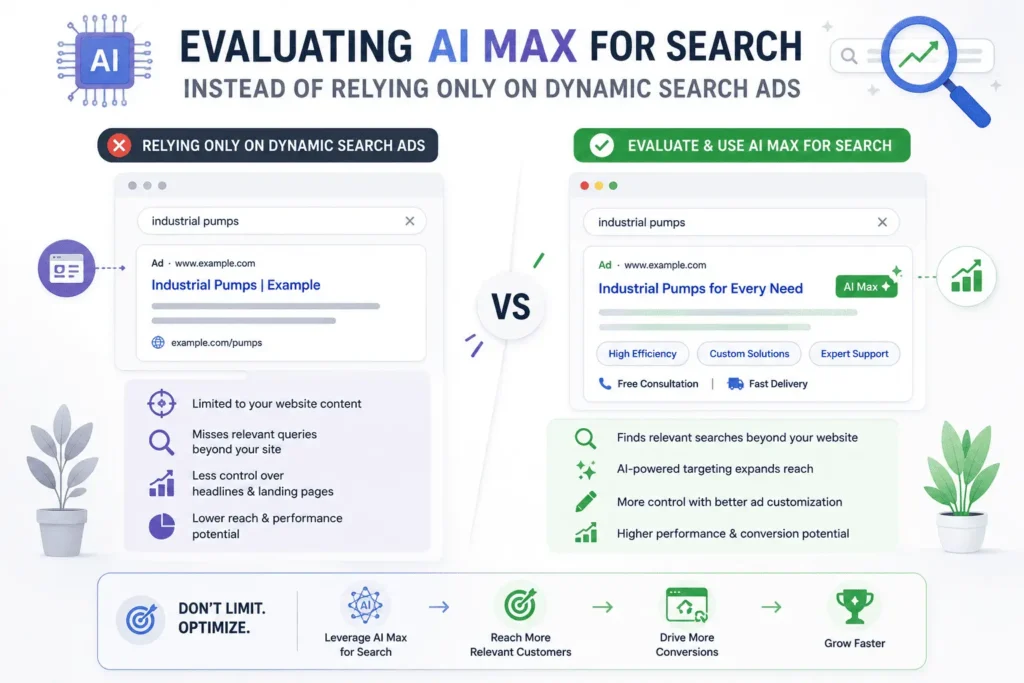
AI Max for Search is one of Google’s newest Search features, and it’s still evolving. Like Performance Max when it first launched, not every advertiser has adopted it – and that’s okay. Results can vary depending on your business, industry, and account setup.
Dynamic Search Ads vs. AI Max for Search
| Feature | Dynamic Search Ads (DSA) | AI Max for Search |
| Query Matching | Dynamic | AI-powered |
| Ad Creation | Dynamic headlines | AI-assisted headlines & descriptions |
| Landing Pages | Automatic | AI-optimized |
| Optimization | Limited | Advanced automation |
| Future Direction | Legacy solution | Google’s latest AI-powered Search solution |
Before testing AI Max, make sure you have:
- Accurate conversion tracking
- Sufficient conversion data
- Well-structured campaigns
- High-quality landing pages
┃ We recommend treating AI Max as a feature to test – not to blindly enable. Let your campaign performance determine whether it’s the right fit for your business.
9. Sending Traffic to Weak Landing Pages
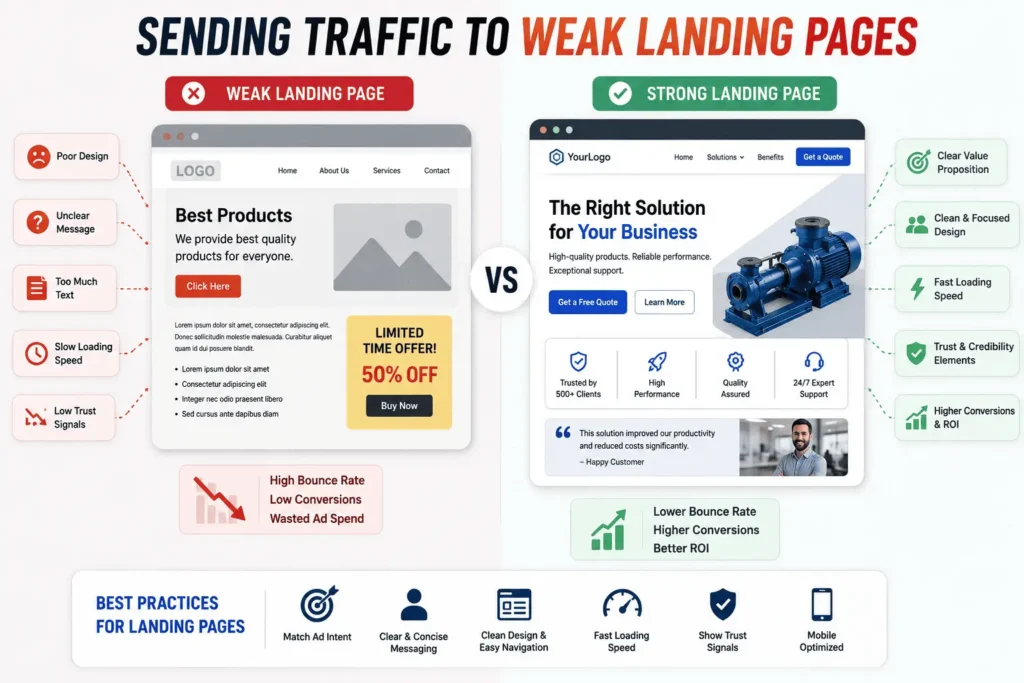
You can do everything else right and still lose the sale here.
Someone clicks an ad promising a free consultation, lands on a generic homepage, and has to hunt for what they came for. Most won’t bother.
A landing page that actually converts:
- Matches exactly what the ad promised
- Loads fast and works properly on mobile
- Has one clear call to action, not five competing for attention
- Includes a trust signal – testimonials, reviews, something real
Even small fixes here – a clearer headline, a shorter form – tend to move conversion rate more than people expect.
10. Using the Wrong Bidding Strategy – and Ignoring Lifetime Value
Not every campaign should be optimized the same way.
Choose the Right Bidding Strategy
| Campaign Goal | Recommended Bidding Strategy | Best For |
| Website Traffic | Maximize Clicks | Driving more visitors |
| Lead Generation | Maximize Conversions or Target CPA | Form fills and phone calls |
| E-commerce Sales | Maximize Conversion Value or Target ROAS | Online stores and revenue growth |
| Brand Visibility | Target Impression Share | Brand awareness campaigns |
Google’s Smart Bidding overview breaks down how each one actually works. Pick the wrong one, and a campaign can hit its target metric while completely missing the business outcome you wanted.
This connects to a second mistake: judging a campaign on the first sale alone, instead of on Customer Lifetime Value (LTV). Plenty of customers come back and buy again – sometimes for years. Know your LTV, and your acceptable acquisition cost stops being a guess.
11. Skipping GA4 – and First-Party Audiences
GA4 goes well beyond traffic counts – user journeys, engagement, conversion paths, revenue attribution. Paired with Google Ads, it shows you what’s actually working.
Equally important right now: first-party audiences. Privacy changes have made this data more valuable, not less.
How First-Party Audiences Improve Performance
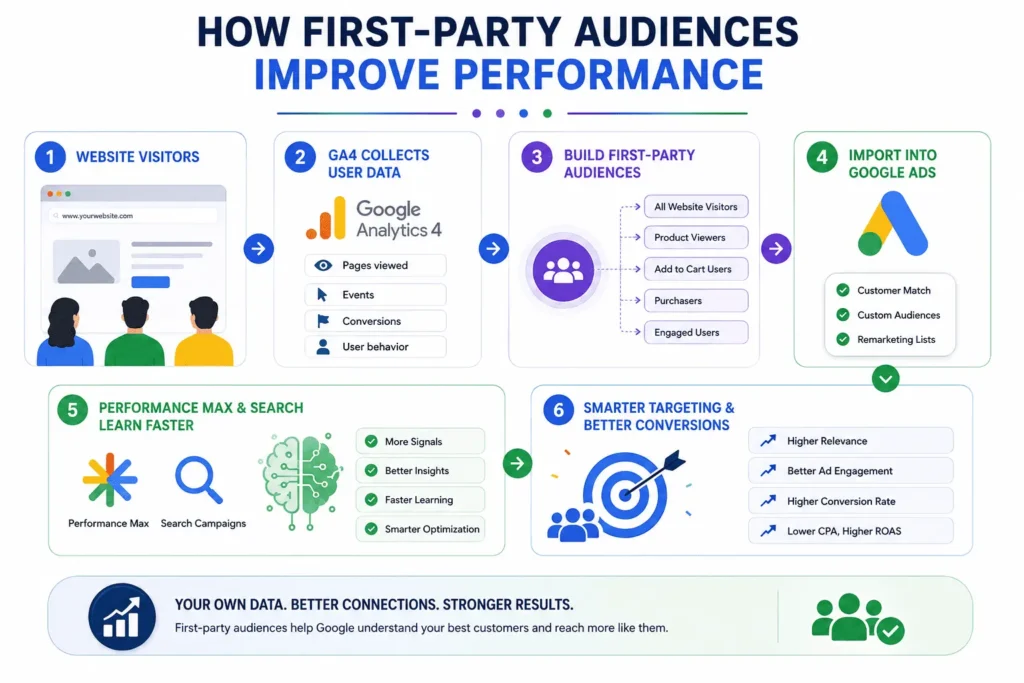
Lists worth building:
- Website visitors
- Cart abandoners
- Existing customers and past purchasers
- Email subscribers
Feed these into Performance Max or Search as audience signals, and the algorithm learns faster.
A Quick Word on Automation and Performance Max
Performance Max runs Search, Shopping, Display, YouTube, and Gmail from one setup – but it’s only as good as what you feed it. A weak product feed in Google Merchant Center – thin titles, missing images, no GTINs – holds back even a well-built campaign.
Worth reviewing: PMax picked up real new controls through 2026 – brand exclusions, so your ads avoid sitting beside content from brands you don’t want near, plus clearer asset-group and channel-level reporting. Early PMax was a black box. It isn’t anymore.
For e-commerce specifically: Shopping Ads remain one of the most effective formats around – product image, price, and rating, right there in the results. Paired with Performance Max, this is where most online stores make most of their revenue.
┃One last thing: automation is not autopilot. The advertisers who win consistently still review performance, dig into search terms, and adjust strategy – even with AI doing the heavy lifting.
Conclusion
Google Ads has changed enormously. The automation is smarter, AI plays a bigger role, and the platform does more of the heavy lifting than it used to.
But the fundamentals haven’t moved: understand your audience, track what matters, match the landing page to the ad, follow the data, keep testing.
None of these mistakes is complicated. They often go unnoticed because performance declines gradually – not overnight. Small improvements in several areas usually outperform one big change in a single area.
Go through your account against this list. More often than not, the fix isn’t a bigger budget. It’s closing a handful of gaps that have probably been sitting there for a while.
If you’d rather have someone experienced take a proper look, our Google Ads management services start with exactly this kind of audit – and we’ll tell you plainly where the budget is leaking, whether you work with us or not.
Frequently Asked Questions
What’s the single biggest mistake businesses make with Google Ads?
Broken or missing conversion tracking is one of the most expensive Google Ads mistakes. Without reliable conversion data, Google’s Smart Bidding optimizes for clicks instead of valuable business actions like purchases, leads, or phone calls.
Is Performance Max better than running standalone Search campaigns?
Not automatically. They usually perform best together – Search for tight control over high-intent traffic, Performance Max for reach across the rest of Google’s properties.
How often should I actually review my account?
Weekly for performance and search terms, monthly for a deeper optimization pass. Accounts left untouched for weeks accumulate small inefficiencies fast.
My ads rely on call-only ads – what do I need to do?
Move now. Creating new call-only ads was already removed in February 2026, and existing ones will stop serving by February 2027. Switch to Responsive Search Ads with call assets before the gap hits your call volume.
What’s the difference between Dynamic Search Ads and AI Max for Search?
AI Max builds on many of the capabilities previously associated with Dynamic Search Ads, but it isn’t automatically the right choice for every business. In our experience, it’s best treated as a feature to test based on your goals, conversion data, and campaign performance.
Still Have Questions About Google Ads?
Every business is different, and there’s no one-size-fits-all strategy.
If you’d like expert feedback on your campaigns, request a Google Ads audit. We’ll identify opportunities, highlight wasted spend, and recommend practical improvements – whether you work with us or not.
Anand Dalsaniya

Hi, I'm Anand Dalsaniya, a PPC Executive at OLBUZ. I specialize in creating and optimizing Google Ads, Microsoft Ads (Bing Ads), and Meta Ads campaigns for both eCommerce brands and lead generation businesses. From scaling online stores with data-driven strategies to generating high-quality leads through performance marketing, I focus on maximizing ROAS, reducing acquisition costs, and delivering measurable business growth. Through my blogs, I share practical insights, campaign strategies, and real-world lessons to help businesses and marketers achieve better results.
Contact Form Popup
Boost Your Business Now
This will close in 0 seconds
apply now popup
Apply Now
This will close in 0 seconds
Get free audit popup
Get Free Google Ads Account Audit Worth $999
This will close in 0 seconds
Contact page Form Popup
Contact Us
This will close in 0 seconds