

Agentic commerce is not the next version of online shopping. It is a complete rebuild of how buying and selling happens.
In traditional ecommerce, you search, compare, and check out yourself. Every step needs your attention. Agentic commerce removes most of that. An AI agent does it on your behalf from the first search to the final transaction without you visiting a single website
This is not a future concept. Agentic shopping powered by AI agents influenced $262 billion in global retail sales during the 2025 holiday season. Retailers with their own AI agents grew 59% faster than those without. The shift is not coming. It is already running.
What Is Agentic Commerce?
Agentic commerce is buying and selling in which AI agents act on behalf of consumers or businesses to research, compare, negotiate, and complete purchases — often without direct human involvement at each step.
A consumer tells an AI agent: “Book me a nonstop flight to London under $600 next week, no red-eyes.” The agent searches across airlines, checks loyalty memberships, identifies the best option, purchases the ticket, and confirms. The consumer never visits an airline website.
That same logic applies to grocery reordering, B2B procurement, subscription management, fashion, and almost every category where a purchase decision follows a pattern the agent can learn.
How It Differs from Traditional Ecommerce
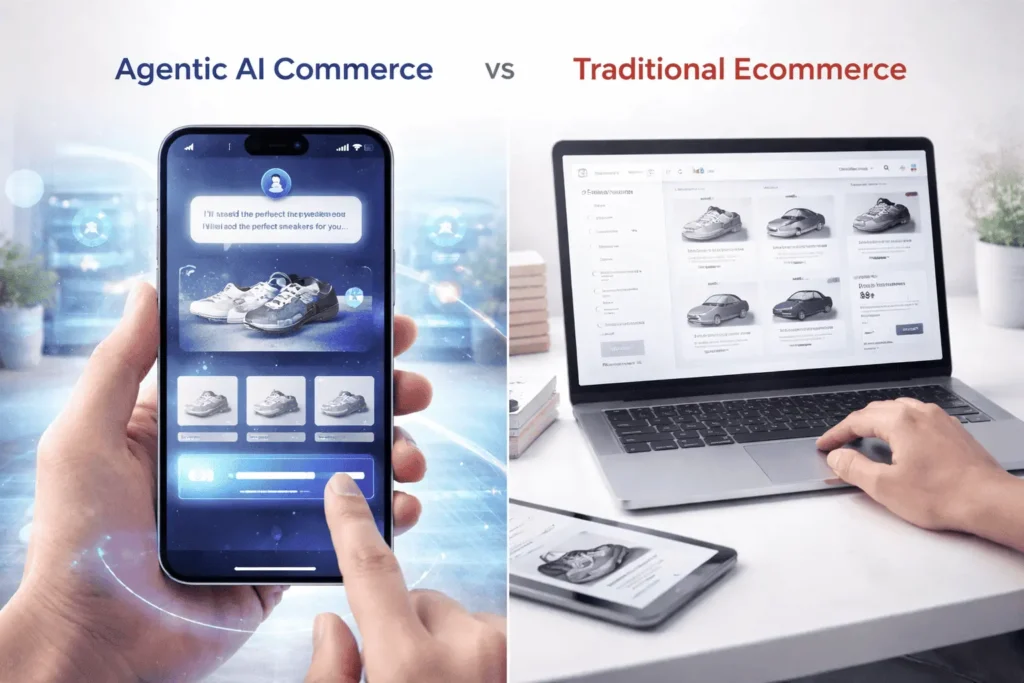
| Dimension | Traditional Ecommerce | Agentic Commerce |
| Search | User types a query and browses results | Agent researches across multiple sources simultaneously |
| Comparison | Manual, tab by tab | Automated multi-variable analysis |
| Checkout | User fills forms | Delegated authorization, tokenized payment |
| Post-purchase | User tracks manually | Agent monitors and manages |
| Learning | None between sessions | Memory layer improves with every purchase |
| Speed | Minutes to hours | Seconds to minutes |
The biggest difference is in discovery. Traditional SEO optimizes content for human searches on Google. In an agentic world, AI agents scan structured product data and machine-readable catalogs. A product that ranks well on Google may be completely invisible to an AI shopping agent if the merchant’s data is not structured for machine readability.
This is why generative engine optimization (GEO) structuring product data so AI systems can interpret and act on it — is becoming as strategically important as SEO was in the early 2000s.
How Agentic Commerce Works: The 5 Stages
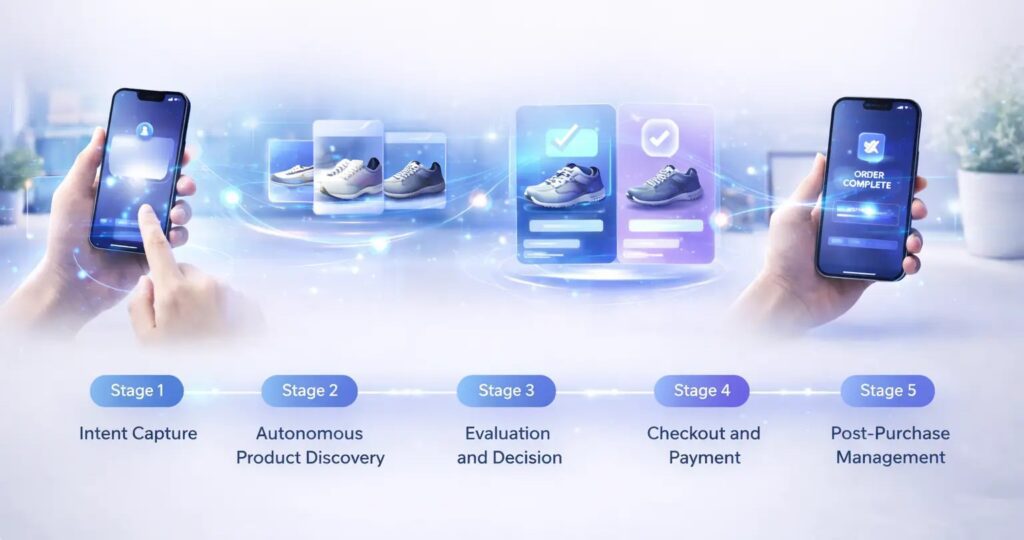
Stage 1: Intent Capture
The user sets a goal in natural language not a search query but a full instruction with constraints. “Find me trail running shoes, size 10, under $150, delivered by Friday.” The agent builds a task plan and pulls from its memory layer: past preferences, saved payment credentials, behavioral patterns.
Stage 2: Autonomous Product Discovery
The agent scans multiple retailers simultaneously. It queries product catalogs, checks retailer APIs, and reads structured data feeds which is exactly where most of the real world decision flow happens in how agentic shopping works. Retailers with agent ready catalogs machine readable API accessible product data have a major advantage here. Agents skip websites they cannot easily parse.
Stage 3: Evaluation and Decision
The agent ranks options based on stated preferences and memory signals. It weighs price, delivery time, specification match, and retailer trust. If two products score closely, it may pause and ask the user once. This is often the only moment human input re-enters the process.
Stage 4: Checkout and Payment
The agent completes the purchase through delegated authorization and tokenized payment credentials. Mastercard Agent Pay, Visa’s AI-ready credentials and Stripe’s ChatGPT integration allow verified agents to transact without the user entering card details.
Stage 5: Post-Purchase Management
The agent tracks shipments, initiates returns if needed, monitors pricing on subscriptions, and updates its memory from every completed transaction. Each purchase makes the next recommendation faster and more accurate.
The Three Interaction Models

Agent to Site: The AI agent interacts directly with a merchant’s website or API, navigating it like a human would. The most common model today.
Agent to Agent: The user’s AI agent communicates directly with a merchant-side AI agent. No website navigation required. Structured data is exchanged through a shared protocol layer. This is where the industry is heading.
Brokered Agent to Site: A third-party orchestration agent sits between the user’s agent and multiple merchant systems, handling authentication and payment routing. OpenAI’s Operator and Perplexity currently operate closest to this model.
Key Protocols Powering Agentic Commerce
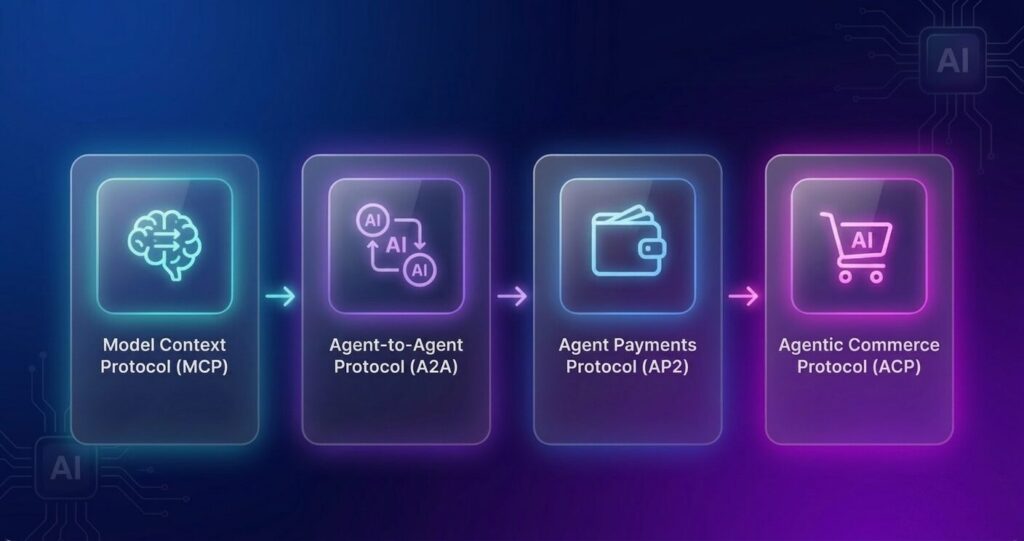
Model Context Protocol (MCP): Developed by Anthropic, MCP is the integration layer that lets agents pull live product data from retailer APIs and maintain memory across sessions.
Agent-to-Agent Protocol (A2A): Enables structured, verified communication between AI agents from different vendors — authentication, data formatting, and trust signals.
Agent Payments Protocol (AP2): Google’s open payment standard standardizing how agents communicate financial intent to merchant systems. Backed by Mastercard, PayPal, and American Express.
Agentic Commerce Protocol (ACP): Governs how agents represent user identity, permissions, and intent across merchant platforms. Shopify handles ACP integration automatically for its merchants..
How Agentic Commerce Affects Retailers
The structural impact is already showing up in revenue data.
Product discovery is shifting. Retailers with non-machine-readable catalogs will not appear in agent searches. This means ecommerce marketing strategies must now account for AI agents and human shoppers as distinct audiences with different discovery requirements.
Traditional advertising is under pressure. When an AI agent optimizes for price, availability, and delivery speed, brand recognition carries less weight. This directly affects PPC campaigns and paid strategies built around capturing human attention.
New infrastructure is required. Agent-ready websites need structured data, fast-loading pages, and machine-readable product information. This is now a web development priority as much as a marketing one.
Retailers deploying their own AI agents grew 59% faster than those without during the 2025 holiday season. AI-generated product recommendations convert at 4.4x the rate of traditional search browsing.
Trust and Safety
Trust is the foundational challenge in agentic commerce. The payment infrastructure built in 2025 specifically addresses consumer concerns:
- Spending limits are set by the user before the agent acts — enforced at the payment network level
- Tokenized credentials mean the agent never holds actual card data
- Know Your Agent (KYA) frameworks are emerging to verify agent identity the way KYC verifies humans in financial services
- Explainability requirements in the EU AI Act mandate that agents show users why a decision was made
Control has not gone away. It has been shifted upstream, is set once, and is then enforced automatically across every transaction.
What to Do Now
Standardize your product data. Machine-readable catalogs with accurate attributes and pricing are the minimum requirement for agent discoverability.
Audit your API infrastructure. If your product catalog and checkout are not API-accessible, agents cannot transact with you.
Rethink SEO for AI. Generative engine optimization requires structured data and content that answers agent queries directly. A digital marketing agency experienced in both traditional SEO and AI visibility is increasingly valuable here.
Define your agent strategy. Decide between building your own agent, partnering with AI platforms, or depending on third-party agents. Waiting is also a choice — one that hands the decision to your competitors.
Conclusion
Agentic commerce is already showing up in revenue data. The gap between agent-ready businesses and those that are not is widening.
Understanding what agentic commerce is, how it works, and what infrastructure it requires is the starting point. The businesses that build for this shift now will not need to play catch-up later.
If your brand needs help aligning its digital marketing and ecommerce strategy to this shift, OLBUZ’s team builds for exactly this kind of channel evolution.
Frequently Asked Questions
Shopping powered by AI agents that act on your behalf. You tell the AI what you need, it researches options, and completes the purchase.
Yes. Perplexity launched Buy with Pro in 2024. OpenAI’s Operator handles bookings inside ChatGPT. Shopify processes agent transactions through ACP. Mastercard, Visa, and Google have all launched agentic payment infrastructure.
A chatbot responds. An AI agent executes. Chatbots answer questions. Agentic shopping systems take multi-step actions — research, compare, evaluate, transact, and follow up — without a new command at each step.
GEO is structuring product content so AI agents can accurately read and act on it during discovery. Just as SEO helped pages rank on Google, GEO helps products appear in AI-driven shopping results.
McKinsey projects $3 to $5 trillion globally by 2030. Bain estimates $300 to $500 billion for the US, representing 15 to 25% of total ecommerce.
Not immediately. The Agent-to-Site model still relies on retailer websites as a data source. But as Agent-to-Agent protocols mature, the traditional product page shifts from a consumer-facing destination to a machine-readable data source.
Vikram Raj Gurjar

An SEO Executive at OLBUZ, specializing in search engine optimization, content strategy, and AI-driven search marketing. Focused on building scalable SEO frameworks, strengthening topical authority, optimizing search intent alignment, and improving organic visibility. Dedicated to helping businesses increase qualified traffic, enhance user experience, and achieve sustainable growth in an evolving digital search landscape.


Contact Form Popup
Boost Your Business Now
This will close in 0 seconds
apply now popup
Apply Now
This will close in 0 seconds
Get free audit popup
Get Free Google Ads Account Audit Worth $999
This will close in 0 seconds
Contact page Form Popup
Contact Us
This will close in 0 seconds