

A majority of advertisers employed Product Listing Ads (PLA) for product promotion on the Google Search platform. PLA campaigns then utilized product imagery, prices, and seller names within the Search Result Page. But with the advancements in the world of Internet commerce and marketing, the demand emerged within the Google ecosystem.
The addition of Google ad Shopping Campaigns brought about a significant change in the management of product-based advertising. The migration process involving PLA to Google Shopping Campaigns is more than an update. It is a complete turnaround in the approach for advertising, organizing, optimizing, and measuring the success of feeds.
This article is a comprehensive presentation of the PLA to Google Shopping Campaign migration process and its importance in the creation of the basis for contemporary Google Shopping campaigns.
1. PLA Overview and Google Shopping Campaigns
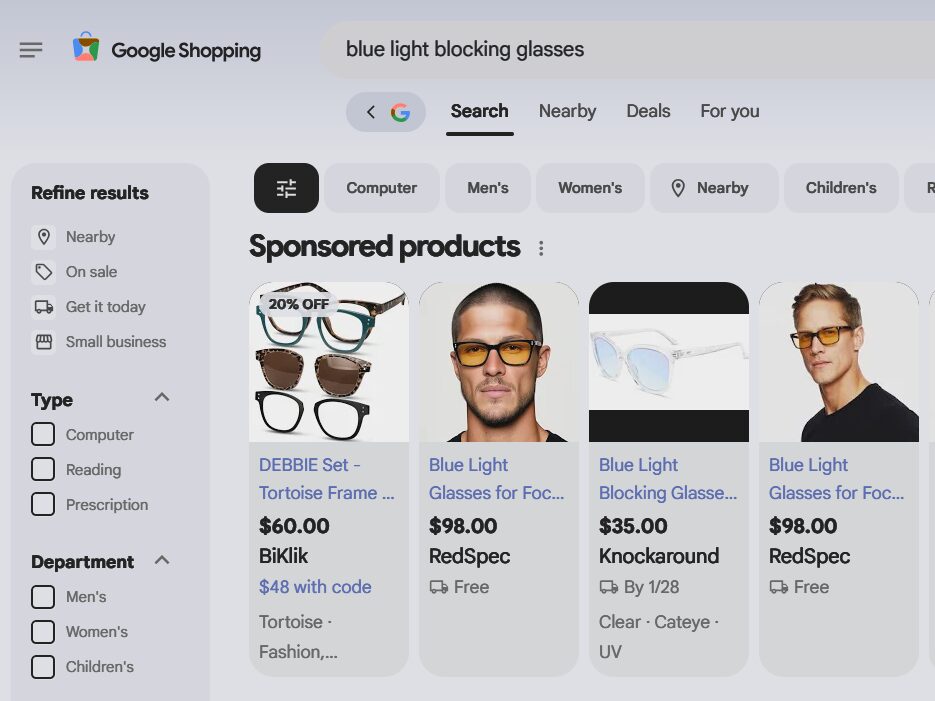
Product Listing Ads (PLA) were among the first types of retail ads to appear on Google. These ads were highly dependent on the product feeds provided to the Google Merchant Center, which enabled advertisers to target their products via limited ad controls.
The Google Shopping Campaigns were introduced as an improvement to the existing structure. The Shopping Campaigns were not keyword-driven, unlike the previous structure.
They were driven mainly by the characteristics of the product, the quality of the feeds, and the performance. The Shopping Campaigns enabled the advertisers to handle their inventory much better.
2. Reasons Why Google Replaced PLA with Shopping Campaigns
Google introduced PLA as a replacement for PLA campaigns because of the shortcomings in control, reporting, and scalability. PLA campaigns provided less detailed information about their performance, and it was difficult to choose which products to feature as an advertisement in relation to business objectives.
Shopping Campaigns brought a retail-minded way of doing things, a way of structuring products just like a physical store. This enabled advertisers to neatly demarcate their products, budget more effectively, and bid accordingly.
The change was announced by Google itself and was completed by August 2014.
Apart from these, there are number of advantages offered by new shopping campaign discussed here.
3. What Changed in the New Google Shopping Campaign Structure
i. Product Groups and Custom Labels
Shopping Campaigns introduced product groups that replaced product targets. This allowed the advertiser to segment products based on attributes like brand, product, item ID, product condition, and custom product labels.
Custom labels emerged as a powerful tool to segment products based on business logic related to margin, seasonal, best-selling, or promotional items of the business. Advertisers could utilize a maximum of five custom labels in advanced segmentation.
How to use the Shopping Campaign feature?
The given screenshot demonstrates Product Groups fetched by Google AdWords from the shopping feed. We can not only control the bid for each product group, but we can also understand the important metrics like impression share, benchmark CTR, and take the marketing decision for better ROI.
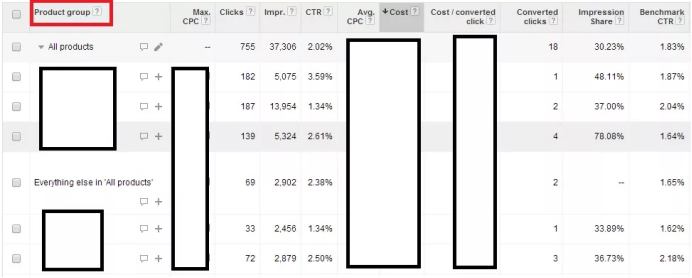
You can always visit the official AdWords guide to learn more about custom labels.
ii. More Extensive Reporting and Transparency
One of the most significant upgrades was expanded reporting. The advertisers could see SKU-level data, showing them precisely which products generated impressions, clicks, and conversions.
Because all of this was transparent, marketers could do some serious optimization of bids and budgets based on real performance rather than assumptions.
iii. Competitive Insights and Benchmarking
Shopping campaigns introduced competitive metrics like impression share, benchmark CPC, and benchmark CTR. These insights helped advertisers understand how well products fared against competitors and where to improve.
iv. API Integrations and Automation
Google expanded the API support for Shopping Campaigns, enabling agencies and large advertisers to automate feed management, reporting, and bidding strategies that made Shopping Campaigns more scalable for businesses with large inventories.
v. Priority of Campaigns for Similar Products
Campaign priority settings allowed advertisers to determine which campaign served ads in cases when the same product was included in several campaigns. In this way, it helped manage various bidding strategies across different business objectives.
4. How PLA to Google Shopping Campaign Migration Worked
i. Feeding Optimization Requirements
Before the migration, it was necessary to enhance the ad product feeds. The use of Adwords labels was no longer supported, and it became necessary to use custom labels and feed attributes.
These are some of the critical feed factors that comprise accurate title names, precise descriptions, proper categorization, high-resolution images, and well-structured pricing variables.
ii. Process of Creating a Campaign
Advertisers created new Shopping Campaigns using Google Adwords (Google Ads) directly. This involved associating the Google Merchant Center account, specifying campaign preferences, budget assignments, and the method of bidding.
It was advised to hold back the running PLA campaigns before activating the Shopping Campaigns.
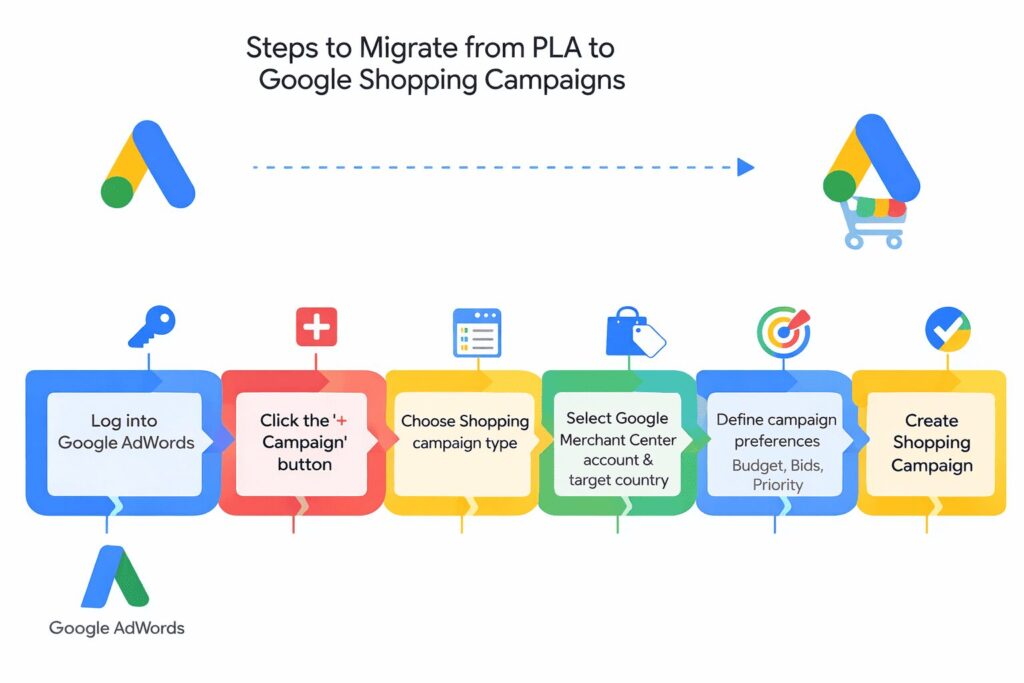
Step by Step:
In order to migrate from PLA to Google Shopping Campaigns, the following were the required steps for advertisers to set up the new shopping campaign in Google Ads:
- Log on to your Google AdWords account.
- Click the ‘+ Campaign’ button to see the list of all the campaign options.
- Choose Shopping from under the list of available campaign options and follow the instructions.
- Select the connected Google Merchant Center account and enter your target country.
- Define the preferences for your advertising campaigns, such as budget, bidding, and priority.
Note: Please note that new advertisers will not find the merchant name in the merchant identifier tab. It is mediatory to integrate your Google merchant account with your Adwords account to run your shopping feed. I have published a detailed article explaining this integration process in more detail (the article is about PLA, but the integration process will remain the same).
5. Why This Migration Still Matters Today
Even though the PLA campaigns ceased their activity, knowledge of this migration has great relevance to contemporary advertising. This transition established the hierarchy for Smart Shopping and Performance Max campaigns.
Google Shopping is still founded on principles like optimization, segmentation, and rule-driven decision-making on the basis of performance.
6. Real Business Benefits Experienced Post-Migration
Advertisers that made the transition successfully saw improved control of ad placements, improved ad spend allocation, and improved ad performance data.
ROAS improved in many businesses because of better bidding and product allocation. It became possible to monitor and analyze the performance of products, which allowed businesses to allocate more to profitable inventory.
7. Common Challenges Advertisers Face
Some advertisers experienced some issues during the migration process, such as disapproval of their feeds, mis-categorization of their products, and misalignment.
Companies with high inventory levels involved planning to make sure the product categories were set up properly to meet business goals.
8. Key Takeaways for Modern Shopping Campaigns
PLA to Google Shopping Campaign migration is important for understanding the role of feed quality, structured data, and performance reporting.
The success of “Modern Shopping” still requires accurate product information, segmentation, and optimization.
9. Conclusion
The migration to Google Shopping Campaigns from Product Listing Ads was a defining moment in Google’s retail advertising evolution. It transformed the way advertisers manage their inventory, measure performance, and scale campaigns.
While the advertising ecosystem continues to evolve, the principles migrated upon remain vital. Understanding this transition helps marketers build better data-driven Shopping strategies for long-term growth.
Need Expert Help With Google Shopping Migration?
Just reach out to us by visiting our contact page. Our Google Ads–certified professionals at Olbuz will get back to you within 24 hours to assist with Google Shopping Campaign migration or optimization.
FAQ
Google introduced Shopping Campaigns in replacement for PLA as a means for advertisers to have more control, more in-depth reporting, and scalable product management. This tool enables advertisers to divide products into logical groups, bid effectively, and even optimize based on real data as opposed to constrained product goals.
Unlike in PLA campaigns, Shopping Campaigns are not keyword-oriented. They are based on product feed attributes, products, and their performance. This enables more transparency, reporting by SKU, and availability of better bid flexibilities.
Custom labels enable advertisers to reach their audience starting from the product level, where segmentation can be done based on business logic like margin, season, best-selling, and promotions. The use of up to five custom labels helps in prioritizing inventory to optimize ROAS.
Yes, it did. In fact, it laid the foundation for all the new, modern formats such as Smart Shopping and Performance Max. The core principles-feed quality, structured data, and performance-based optimization-remain key constituents of a successful Google Shopping strategy today.
The common problems were feed disapprovals, product misclassification, loss of ad labels on AdWords, and inventory management issues, particularly where inventories were large. Optimizing and organizing campaign structuring alleviated these problems.
Jignesh Gohel

Jignesh Gohel is a Founder and Digital Marketing head at OLBUZ (Google Premier Partner Agency 2023, 2024 and 2026) and India's leading travel portal TheIndia. With over 18 years of experience in digital marketing Jignesh has helped many large, medium and small businesses to grow multi-fold.


Contact Form Popup
Boost Your Business Now
This will close in 0 seconds
apply now popup
Apply Now
This will close in 0 seconds
Get free audit popup
Get Free Google Ads Account Audit Worth $999
This will close in 0 seconds
Contact page Form Popup
Contact Us
This will close in 0 seconds